
Most small business owners know they “should” have a blog. They’ve heard it helps with SEO. Maybe they’ve even started one — posted two or three articles, watched the tumbleweeds roll in, and quietly moved on.
The problem isn’t blogging. The problem is blogging without a strategy.
Content marketing done right is one of the highest-ROI marketing investments a small business can make. A single well-written article can bring in qualified leads for years with zero ongoing spend. But “done right” is the key phrase. Here’s what that actually looks like in practice.
Why Content Marketing Works (and Why Most Small Businesses Get It Wrong)
Content marketing works because it aligns with how people buy. Before your next customer calls you, they probably Googled something. Maybe it was “how to remove a water stain from hardwood floors” (plumber) or “what’s a good age for Botox?” (aesthetic practice) or “best CRM for a 5-person sales team” (software consultant).
If your content answers those questions, you show up. You build trust before they ever click your contact button.
The mistake most small businesses make is one of three things:
- Writing about themselves instead of their customers’ problems
- Posting sporadically with no plan or consistency
- Treating every post as a sales pitch instead of genuine education
Content that converts isn’t promotional. It’s useful. The sale happens because your readers start to think, “If they know this much in their free content, imagine what their paid service is like.”
Step 1: Define What You’re Trying to Achieve
Before writing a single word, get clear on your goal. Content marketing can do several things — but it can’t do all of them at once, at least not at first.
Common goals for small business content:
- Organic search traffic — Show up on Google when people search for services you offer
- Lead generation — Turn readers into email subscribers or consultation requests
- Trust building — Demonstrate expertise to warm up prospects already in your pipeline
- Referral amplification — Create shareable content that partners, clients, and peers send around
For most local service businesses, the priority order is: search traffic first, lead generation second. For B2B service providers, trust building often matters more because sales cycles are longer.
Knowing your goal shapes everything else — the topics you choose, the calls-to-action you include, and how you measure success.
Step 2: Pick Topics Your Customers Actually Search For
This is where strategy separates from guesswork. Good blog topics aren’t things you find interesting — they’re things your ideal customers are actively searching for.
Here’s a simple process to find them:
1. List your customers’ top 10 questions. What does every new client ask? What confuses people during the sales process? What objections do you hear repeatedly? Each of those is a potential blog post.
2. Use free keyword tools. Google’s autocomplete is a goldmine. Start typing a topic and see what Google suggests — those are real searches. Tools like Google Search Console, Ubersuggest, or Keywords Everywhere can show you monthly search volume.
3. Look at what’s ranking. Search your target phrase and study the top results. What are they covering? What are they missing? Write something better or more specific.
4. Think local. If you serve a specific area, “best [service] in [city]” and “[problem] in [city]” are high-intent searches with lower competition than national terms.
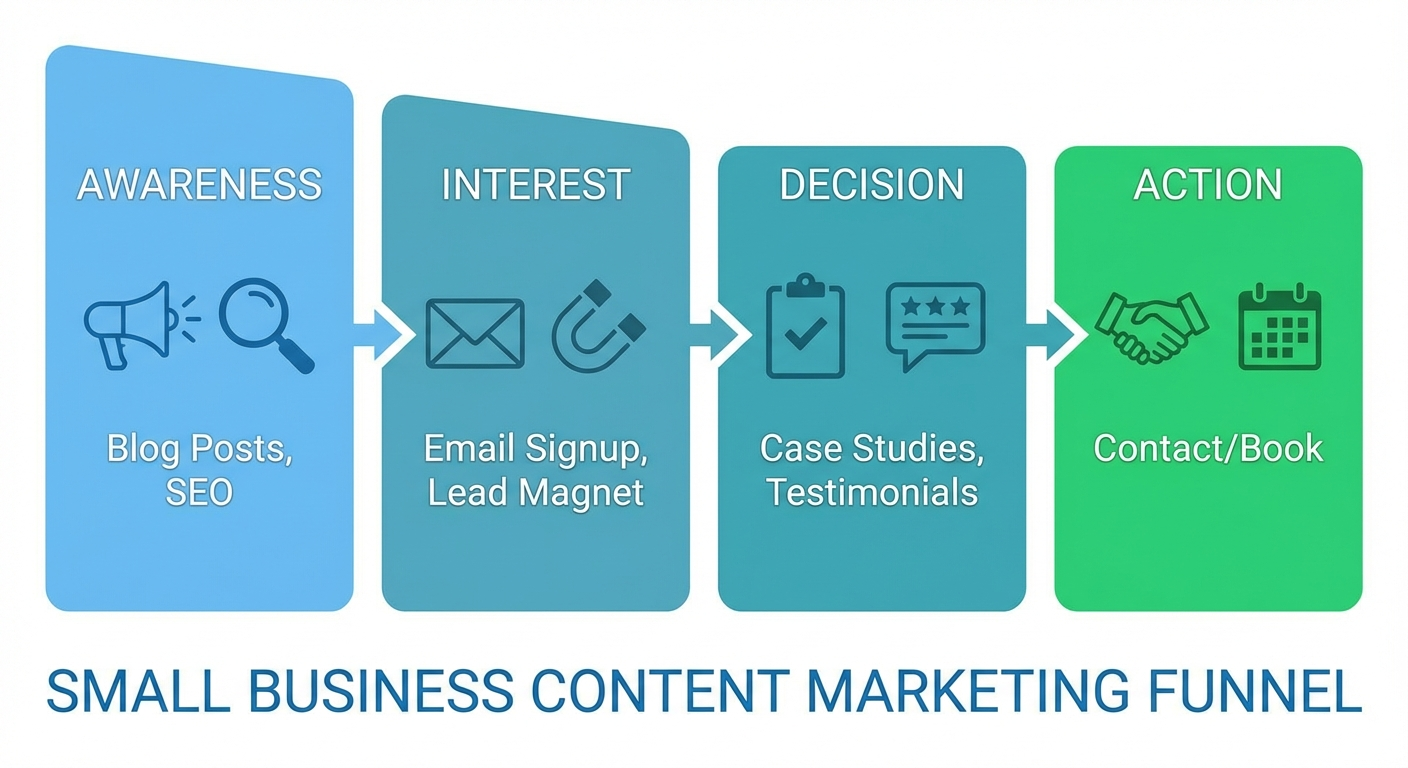
Step 3: Understand the 4 Types of Posts That Actually Work
Not all content serves the same purpose. A strong content strategy uses a mix of post types to attract different kinds of readers at different stages of their buying journey.
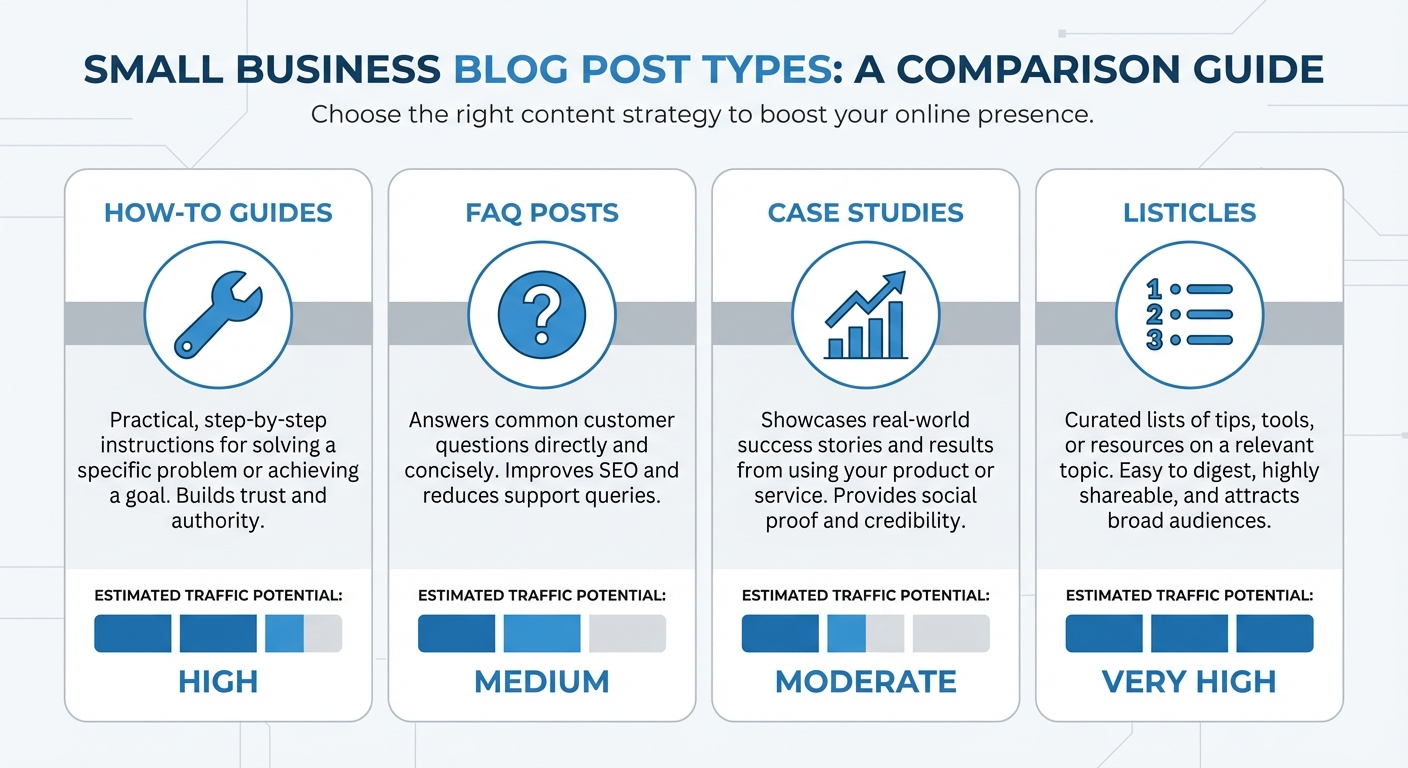
How-To Guides are the workhorses of small business content. They answer a specific question with step-by-step instructions. “How to Prepare Your Roof for Hurricane Season,” “How to Choose the Right Facial Filler,” “How to Set Up Automated Invoicing for Your Freelance Business.” These rank well because they match exactly how people search.
FAQ Posts capture question-based searches. “Does insurance cover laser hair removal?” “What’s the difference between a bookkeeper and an accountant?” These are great for voice search and featured snippets. Check out our voice search optimization guide for more on that.
Case Studies and Before/Afters are trust-builders. They show real results for real customers. They don’t rank as well for cold search traffic, but they’re incredibly powerful for warming up prospects who’ve already found you. For aesthetics practices, we’ve written specifically about before and after gallery best practices.
Comparison Posts (“X vs Y” or “Top 5 Options for Z”) capture high-intent researchers who are close to buying. “HubSpot vs Zoho for Small Business” or “Botox vs Dysport: What’s the Difference?” These readers know what they want — they’re just deciding who to buy from.
Step 4: Build a Content Calendar You’ll Actually Stick To
The number one killer of small business content marketing is inconsistency. A burst of posts followed by months of silence actually hurts you — search engines reward consistency, and so do readers.
The good news: you don’t need to publish daily, or even weekly. One high-quality post per month, published consistently, outperforms four rushed posts followed by six months of nothing.
Here’s how to build a sustainable calendar:
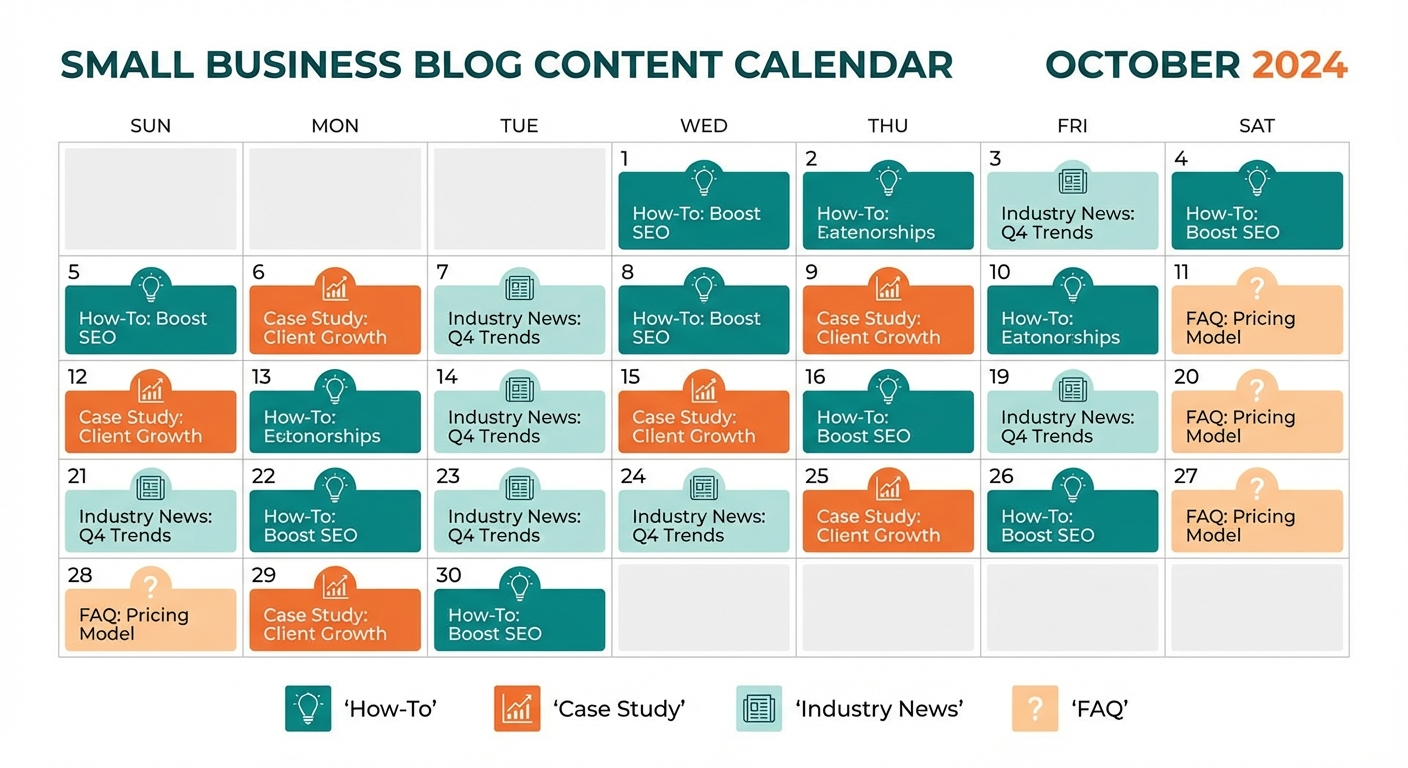
Start with a 3-month plan. Map out topics for the next 12 weeks. Mix your post types — maybe two how-to guides, one FAQ roundup, one case study. Block time on your calendar to write or brief a writer.
Batch your work. Many business owners find it easier to write several posts in one focused session rather than switching context every week. Dedicate a half-day per month to content and protect that time.
Repurpose everything. A single blog post can become a social media caption series, a newsletter, an email sequence, and a short video script. You’re not creating more content — you’re getting more mileage from content you’ve already created.
Step 5: Write Posts That Actually Rank
SEO is a deep topic, but the fundamentals aren’t complicated. For most small businesses, these basics will get you 80% of the results:
Include your target keyword naturally. It should appear in your title, your first paragraph, at least one subheading, and a few times throughout the post. Don’t stuff it — just make sure it’s there. For a full SEO primer, see our SEO for small business guide.
Write long enough to be comprehensive. Short posts rarely rank. Aim for 1,200–2,500 words for most topics. If you can cover a topic thoroughly in 800 words, fine — but don’t pad it either.
Link to related posts on your own site. Internal links help search engines understand your site’s structure and keep readers engaged longer. They also distribute “link authority” across your content.
Use headers (H2s and H3s) to break up content. This helps readers scan and helps search engines understand your structure. Most people don’t read — they skim until something catches their eye.
Optimize your meta description. This is the text that appears under your title in search results. Write it like an ad: include your keyword, communicate the benefit, and create a reason to click.
Step 6: Convert Readers Into Leads
Traffic without conversion is just vanity. Every blog post should have a clear next step for readers who want more.
For most small businesses, the highest-converting calls-to-action are:
- Book a free consultation — direct and specific. Optimizing your consultation booking process can dramatically improve how many readers become clients.
- Download a free resource — a checklist, template, or guide in exchange for an email address
- Read a related post — keeps readers on your site and deepens their engagement
- Subscribe to your newsletter — for longer buying cycles, getting into someone’s inbox is the goal
Place your CTA naturally within the post — not just at the very end where most people have already bounced. A relevant prompt mid-article often converts better than a footer call-to-action.
Once you have an email list, email marketing automation and automated follow-up sequences can turn those subscribers into paying customers with minimal ongoing effort.
Step 7: Measure What Matters
You don’t need a complex analytics setup to know if your content is working. Google Analytics 4 gives you everything you need for free. Track:
- Organic traffic — how many people are finding your posts through search?
- Top landing pages — which posts are getting the most visitors?
- Engagement rate — are people reading and interacting, or bouncing immediately?
- Conversion events — are readers clicking your CTAs, booking calls, or filling out forms?
Review these numbers monthly. Double down on the post types and topics that perform. Don’t waste time on formats that aren’t working for your audience.
How Long Before You See Results?
Honest answer: content marketing is a long game. Most new posts take 3–6 months to rank for competitive search terms. But here’s the thing — once they rank, they keep driving traffic for years without additional investment.
A paid ad stops working the moment you stop paying. A well-optimized blog post keeps earning traffic month after month. That’s the compounding math that makes content marketing worth the initial patience.
For faster results while you wait for organic traction, publish to social media, send new posts to your email list, and share them in communities where your customers spend time.
Practical Starting Point
If you’re starting from zero, here’s a simple 90-day plan:
Month 1: Write your first three posts. One how-to guide targeting your most common customer question. One FAQ post. One about a local topic (“Best [your service] in [your city]”). Publish them.
Month 2: Publish two more posts. Start building your email list with a simple opt-in. Set up Google Search Console to track which queries are showing your content.
Month 3: Analyze what’s getting traction. Write more of it. Set up a basic monthly newsletter to keep subscribers engaged.
After 90 days, you’ll have a foundation. After 12 months, if you’ve been consistent, you’ll have an audience.
Content marketing isn’t a magic switch. But done consistently, it’s one of the most durable growth channels a small business can build. It works while you sleep, while you’re on a job, while you’re on vacation. Every post you publish is an asset — not an expense.
Need help building a content strategy or getting your website set up to convert that traffic? Contact Monsoft Solutions to see how we help small businesses turn their digital presence into a lead-generation machine.