
You spent money on ads. You networked at events. You finally got someone to visit your website and sign up for your newsletter. And then… nothing. They sat in your email list, slowly forgetting you existed.
This is the email marketing paradox most small businesses face: you know email works—it still delivers the highest ROI of any marketing channel at $36 for every $1 spent—but you don’t have time to send personalized messages to every lead.
That’s where automation changes the game. Set it up once, and the right message reaches the right person at the right time, every time. No manual work required.
Why Email Automation Beats Manual Outreach
Before diving into specific sequences, let’s address the elephant in the room: “Won’t automated emails feel impersonal?”
The opposite is actually true. Automated emails, when done well, are more personalized than manual ones because:
- Timing is perfect. A welcome email arrives instantly, not whenever you remember to send it
- Relevance is built-in. Triggers ensure people only receive emails that match their behavior
- Consistency is guaranteed. Every lead gets the same quality experience, not just the ones you personally follow up with
Consider the alternative: manually emailing every new subscriber, every abandoned cart, every customer who hasn’t purchased in 90 days. It’s impossible at scale. Automation makes personalization scalable.
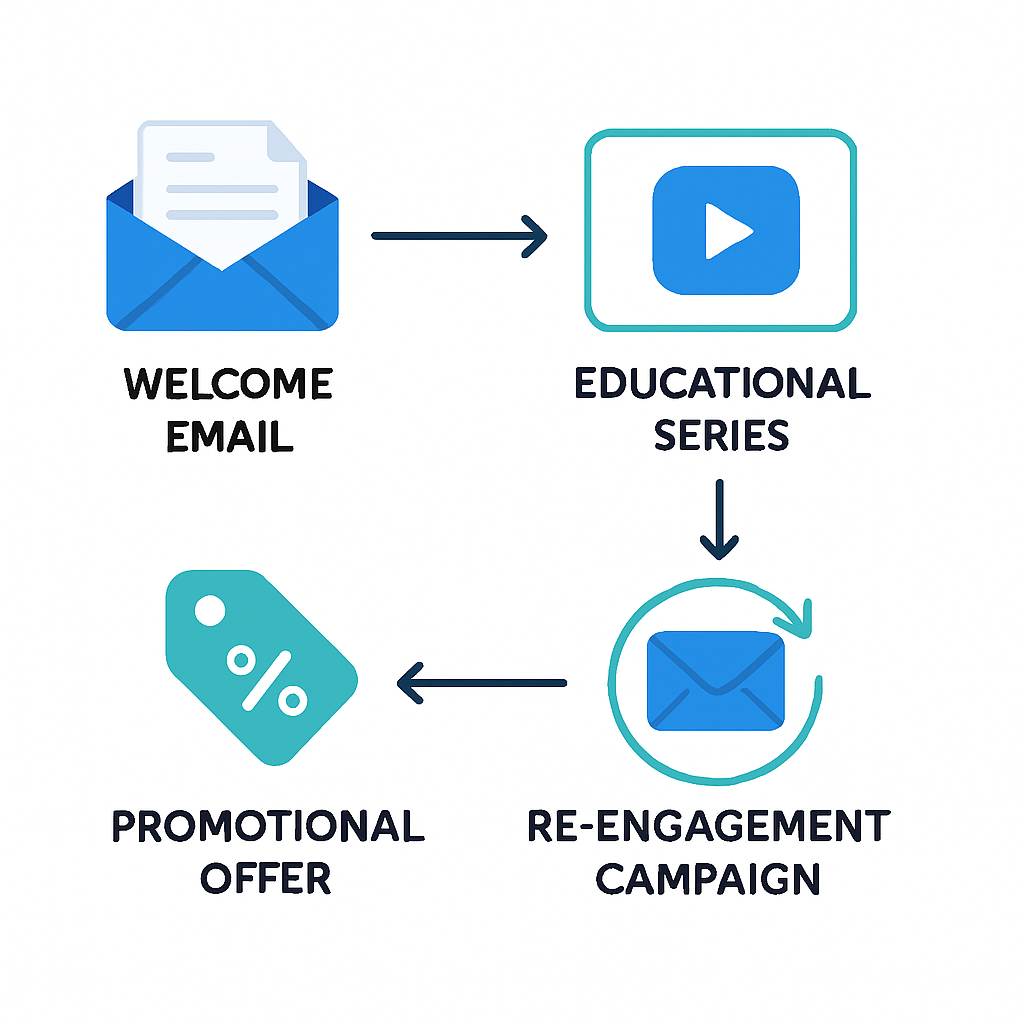
The 7 Essential Email Sequences
Here are the automation sequences that deliver the biggest impact for small businesses. Start with the first two, then add more as you grow.
1. Welcome Sequence (The First Impression)
Trigger: Someone subscribes to your list
Why it matters: Welcome emails have the highest open rates of any email type—often 50% or higher. This is your moment of maximum attention.
Sequence structure:
- Email 1 (Immediate): Thank them, deliver any promised content, set expectations for what’s next
- Email 2 (Day 2): Share your story or mission—why you do what you do
- Email 3 (Day 4): Provide immediate value—a tip, resource, or insight they can use today
- Email 4 (Day 7): Soft introduction to your services with social proof
Pro tip: Don’t pitch in email one. Build the relationship first. The sale comes after trust.
2. Lead Nurturing Sequence (The Education Path)
Trigger: Welcome sequence complete, hasn’t purchased
Why it matters: Most leads aren’t ready to buy immediately. The businesses that stay helpful during the consideration phase win when purchase intent emerges.
Sequence structure:
- Emails 1-3 (Weekly): Educational content addressing common questions and pain points
- Email 4: Case study or success story showing transformation
- Email 5: FAQ addressing common objections
- Email 6: Direct offer with clear call-to-action
For aesthetic practices: This might include content about what to expect during consultations, how to evaluate credentials, financing options, and recovery timelines.
For local businesses: Focus on local relevance—seasonal tips, community involvement, and solutions to problems specific to your service area.
3. Abandoned Cart/Inquiry Sequence (The Recovery System)
Trigger: Started checkout or inquiry but didn’t complete
Why it matters: 69% of shopping carts are abandoned. For service businesses, the number of started-but-not-completed booking forms is similar. A gentle reminder recovers a meaningful percentage.
Sequence structure:
- Email 1 (1 hour): Simple reminder—“Did something go wrong?”
- Email 2 (24 hours): Address common concerns, answer questions
- Email 3 (72 hours): Create urgency or offer assistance
What to avoid: Don’t be pushy. These people showed interest—something stopped them. Your job is to help them over the obstacle, not pressure them.
4. Post-Purchase Sequence (The Relationship Builder)
Trigger: Purchase or booking completed
Why it matters: The relationship shouldn’t end at the sale. This sequence reduces buyer’s remorse, encourages reviews, and sets up repeat business.
Sequence structure:
- Email 1 (Immediate): Confirmation + what to expect next
- Email 2 (Day 3): Check-in—is everything going well?
- Email 3 (Day 7-14): Request for feedback or review
- Email 4 (Day 30): Related offer or referral request
For aesthetic practices: Include pre-procedure preparation tips, post-procedure care instructions, and follow-up appointment reminders.
For service businesses: Ask for reviews on Google, offer maintenance tips, and suggest complementary services.
5. Re-Engagement Sequence (The Win-Back Campaign)
Trigger: No opens or clicks in 60-90 days
Why it matters: Email lists decay naturally—people change jobs, lose interest, or simply get busy. A re-engagement sequence either revives cold subscribers or cleans your list (both valuable outcomes).
Sequence structure:
- Email 1: “We miss you” + valuable content offer
- Email 2: Exclusive offer available only to returning subscribers
- Email 3: “Should we part ways?” with easy unsubscribe option
Important: Remove non-responders after this sequence. A smaller, engaged list performs better than a large, dead one. Your deliverability will thank you.
6. Milestone/Anniversary Sequence (The Personal Touch)
Trigger: Date-based (signup anniversary, birthday, purchase anniversary)
Why it matters: Remembering milestones makes customers feel valued. These emails consistently outperform standard promotional emails.
Sequence structure:
- Single email: Celebration message with personalized offer
Examples:
- “Happy 1-year anniversary! Here’s 20% off your next service”
- “It’s been 6 months since your last visit—time for a check-in?”
- Birthday discount codes
Implementation tip: Collect birthdays during signup, but make it optional. Not everyone wants to share.
7. Referral Request Sequence (The Growth Engine)
Trigger: Positive review submitted or post-purchase satisfaction confirmed
Why it matters: Happy customers are your best salespeople. But they need to be asked. A systematic referral request turns word-of-mouth from random to reliable.
Sequence structure:
- Email 1: Thank them for their feedback
- Email 2: Explain your referral program with clear incentives
- Email 3: Make sharing easy with pre-written messages and links
Key insight: Time this sequence for when satisfaction is highest—right after a positive review or successful project completion.
Measuring What Matters
Setting up sequences is step one. Optimizing them is where the real results come from.
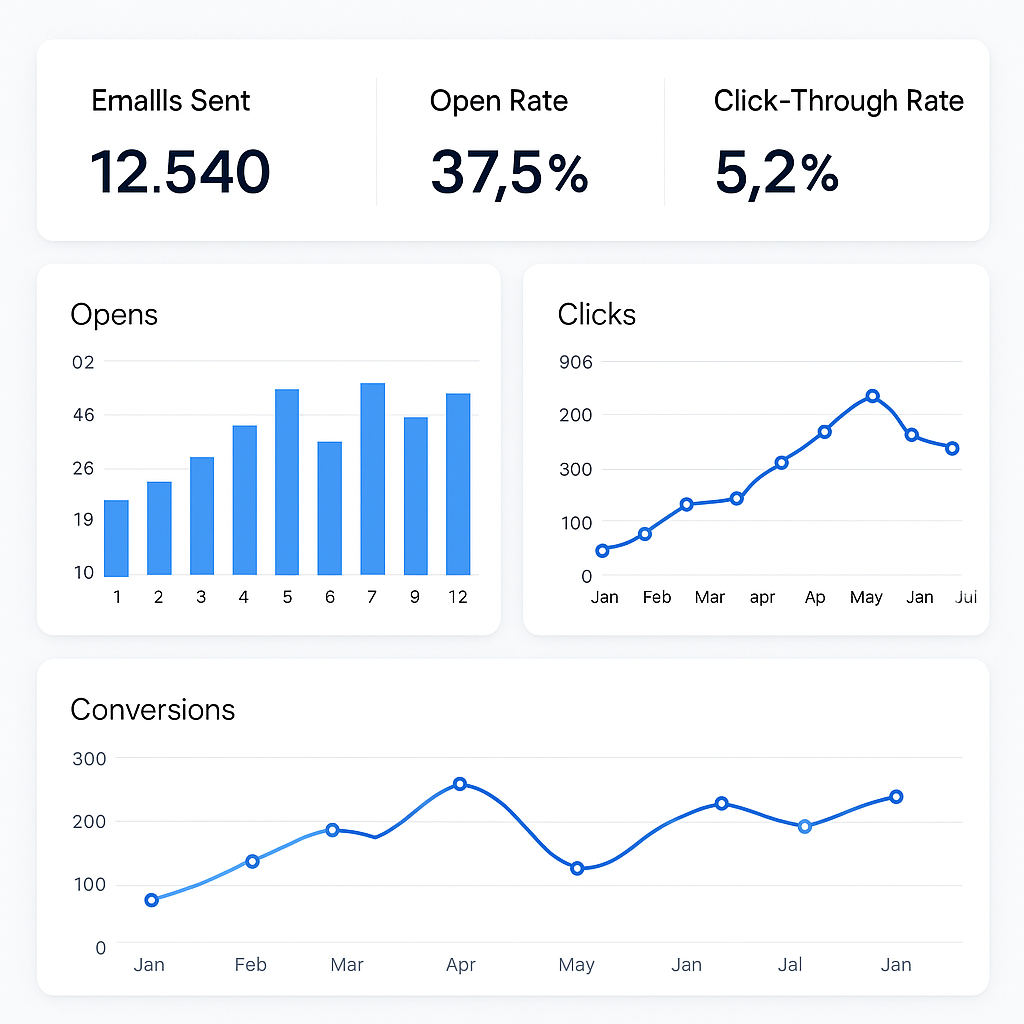
Key Metrics to Track
| Metric | What It Tells You | Benchmark |
|---|---|---|
| Open Rate | Subject line effectiveness | 20-25% average |
| Click Rate | Content relevance | 2-5% average |
| Conversion Rate | Offer effectiveness | Varies by industry |
| Unsubscribe Rate | List health | Under 0.5% per email |
| Revenue Per Email | Overall ROI | Track over time |
The Metrics That Actually Drive Decisions
- Open rate dropping? Test new subject lines
- Opens high but clicks low? Content isn’t matching expectations
- Clicks high but conversions low? Landing page needs work
- Unsubscribes spiking? You’re emailing too often or content isn’t relevant
Getting Started This Week
Don’t try to build all seven sequences at once. Start with the two that deliver immediate ROI:
Week 1: Welcome Sequence
- Write 4 emails following the structure above
- Set up the automation in your email platform (most have templates for this)
- Test the sequence by subscribing with a personal email
- Go live and monitor for the first week
Week 2: Abandoned Cart/Inquiry Recovery
- Identify your abandonment point (cart, form, booking page)
- Write 3 recovery emails
- Set up triggers based on user behavior
- Track recovery rate as your baseline
Beyond Week 2: Build Based on Need
Look at your funnel. Where are you losing people? That’s where your next sequence should focus.
- Lots of leads but few sales? → Lead nurturing sequence
- High customer churn? → Post-purchase + re-engagement sequences
- Steady customers but no growth? → Referral sequence
Common Mistakes to Avoid
Mistake 1: Writing like a robot. Automated doesn’t mean impersonal. Write like a human talking to another human.
Mistake 2: Too many emails too fast. Space your sequences appropriately. Getting three emails in one day feels like spam.
Mistake 3: No clear call-to-action. Every email should have one obvious next step. Not three. One.
Mistake 4: Ignoring mobile. Over 60% of emails are opened on mobile. Short paragraphs, big buttons, scannable content.
Mistake 5: Set-and-forget mentality. Automation isn’t autopilot. Review performance monthly and optimize.
Tools That Make This Easier
You don’t need enterprise software to run effective email automation. Several platforms offer robust automation at small business prices:
- Mailchimp: Great for beginners, intuitive automation builder
- ConvertKit: Built for creators and service businesses
- ActiveCampaign: More advanced automation for growing businesses
- Klaviyo: E-commerce focused with powerful segmentation
The best tool is the one you’ll actually use. Start simple, upgrade as needed.
The Bottom Line
Email automation isn’t about removing the human element—it’s about scaling it. The personal touch you’d give your best customer, delivered to everyone who deserves it.
Start with welcome and recovery sequences. Add more as you grow. Measure what matters. Optimize continuously.
Ready to implement email automation for your business? Contact us to discuss how we can help you build sequences that convert. Or explore our automation services to see how we’ve helped businesses like yours save 20+ hours per week while increasing revenue.
Related reading: How AI Automation Can Save Your Small Business 20+ Hours Per Week and 7 Customer Retention Strategies That Keep Small Businesses Thriving