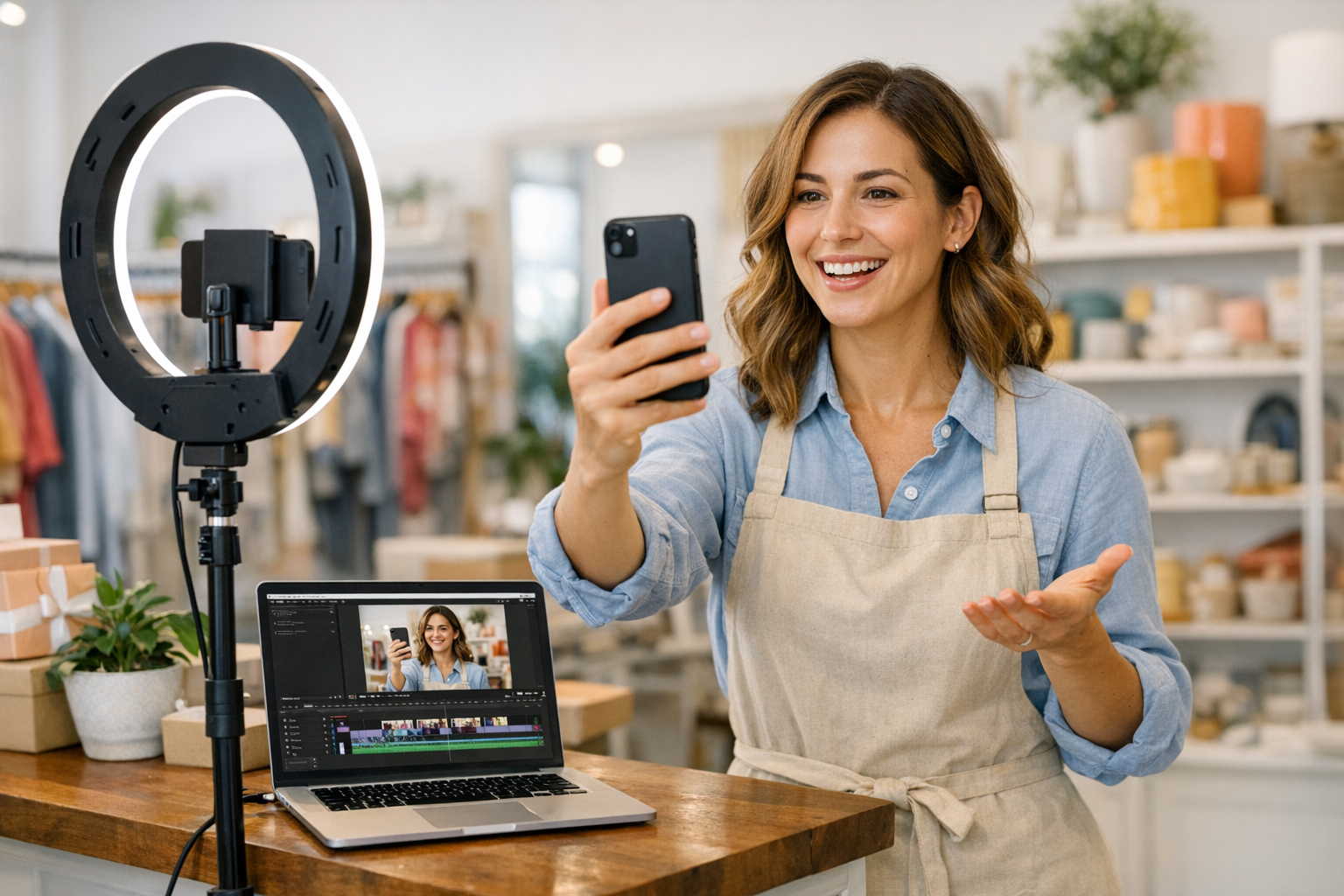
You’ve probably heard it before: video is the future of marketing. What people don’t tell you is that the future arrived about five years ago — and if you’re a small business still relying on text and static images to attract customers, you’re leaving serious money on the table.
Video is now the dominant content format across every platform that matters. Instagram Reels, TikTok, YouTube Shorts, Facebook — the algorithms favor video overwhelmingly, and so do your potential customers. Studies consistently show that consumers are more likely to buy after watching a product or service video, and that they retain information far better from video than from text.
The good news? You don’t need expensive equipment, a film crew, or a production agency. The most effective small business video content is often the simplest — shot on a smartphone, authentic, and focused on solving a real customer problem or answering a real question.
Here’s how to do it right.
Why Video Marketing Works for Small Businesses
Before diving into tactics, it helps to understand what video actually does for a local or service business — because it’s more than just “content.”
Video builds trust faster than any other format. When someone can see you, hear you, and watch how you work, the trust-building process that normally takes weeks of email exchanges or phone calls can happen in 90 seconds. For service businesses, that pre-built trust translates directly into easier sales conversations and higher close rates.
Video improves your visibility everywhere. Search engines index video. Social algorithms boost it. YouTube is the second largest search engine in the world — and showing up there means you’re visible to people actively searching for what you sell. A well-optimized video can drive traffic for years.
Video converts at a significantly higher rate than text. Landing pages with video convert up to 80% better than those without. Product pages with video see longer time-on-site and lower bounce rates. Service businesses that add video testimonials to their websites consistently report higher inquiry rates.
Video differentiates you locally. Most small businesses in your area aren’t producing video. You don’t have to be polished — you just have to be consistent. Showing up on video regularly puts your face and personality in front of your local audience in a way that no competitor is doing.
The barrier isn’t technology. It’s getting over the mental hurdle of pressing record.
The 4 Types of Video Every Small Business Should Make
Not all video serves the same purpose. Here’s a practical framework for the types of video that move the needle for service businesses and local shops:
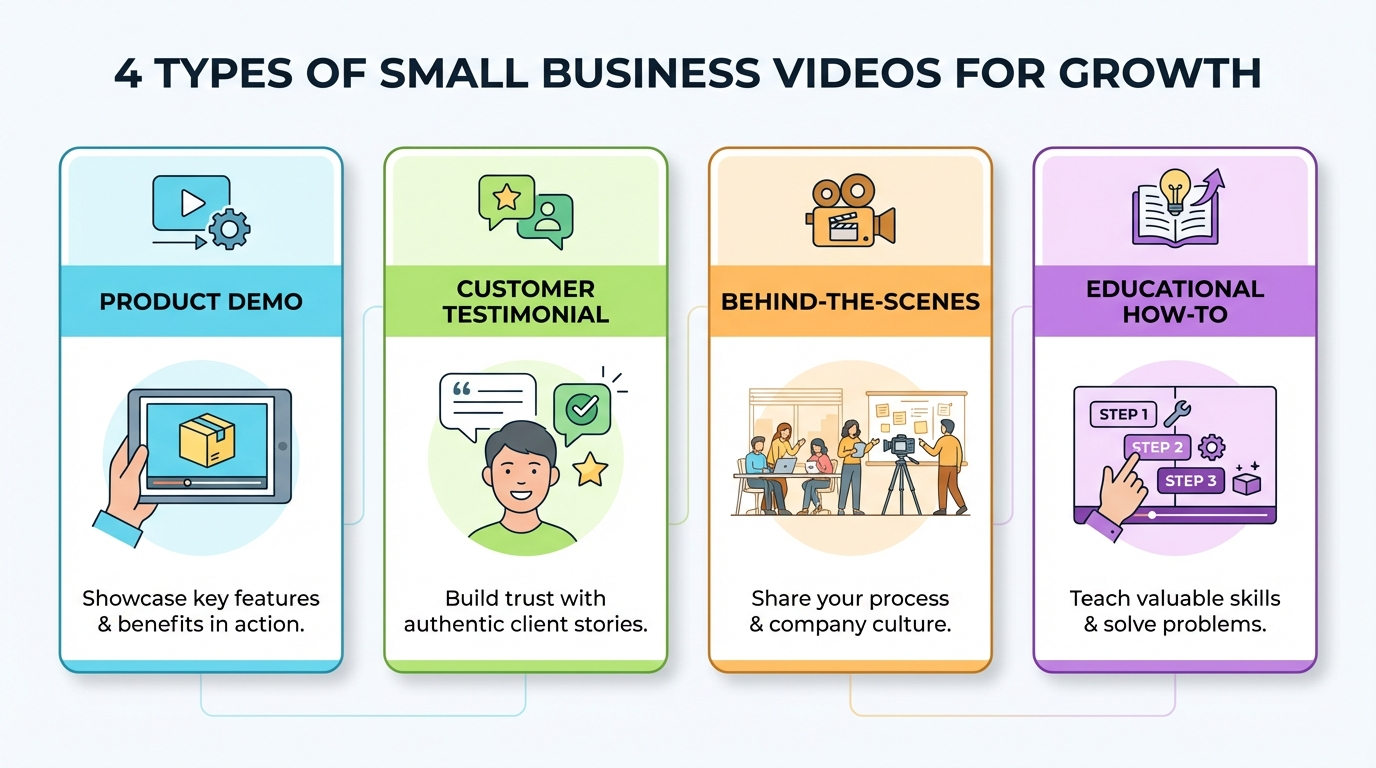
1. Educational / How-To Videos
These are the workhorses of small business video marketing. Pick a question your customers ask constantly — “How do I know if I need a new roof?” “What happens during a facial treatment?” “What’s the difference between Botox and filler?” — and answer it on camera.
Educational videos:
- Rank on YouTube and Google for long-tail search queries
- Position you as the expert in your category
- Attract ideal customers who are already in research mode
- Build trust before any sales conversation happens
A 2–4 minute “plain language answer to a common question” video, made on your phone, can drive leads for years.
2. Behind-the-Scenes / Day-in-the-Life
People buy from people they feel they know. Behind-the-scenes video lets potential customers see your process, your team, your workspace, and the care that goes into your work before they ever pick up the phone.
For a landscaping company, this might be a 30-second walk-through of a completed project. For a med spa, it might be a time-lapse of a room being prepped for a treatment day. For a bakery, it’s the morning routine getting ready to open.
These videos don’t require scripts. Just press record and narrate what you’re doing.
3. Customer Testimonial / Success Story Videos
Written reviews are valuable — but video testimonials are exponentially more powerful. When a real customer looks into the camera and says, “I was nervous to start, but here’s what happened,” they’re doing your most persuasive selling for you.
Ask your best customers if they’d be willing to record a 60–90 second video on their phone answering: “What problem were you trying to solve? What happened after working with us? Who would you recommend us to?”
Most satisfied customers will say yes if you make it easy and low-pressure.
4. Product / Service Demos
Show your work. If you’re a home remodeler, show a before-and-after walkthrough. If you sell a physical product, demonstrate it in use. If you’re a consultant, show the framework or tool you actually use with clients.
Demo videos are especially powerful on product pages and landing pages — they replace the “is this real?” skepticism with concrete evidence of what you deliver.
What Equipment Do You Actually Need?
Less than you think. Here’s the real minimum to start:
Phone: A smartphone from the last 2–3 years shoots excellent video. Don’t wait until you have a “better” camera. Your phone is fine.
Stabilization: A basic tripod or phone stand ($15–$30) eliminates shaky footage and makes everything look more professional instantly.
Lighting: Good lighting is more important than a good camera. A basic ring light ($25–$50) eliminates shadows and makes faces look clear and bright. Alternatively, film near a window with natural light — this works surprisingly well.
Audio: The built-in microphone on your phone is often fine for short videos outdoors or in an echo-free space. For indoor videos, a clip-on lavalier microphone ($20–$40) dramatically improves sound quality.
Editing: For short-form video (Reels, Shorts, TikTok), CapCut is free and excellent. For longer videos, iMovie (Mac/iOS) or DaVinci Resolve (free, all platforms) does the job. Most platforms now have built-in editing tools.
Total startup cost: Under $100. If you want better gear later, you’ll know exactly what to upgrade. But don’t let gear be the reason you don’t start.
Where to Post: Platform Strategy for Small Business Video
Different platforms serve different purposes. You don’t need to be everywhere — but you should understand the trade-offs:
YouTube
YouTube is where educational and how-to content lives. Videos are searchable, evergreen (they keep driving traffic for years), and the second largest search engine on earth.
Best for: Tutorials, explainers, detailed service overviews, FAQs Video length: 5–15 minutes tends to perform well for educational content Optimization tip: Write detailed titles and descriptions using keywords your customers actually search
Instagram Reels
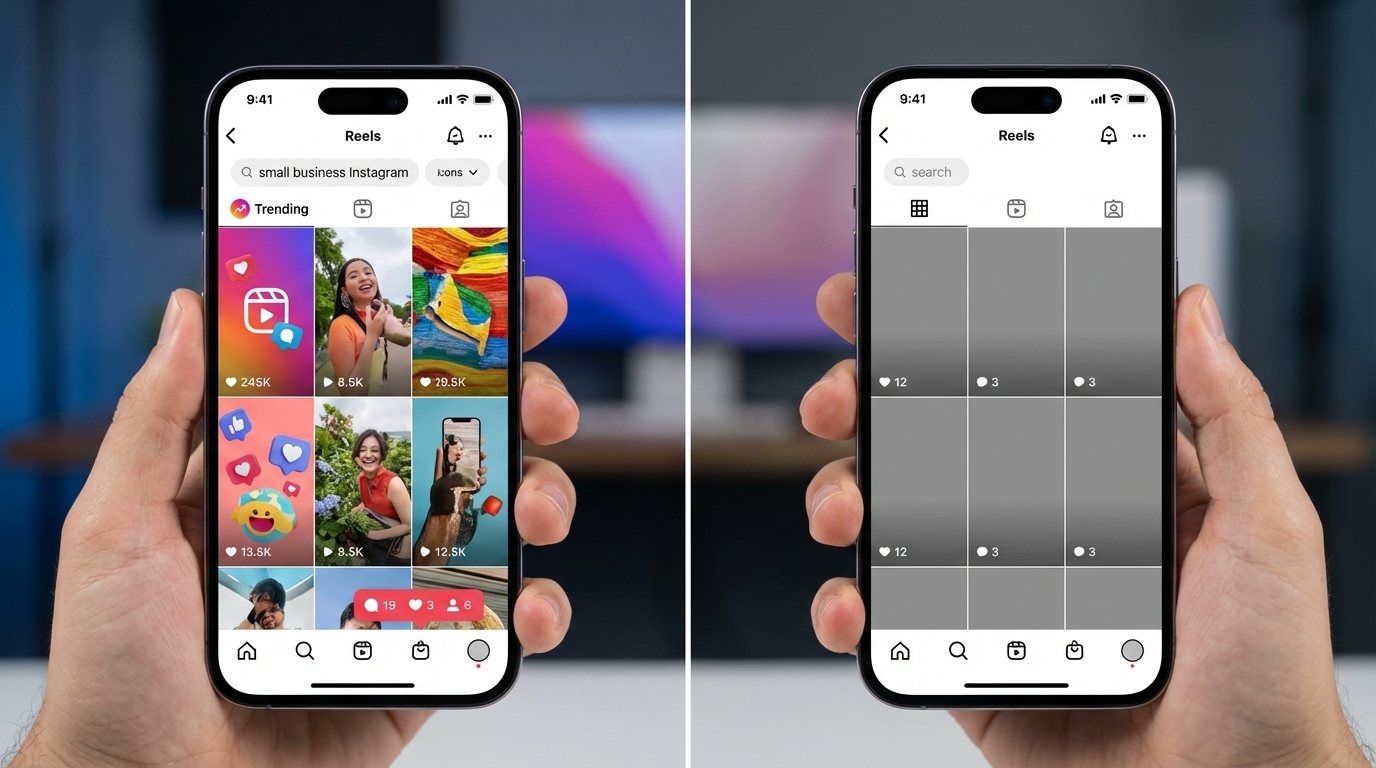
Short-form video (up to 90 seconds) that Instagram actively pushes to non-followers. Reels are one of the fastest organic reach plays available right now for local businesses.
Best for: Behind-the-scenes, before/afters, quick tips, personality content Video length: 15–60 seconds performs best Optimization tip: Add text captions — most people watch without sound
TikTok
Younger audience but growing rapidly for local services. TikTok’s algorithm is extremely good at showing content to people who would genuinely be interested — which means local businesses can get remarkable organic reach.
Best for: Personality content, humor, quick transformations, education-entertainment Video length: 15–60 seconds Optimization tip: Hook in the first 2 seconds or viewers scroll
Still very relevant for local service businesses targeting 35+ demographics. Native video and Facebook Reels both see strong reach among established local audiences.
Best for: Community-oriented content, testimonials, event coverage Video length: 1–3 minutes for native uploads Optimization tip: Captions matter — Facebook feed auto-plays videos silently
YouTube Shorts
YouTube’s short-form format distributes to the massive YouTube audience and appears in Google search results. Highly underutilized by small businesses right now.
Best for: Repurposing content from other platforms, quick tips Video length: Under 60 seconds Optimization tip: A vertical short can become a thumbnail for a longer video — use them as entry points
You don’t need to be on all of these. Pick two that match your audience and create consistently.
The One-Video-Per-Week System
Consistency beats perfection. One video per week — even imperfect — compounds dramatically over time. Here’s a simple system to make that happen without consuming your life:
Monday: Pick your topic. What question did you hear last week? What’s coming up seasonally? What objection do you hear before people hire you?
Tuesday or Wednesday: Record it. One take or two, unscripted or with brief bullet-point notes. Keep it under 3 minutes. Don’t over-produce.
Thursday: Light editing (trim the start/end, add captions if posting to social), write a short description or caption.
Friday: Post it. YouTube with a keyword-optimized title and description. Repurpose as a Reel or Short with a quick caption.
That’s it. Done in under 2 hours per week.
Within 90 days, you’ll have a library of content that’s working for you around the clock — answering questions, building trust, and showing up in search results while you focus on running your business.
Integrating Video With Your Broader Marketing System
Video works best when it connects to the rest of your marketing — not as a standalone activity.
Use video in email marketing. A “watch our latest video” link in your weekly email newsletter dramatically increases click-through rates. A thumbnail image linking to YouTube is enough.
Add video to landing pages. If you’re running Google or Facebook ads, adding a short explainer or testimonial video to your landing page increases conversions significantly. Landing page optimization and video work together better than either does alone.
Use testimonial videos in your social proof strategy. Video testimonials embedded on your website, sent in follow-up sequences, and posted on social media are among the highest-converting trust signals available to small businesses.
Feed video content into your CRM automation. When a prospect watches a video, that’s a buying signal. Advanced setups can trigger automated follow-up based on video engagement — a significant edge for service businesses.
Track performance in Google Analytics 4. Measure which videos drive website traffic, how long visitors engage with video pages, and which video sources convert into leads.
Common Objections (and Why They Don’t Hold Up)
“I’m not comfortable on camera.” Almost nobody is — at first. The first video you make will feel awkward. The fifth video will feel manageable. The twentieth video will feel natural. The only way through is to start. Your audience connects with you because you’re real, not because you’re polished.
“I don’t have anything interesting to say.” Your customers prove this wrong every day. Every question they ask, every concern they raise before hiring you, every “how does this work?” is a video topic. You are the expert. Start there.
“I don’t have time.” One video a week is two hours. That’s less time than most business owners spend on tasks that don’t directly generate revenue. Video is one of the few marketing activities that compounds — the video you make today keeps working for years.
“The quality won’t be good enough.” “Good enough” in 2026 means clear video and audible audio. Authenticity beats production value for small businesses. A genuine 60-second iPhone video from a local business owner consistently outperforms polished corporate ads in local markets.
Measuring What Matters
Once you’re producing video consistently, track these metrics to understand what’s working:
Views and reach — basic visibility; how many people see your content Watch time / average view duration — how engaging your content is; the metric that matters most to algorithms Traffic from video — how much website traffic originates from YouTube, Reels, or other video sources (visible in Google Analytics 4) Leads attributed to video — ask new inquiries “how did you find us?” and note when video is mentioned Conversion rate on video landing pages — compare pages with video versus without
Don’t obsess over vanity metrics (views on a single video). Look at trends over 90-day periods. The compound effect of consistent video production shows up clearly over time.

Video Marketing for Service Businesses in Southwest Florida
If you’re running a service business in Naples, Fort Myers, Cape Coral, or the broader SWFL area, local video has particular advantages:
Local landmarks and recognizable context build trust. Mentioning or showing local neighborhoods, seasonal conditions, or region-specific considerations immediately signals that you’re a local expert, not a national chain.
Seasonal content is highly relevant. Season in Southwest Florida has a predictable pattern. Videos timed to seasonal needs — hurricane preparation for roofing and storm shutters, snowbird season for service businesses, summer humidity considerations for home services — create timely relevance.
Local competition is low. The honest reality: most local businesses in Southwest Florida are not producing consistent video content. Showing up consistently on YouTube, Instagram, and TikTok makes you stand out dramatically in a crowded local market.
Frequently Asked Questions
How long should my videos be?
It depends on the platform and content type. Short-form (Reels, Shorts, TikTok): 15–60 seconds. YouTube educational content: 3–8 minutes is the sweet spot for most small business topics. Facebook: 1–3 minutes. The rule is: as long as it needs to be to deliver value, not one second longer.
Do I need to appear on camera?
No — but it helps. Voiceover with screen recordings, text-based videos, time-lapse footage, and product demos all work without showing your face. That said, face-to-camera content builds trust the fastest. Even occasional “face” videos mixed in with other formats makes a big difference.
Should I hire a videographer?
For specific high-value content (a brand video, a major before/after case study, or a formal testimonial), yes. For ongoing weekly content, no. Weekly iPhone content out-performs sporadic professional productions in most local service markets because consistency matters more than production value.
How do I get customers to agree to testimonial videos?
Ask. Most satisfied customers will say yes when you make it simple: “Would you be willing to record a 60-second video on your phone? Just answer three questions I’ll text you. It doesn’t have to be perfect.” Send them the questions, let them record at their convenience, and accept whatever they send. Even imperfect testimonials are powerful.
What’s the fastest way to repurpose video content?
Record a 3–5 minute YouTube video, then trim it into 3–4 short clips for Reels and Shorts. The short clips drive discovery, the full video provides depth. This one recording session produces a week’s worth of content across multiple platforms.
Your First Video: This Week
The most common mistake businesses make with video marketing isn’t a technical error — it’s waiting. Waiting for better equipment, more time, a clearer strategy, or more confidence. In the meantime, competitors who aren’t waiting are showing up in search results, building audiences, and earning the trust of your potential customers.
Here’s your assignment for this week:
- Pick one question a customer has asked you in the last month
- Film a 60–90 second answer on your phone (no script necessary — bullet points are fine)
- Post it to YouTube with a keyword-rich title, and share it as a Reel
That’s it. One video. The second one will be easier.
Ready to connect your video marketing to an automated follow-up and lead nurturing system? Explore how automated follow-up sequences can convert video viewers into paying customers — or contact our team to build a complete content and automation strategy for your business.