
You could spend hours crafting the perfect sales pitch. Or you could let your happy customers do the talking.
That’s social proof in a nutshell — and it’s one of the most powerful, underutilized tools in small business marketing. When potential customers see that real people trust you, they’re far more likely to trust you too. Not because of what you said about yourself. Because of what others said.
Research consistently shows that over 90% of consumers read reviews before making a purchase decision, and more than 70% say positive reviews directly increase their trust in a business. Yet most small business owners collect testimonials haphazardly, bury them on an “About” page nobody reads, and wonder why their conversion rate is stuck.
This guide will show you exactly how to build a social proof marketing system — collecting it, organizing it, and deploying it where it actually moves the needle.
What Is Social Proof (And Why It Works)
Social proof is the psychological principle that people look to others’ behavior and opinions to guide their own decisions. When you’re unsure whether to try a new restaurant, you check Yelp. When you’re considering a software subscription, you scan the G2 reviews. When you’re deciding between two service providers, you ask around.
This isn’t irrational — it’s efficient. Other people’s experiences are genuine data points about what you’re likely to experience. Smart businesses recognize this and build it into their marketing deliberately.
Social proof comes in several forms:
- Customer reviews and star ratings (Google, Yelp, Facebook)
- Written testimonials (specific stories from happy clients)
- Video testimonials (the most trusted form)
- Case studies (detailed before/after outcomes)
- User-generated content (photos and posts from real customers)
- Media mentions and press coverage
- Certifications, awards, and trust badges
- Client logos (especially effective for B2B)
- Social follower counts and engagement
- “As seen on” or partner badges
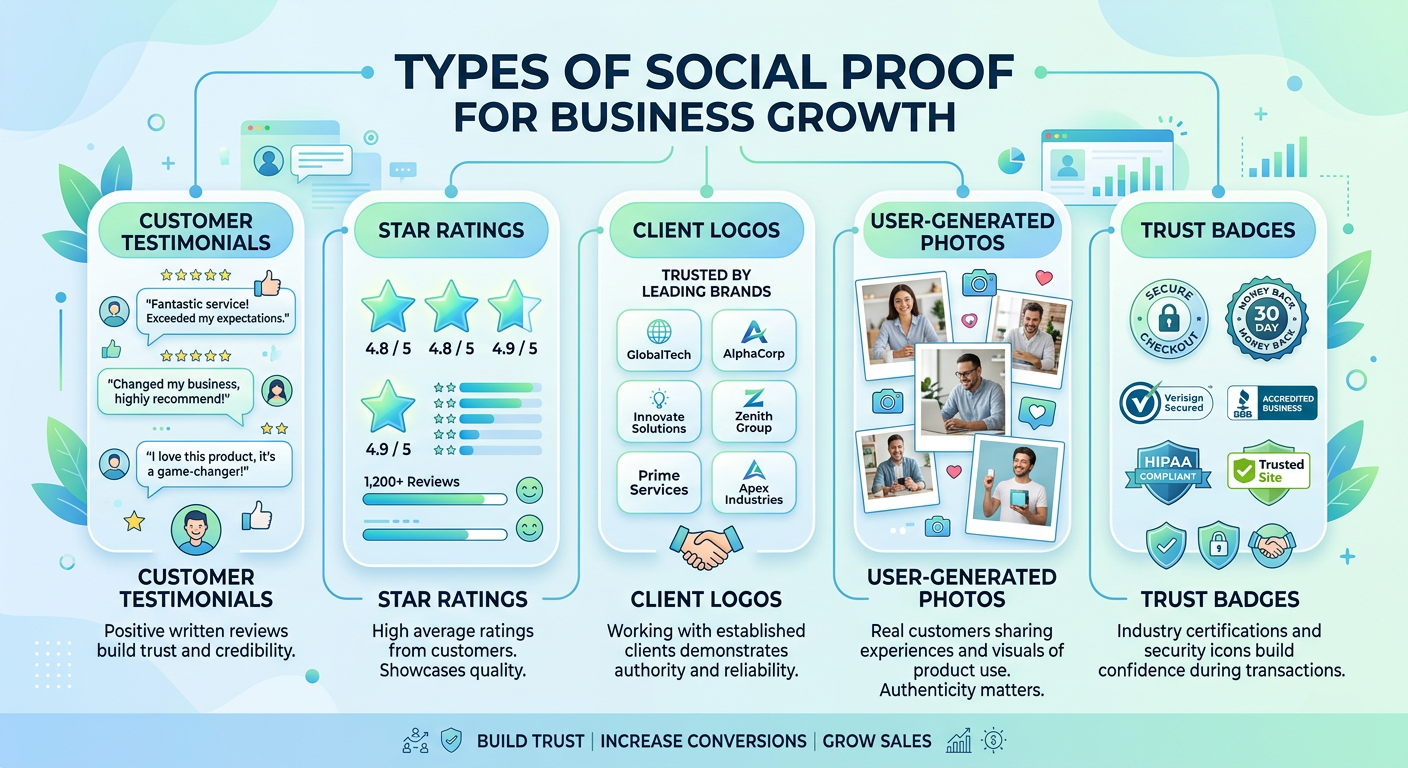
Each type serves a different purpose and works differently depending on where a customer is in their decision journey. The key is deploying the right type of social proof at the right moment — not just dumping everything in one place and hoping for the best.
The Social Proof Gap Most Small Businesses Have
Before we get into strategy, let’s be honest about where most businesses stand.
You probably have some social proof. Maybe a few Google reviews, a handful of kind emails from customers, a photo or two posted by a client on Instagram. That’s a start. But raw social proof just sitting there isn’t doing much work for you.
The gap is almost always one of three things:
1. Not enough volume. A business with 12 reviews looks a lot less established than one with 312, even if the ratings are identical. Quantity signals longevity and consistent quality.
2. Too generic. “Great service!” does almost nothing. “After three sessions, my back pain was completely gone and I was back on the tennis court” is compelling. Specificity is what makes social proof believable.
3. Poorly placed. Hiding your best testimonials on a dedicated page no one visits means they’re not working. Social proof needs to appear where people are hesitating — at every point of doubt in the buying journey.
Fix those three things and you’ll see the impact quickly.
Building Your Social Proof Collection System
Great social proof doesn’t happen by accident. You need a system for collecting it — consistently, automatically, and at the right moments.
Ask at the Right Time
The single biggest mistake is waiting too long to ask. The ideal window is right after a customer has a win — when they just finished a service, received a result, or had a genuinely positive experience. That’s when the emotion is fresh and the story is specific.
For a hair salon, that’s when the client is admiring themselves in the mirror. For a consultant, it’s the week after you delivered results. For a dentist, it’s right after a successful appointment when the patient looks relieved.
Build the ask into your workflow. If you use an automated appointment system, set a follow-up to trigger 24 hours post-visit with a simple, direct request: “How did your visit go? We’d love to hear what you thought.” Include a direct link to your Google review page — don’t make them hunt for it. If you haven’t automated this yet, check out our guide on automating review requests and follow-ups.
Make It Easy
Every step you add to the review process kills conversion. Remove friction:
- Link directly to the review form, not just your Google Business page
- Pre-fill whatever you can
- On SMS and email follow-ups, keep the ask to one paragraph and one link
- On your website, embed a simple form where customers can leave a testimonial without leaving your site
For video testimonials (which convert far better than text), consider offering a Zoom call with a client, asking three focused questions, and recording with their permission. A 90-second unpolished video of a real customer is worth more than a slick produced ad.
Go Deeper With Case Studies
For higher-ticket offers — consulting, custom projects, healthcare, renovations — a case study format unlocks a level of credibility that a star rating can’t match. A good case study follows a simple arc:
- Situation: Who was the client? What problem were they facing?
- Solution: What did you do specifically?
- Result: What changed? Be specific — numbers, timelines, emotions.
You don’t need long form. Even a 200-word structured story with a before/after is powerful. Pull case studies from your most compelling client outcomes, get permission to use names and photos, and publish them somewhere visible.
Where to Deploy Social Proof (Most Businesses Get This Wrong)
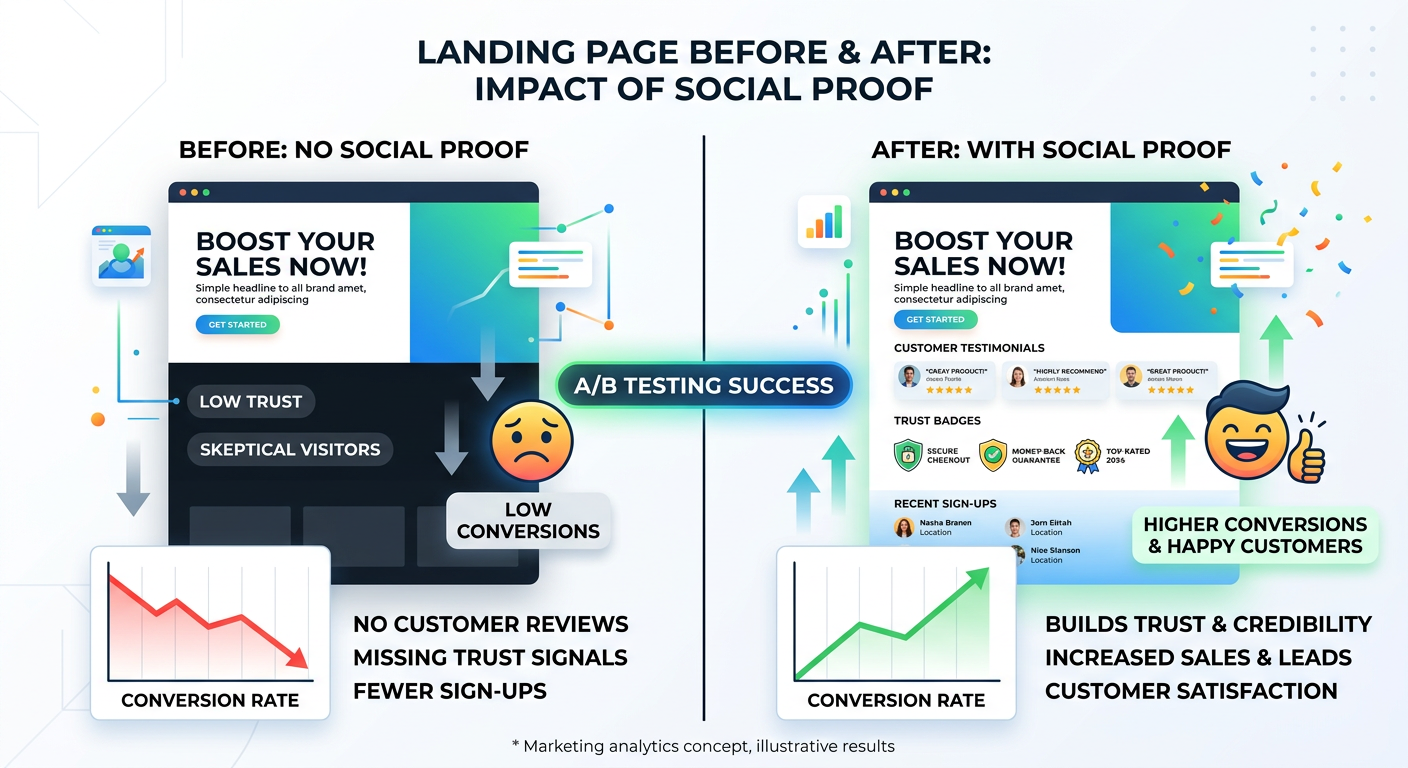
Collecting social proof is only half the job. Placement is where most businesses leave serious conversion points on the table.
Homepage: First Impression, First Proof
Your homepage is where most visitors land cold. Put a credibility signal above the fold — something immediate that says “real people trust us.” This could be:
- A star rating badge with your review count (e.g., ”★★★★★ 4.8 from 127 Google Reviews”)
- A short, punchy pull quote from a real customer
- Client logos if you have well-known clients
Don’t bury this. It belongs near the top, near your main call to action.
Service/Product Pages: Near the Decision Point
When someone is reading about a specific service, that’s the moment they’re evaluating whether to take the next step. A relevant testimonial right before your CTA button can dramatically increase click-through.
Relevance matters here. Don’t just show any testimonial — show one that directly relates to the service on that page. If you have a teeth-whitening service page, the testimonial should be from someone whose teeth got whiter, not a general “great dental office” comment.
Contact and Booking Pages: Reduce Last-Minute Hesitation
This is the most overlooked placement. Right when someone is about to submit their information or book an appointment, doubt peaks. A testimonial or trust badge on the contact/booking page directly addresses that hesitation: “Other people have done this and it worked out great for them.”
Even one strong testimonial on the booking page — something specific like “I was nervous but the team made it so easy, and I saw results within a week” — can noticeably lift conversion.
Email Marketing: Warm the Pipeline
If you’re doing any email marketing, social proof belongs in your nurture sequences. Include a customer story in your welcome sequence. Feature a case study in a monthly newsletter. Rotate testimonials into promotional emails above your main offer.
It doesn’t have to be complicated — even one sentence from a real customer (“Last month, Maria in our community saved 8 hours a week after implementing this”) adds credibility to any message.
Follow-Up Sequences and Retargeting
When leads go cold, social proof reactivates them. An automated follow-up sequence that includes a case study or testimonial mid-sequence gives a prospect a reason to reconsider without you having to hard-sell. They see proof that others in their situation made a decision and were glad they did.
For paid retargeting ads, user-generated content (real customer photos and videos) consistently outperforms polished branded creative. Real looks more real, and real converts better.
Making Social Proof Specific and Believable
Generic social proof is almost useless. “Amazing company, highly recommend!” tells a prospective customer nothing concrete. It could have been written by anyone, about anyone. In fact, many people now assume generic reviews are fake.
Specificity is what creates credibility. Here’s the difference:
Generic: “Great service and very professional!”
Specific: “I called on a Tuesday with a broken HVAC in the middle of summer. They were at my house by Thursday, had the part on hand, and fixed it in under two hours. Charged exactly what they quoted. I’ve already referred three neighbors.”
When you’re collecting testimonials, help customers get specific by asking focused questions:
- “What was the situation before you worked with us?”
- “What specific results have you seen?”
- “Is there a moment that stands out — something we did that you weren’t expecting?”
- “Would you recommend us? To who specifically, and why?”
These prompts produce usable content. “Would you recommend us?” produces “Yes.” The difference is significant.
The Trust Badge Ecosystem
Beyond customer testimonials, trust badges are visual shorthand for credibility. They say “this business is legitimate” without requiring the visitor to read anything.
Depending on your industry, relevant trust badges include:
- Google Business rating (especially effective for local businesses — link to your Google profile with your Google Business Profile optimized)
- BBB accreditation
- Industry certifications (e.g., licensed contractor, board-certified physician, certified financial planner)
- Security badges (SSL, payment processor logos for e-commerce)
- Awards or “Best of” recognition from local publications or industry bodies
- Partnerships (if you’re a Google Partner or work with a recognized brand, display it)
Place these in your footer, on your About page, and near any point where money changes hands. They don’t have to be large — even small icon-sized badges add a quiet layer of trust.
Social Proof for Medical and Aesthetic Practices
Social proof is particularly powerful — and particularly nuanced — for medical and aesthetic practices. Patients researching a cosmetic procedure or medical treatment are making high-stakes, emotionally charged decisions. They’re not just comparing prices; they’re trying to understand what their experience will actually be like.
Before-and-after photos are often the most persuasive content a medical aesthetics practice can have. Done well, they’re detailed, properly lit, and honest. If you haven’t built out a systematic before-and-after gallery, our guide to before-and-after gallery best practices covers the process in depth — including HIPAA-compliant patient consent and photo standards.
For practices specifically, video testimonials from real patients carry outsized weight. A 2-minute patient talking through their experience — why they chose the practice, what the process was like, and how they feel now — is extraordinarily persuasive content that no copywriter can replicate.
Just make sure your social proof strategy is HIPAA-compliant. Patient stories and photos require explicit, documented consent. Never share anything that could identify a patient without proper authorization.
Measuring the Impact of Social Proof
How do you know if it’s working? You track it.
Some things to monitor:
- Conversion rate on pages where you added social proof — did the contact or booking form submission rate go up?
- Review velocity — how many new reviews are you getting per month? Are you accelerating?
- Average star rating trends — are you maintaining 4.5+ stars on key platforms?
- Email engagement rates — when you include testimonials in emails, do open/click rates improve?
- Time on page — do visitors spend longer on pages with social proof content?
If you have Google Analytics 4 set up (and you should — see our GA4 guide for small businesses), you can create event tracking around your review badges and testimonial sections to see engagement directly.
The feedback loop matters too. When customers leave reviews, responding thoughtfully — especially to critical ones — sends a powerful signal that you’re engaged and accountable. This is part of a broader online reputation management practice.
Your Social Proof Action Plan

You don’t need to overhaul everything at once. Here’s a practical sequence:
Week 1: Audit what you already have. Find every positive review, testimonial, or customer email you’ve received in the last year. Compile them in a document.
Week 2: Add a star rating badge and your top two or three testimonials to your homepage and your highest-traffic service page. Make them specific and relevant.
Week 3: Set up an automated review request email or SMS that goes out 24 hours after a service (or purchase, or appointment). Make it simple: one link, one ask.
Week 4: Identify your top two customer success stories. Interview them briefly (in person, by phone, or by Zoom) and write up a 200–300 word case study for each.
Month 2 and beyond: Build a testimonial page, add social proof to your contact/booking form, feature case studies in email sequences, and start using customer photos in your ad creative.
This isn’t a one-time project — it’s a system. Each month you’re adding new proof, placing it better, and measuring what moves the needle. Over time, you build a credibility asset that compounds.
Final Thought
Here’s the honest truth: the best marketing you’ll ever create is what your customers say about you. Your job is to make it easy for them to say it, make sure it’s specific enough to be useful, and put it in front of people at exactly the right moment.
Social proof doesn’t replace good service — it amplifies it. If you’re delivering genuine value, you already have the raw material. Now you just need the system.
Start with what you have. Get specific. Put it where it matters. The results will follow.
Ready to build more systems that grow your business on autopilot? Explore our guides on email marketing automation, CRM automation for small businesses, and content marketing strategy.