
Most local business owners approach social media the same way: post when you remember, throw up a promotion when business is slow, hope something goes viral. It doesn’t work. Not because social media doesn’t work for local businesses — it absolutely does — but because random posting isn’t a strategy. It’s noise.
The local businesses winning on social media aren’t posting more. They’re posting smarter. They have a clear reason for every piece of content, a system that doesn’t require heroic daily effort, and a method for turning followers into foot traffic and bookings.
This guide gives you that system.
Why Most Local Business Social Media Falls Flat
Before we talk about what to do, let’s be honest about what usually goes wrong.
The “promotion only” trap. If every post is a discount or a “buy now,” people tune out fast. Your feed starts to feel like a spam folder. Social media audiences want value before they buy — not just a constant sales pitch.
Inconsistent posting. Going from 5 posts a week to nothing for three weeks destroys the momentum you built. Algorithms bury you, followers forget you, and restarting every few months is exhausting.
Copying big brands. Local businesses aren’t Nike. Polished lifestyle content with expensive production doesn’t play to your strengths. Your advantage is authenticity — the fact that you’re real, local, and approachable. Lean into that.
No clear audience. Posting “for everyone” means posting for no one. A family-owned restaurant in Naples targeting young professionals and grandparents with the same content is going to resonate with neither.
The fix isn’t complicated, but it does require a framework.
Step 1: Nail Down Your One-Sentence Audience
Before you plan a single post, you need to know exactly who you’re talking to. Not a broad demographic — a specific person.
Try this format:
“My content is for [type of person] in [location] who wants [outcome/desire] but struggles with [obstacle].”
Example for a local med spa:
“My content is for women 30–55 in Fort Myers who want to look refreshed and confident but don’t know which treatments are worth the investment or safe to try.”
Example for a local HVAC company:
“My content is for homeowners in Naples who want to stop overpaying on energy bills and avoid surprise system failures but don’t know when or why to call a pro.”
When you know who you’re talking to, content ideas come easily — and every post has a purpose.
Step 2: Build Your Four Content Pillars
A content pillar is a category of content you return to regularly. Four pillars give you enough variety to stay interesting without the paralysis of starting from scratch every time.
These four work for nearly every local business:
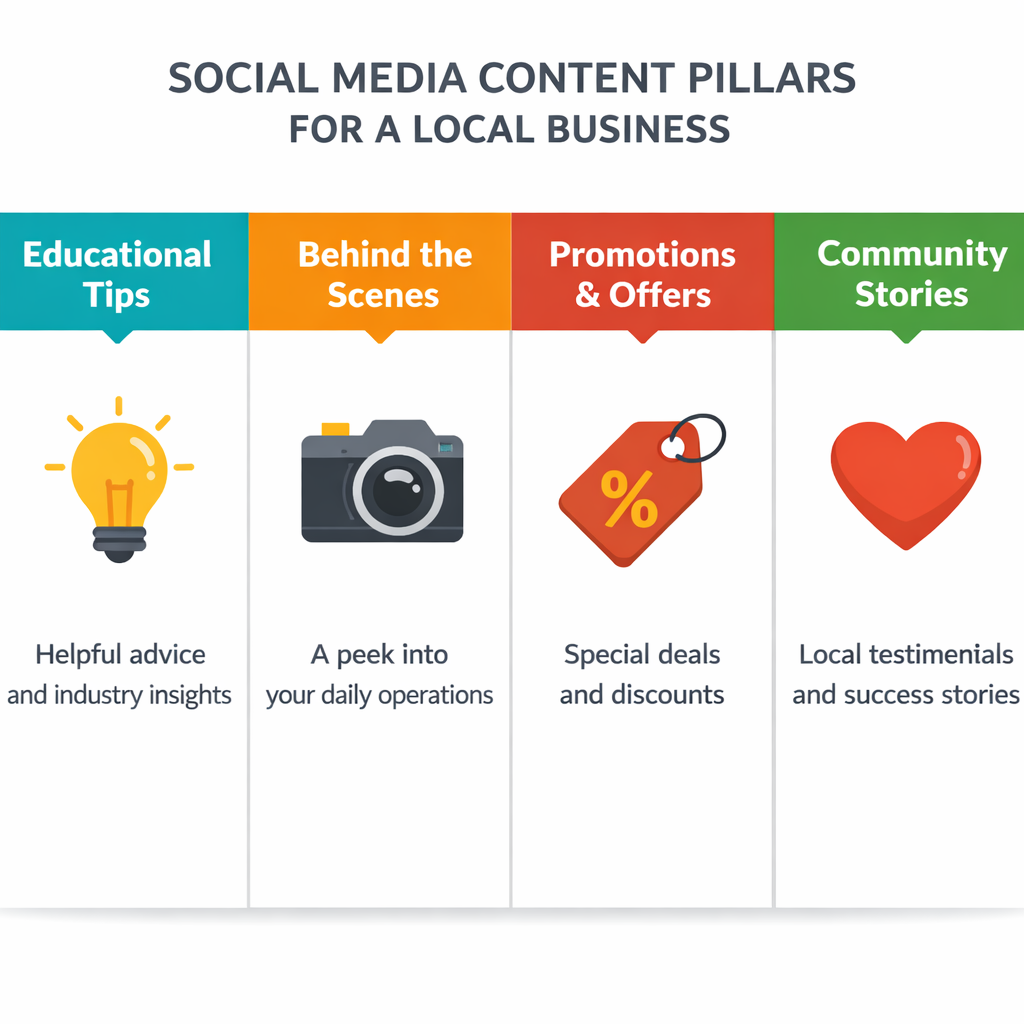
Pillar 1: Education (40% of your content)
Teach your audience something useful. This isn’t about giving away trade secrets — it’s about establishing expertise and building trust before someone ever walks through your door.
A salon might post “3 signs it’s time to deep-condition your hair before summer.” A plumber might share “Why your water pressure is low and what usually fixes it.” A dentist could explain “What whitening strips do vs. professional whitening — and why it matters.”
Educational content gets shared. It positions you as the expert. And it attracts people who are already thinking about the problem you solve.
Pillar 2: Behind the Scenes (25% of your content)
Local businesses have a superpower that national chains will never have: a real human story behind the counter. Use it.
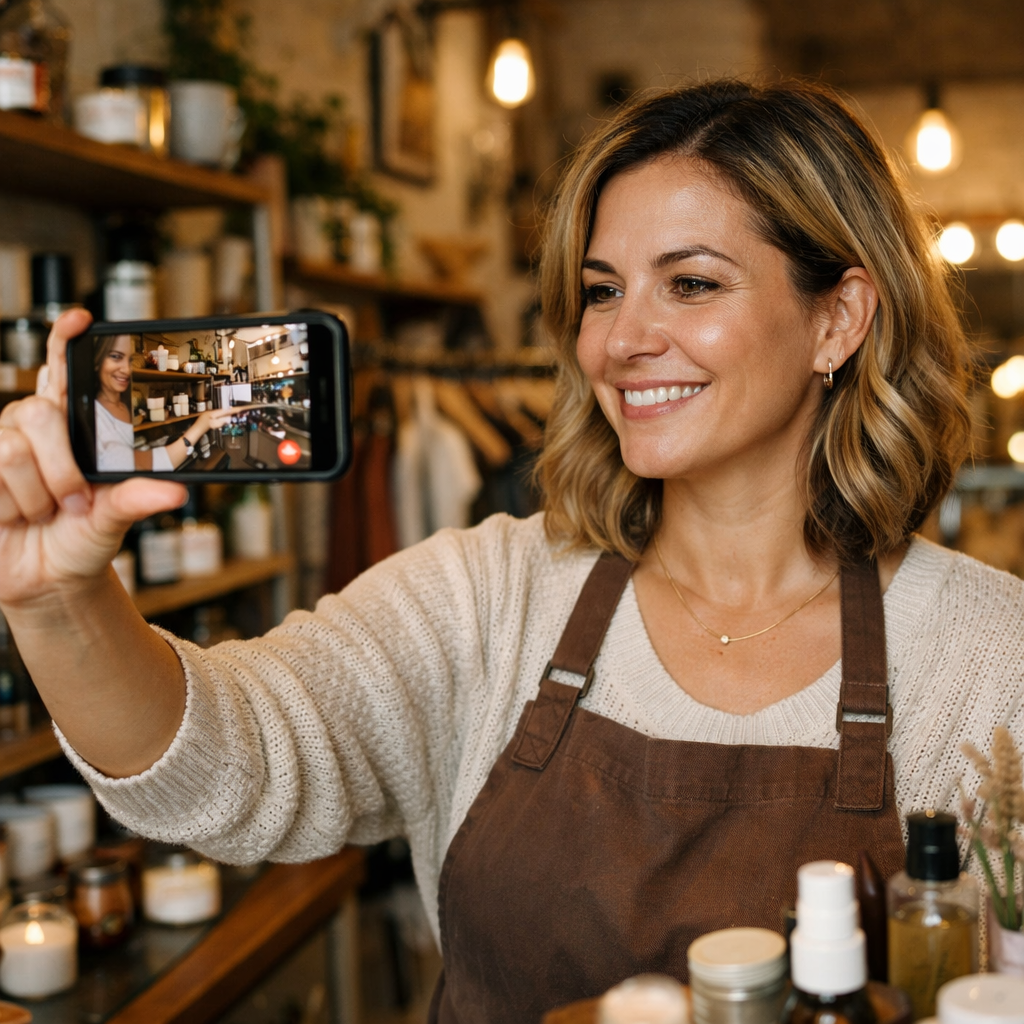
Show your morning setup. Introduce your team. Film a quick time-lapse of the work in progress. Share a blooper or a funny moment from the day. Let people see who they’re buying from — not just what you sell.
This type of content drives the emotional connection that turns casual followers into loyal customers. It’s also the easiest to create: just film your day.
Pillar 3: Promotions and Offers (20% of your content)
Yes, you can absolutely promote your services — just don’t let it dominate the feed. When you’ve built trust through education and behind-the-scenes content, your promotions land differently. Followers actually look forward to your special offers instead of scrolling past.
Make these posts clear and specific. “20% off Botox this Friday only — DM to book” outperforms “Great deals on services this week!” every time. Tell people exactly what to do and exactly what they get.
Pillar 4: Community and Social Proof (15% of your content)
This is where you reinforce that you belong to the local community. Share customer testimonials and before-and-afters (with permission). Highlight a local event you sponsored. Congratulate a community milestone. Repost a customer’s story tag.
This pillar does double duty: it builds credibility through social proof and signals that you’re invested in the community — not just extracting money from it.
Step 3: Choose the Right Platform (Not All of Them)
One of the biggest mistakes small business owners make is trying to maintain a presence on every platform. The result is mediocre content spread too thin.
Pick two platforms max to start. Here’s how to choose:
Instagram is ideal if your business has a visual product or result. Salons, med spas, restaurants, landscapers, interior designers, and contractors all do well here. Instagram Reels currently get the most organic reach of any content type on the platform.
Facebook still works well for local businesses targeting customers 35 and older. Facebook Groups and local community pages can be powerful for word-of-mouth and community engagement. Facebook Events are underused and highly effective for driving foot traffic to open houses, sale events, and workshops.
TikTok is worth considering if you can produce short video content consistently and your audience skews younger (under 40). It has massive organic reach potential — but only if you commit to video.
Google Business Profile posts are often overlooked but matter for local SEO. Posting weekly to your GBP keeps your listing active and can influence your Google Maps ranking.
Nextdoor is a sleeper hit for truly local businesses. Recommendations and posts there reach neighbors who are actively looking for local services.
If you’re starting from scratch: Instagram + Facebook is the most reliable combination for most local businesses in Southwest Florida.
Step 4: Set a Realistic Posting Cadence
Consistency beats frequency. A sustainable schedule you actually keep will always outperform an ambitious one you abandon.
Here’s a starting point for most local businesses:
| Platform | Frequency | Content Type |
|---|---|---|
| Instagram feed | 3–4x/week | Mix of Reels, carousels, photos |
| Instagram Stories | Daily | BTS, polls, quick tips, reposts |
| 3x/week | Posts + 1 Event/month when relevant | |
| GBP | 1x/week | Offers, events, or updates |
If that feels like too much, scale back to 3 Instagram posts per week and commit to that. Three consistent posts is infinitely better than seven posts for two weeks followed by silence.
Batch your content creation. Spend two to three hours one day a week filming and photographing content. Then schedule it out. Tools like Buffer, Later, or Meta Business Suite let you plan a week of posts in under 30 minutes.
Step 5: Create Content That Converts Followers to Customers
Here’s the distinction most local businesses miss: engagement is not revenue. Likes, comments, and saves are signals — but they only matter if they lead to inquiries, bookings, or walk-ins.
Every post should have a micro-purpose beyond getting engagement. Ask yourself: what do I want someone to do after seeing this?
- Learn something → follow you for more
- Get curious → click to your website or bio link
- Feel trust → book a consultation or DM for info
- Act now → call, click, or come in today
The clearest driver is a strong, specific call to action. “Save this for your next haircut appointment” works better than “follow for more tips.” “Comment ‘DEAL’ and I’ll send you details” works better than “DM us anytime.”
Your Instagram bio and link-in-bio page are the bridge between your social content and your actual business. Make sure your bio clearly states what you do, where you’re located, and what action someone should take. A simple landing page or booking link can convert social traffic into real leads.
Step 6: Build a Simple Content System
The businesses that post consistently aren’t posting consistently because they have more time. They have a system.
Here’s a lightweight weekly workflow that works:
Sunday (20 min): Plan the week’s posts. Pick one from each pillar that feels timely or relevant. Jot brief captions.
Monday–Tuesday: Capture raw content (photos, short video clips) during normal business operations. Don’t overthink it — phone quality is fine.
Wednesday (30 min): Edit, write captions, schedule for the week.
Daily (5 min): Check comments and DMs. Reply promptly. Engage with a few local accounts.
That’s roughly one hour a week. You don’t need a social media manager or a content agency. You need a system and the discipline to stick to it.
Step 7: Measure What Matters (and Ignore the Rest)
Stop obsessing over follower count. A business with 800 engaged local followers who DM for appointments is more valuable than one with 12,000 followers spread across the country who never buy anything.
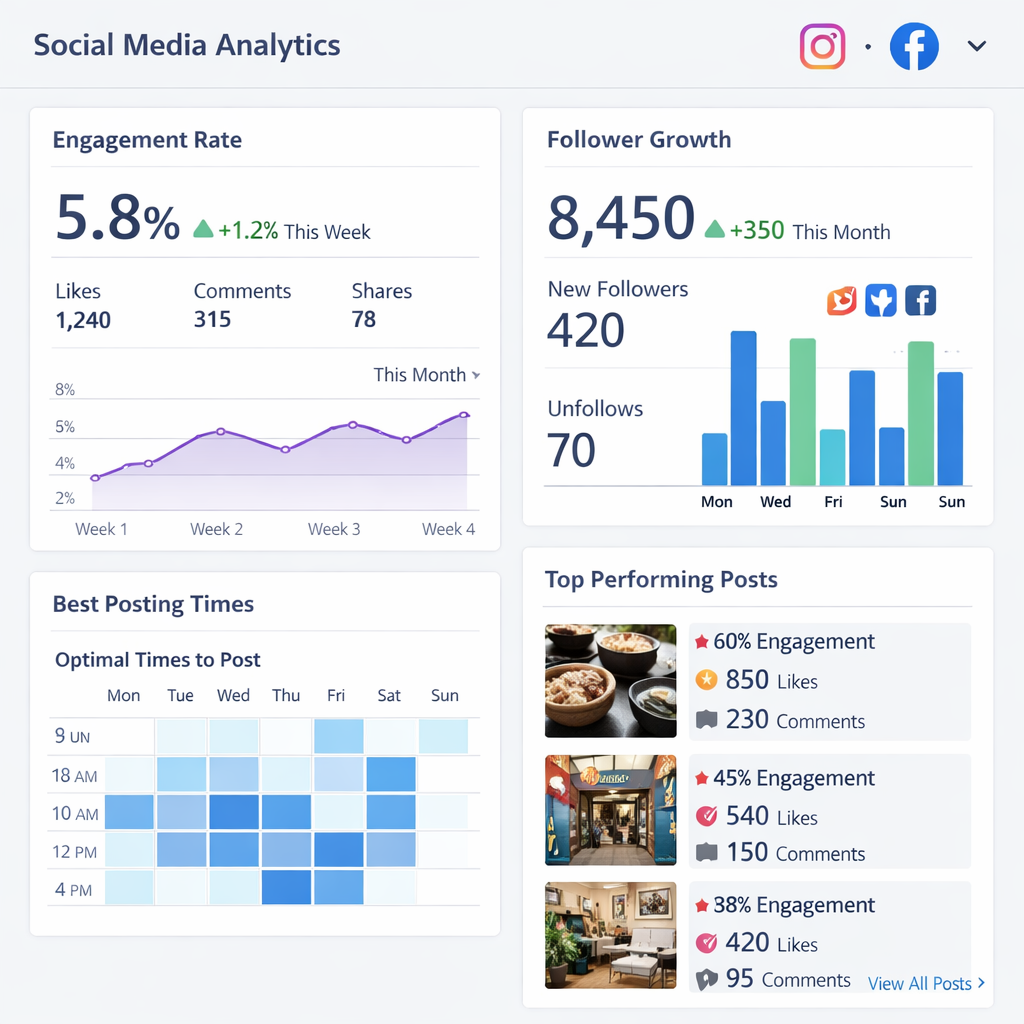
The metrics that actually matter for a local business:
Reach and profile visits. How many people who don’t follow you are seeing your content? This tells you how well you’re growing your potential audience.
Website clicks or link taps. Are people taking the next step? This connects your social activity to real business interest.
DMs and inquiries. Track how many messages or questions come in directly from social content. If posts about a specific service drive inquiries, make more of that content.
Appointment or consultation bookings traced to social. Ask new clients “how did you find us?” and track social media mentions specifically.
Review your top 5 performing posts each month. What did they have in common? More of that.
Platform-Specific Tips for Local Businesses
- Reels get reach; carousels get saves. Use Reels to attract new followers, carousels to deliver deep value that existing followers save and return to.
- Use local hashtags. #NaplesFL, #FortMyersBusiness, #SWFL, and your service type (#NaplesMedSpa, #FortMyersHVAC) help the algorithm surface your content to local audiences.
- Geo-tag every post. Always tag your city and business location. It directly improves local discoverability.
- Respond to every comment within 24 hours. The algorithm rewards engagement; every response counts.
- Create a Facebook Business Event for anything worth announcing. Events get free organic distribution to people in your area who might be interested.
- Join and participate in local community groups (don’t spam — provide value, answer questions, and let your expertise speak for itself).
- Run occasional boosted posts — even $5–10 per day on a high-performing organic post can meaningfully increase local reach.
Google Business Profile
- Post weekly using the “What’s New” or “Offer” post types.
- Include keywords people actually search for (e.g., “Botox in Naples” not just “Botox”).
- Link each post to a relevant page on your website.
Avoiding the Biggest Time Wasters
Chasing trends irrelevant to your business. You don’t need to do every TikTok dance. Trends are tools — use them only if they fit your brand and you can execute quickly.
Overproducing content. The perfectly lit, professionally edited post took you four hours and performed the same as the candid iPhone video you shot in five minutes. Authenticity wins in local social.
Ignoring your existing customers online. If a happy customer tags your business or leaves a comment, respond enthusiastically. That interaction is visible to everyone who follows them — it’s free word-of-mouth marketing.
Buying followers. Fake followers don’t buy anything, tank your engagement rate, and signal to algorithms that your content isn’t worth distributing. Never do it.
Putting It All Together
A social media strategy that actually drives local business growth isn’t complicated. It’s consistent, intentional, and grounded in who your customer is.
Here’s the short version:
- Know your audience precisely
- Build four content pillars (Education, BTS, Promotions, Community)
- Choose two platforms and commit
- Post consistently on a schedule you can actually maintain
- Every post has a purpose and a call to action
- Batch content creation to make it sustainable
- Measure traffic, inquiries, and bookings — not just likes
If you layer in marketing automation to follow up with leads coming from social, email list building to capture interest before someone is ready to buy, and CRM tools to track where customers come from, you’ll start to see compound results that most competitors never achieve.
Social media isn’t a magic growth lever — but it’s one of the best community-building and trust-building tools a local business has. Use it with a plan, and it pays off.
Ready to turn your social media into a real lead source? Monsoft Solutions helps local businesses in Southwest Florida build content systems and marketing automation that work together. Let’s build something that actually drives growth.