
Social media platforms change their algorithms overnight. Ad costs keep climbing. SEO takes months to pay off. But your email list? That belongs to you. No middleman. No pay-to-play. Just a direct line to people who actually asked to hear from you.
The problem is most small businesses either don’t have a list at all, or they have one that’s tiny and barely growing. Not because email marketing doesn’t work — it absolutely does, with an average ROI of $36 for every $1 spent — but because building the list itself gets treated as an afterthought.
This guide changes that. You’ll learn exactly how to build an email list that grows on its own, what to offer people to get them to subscribe, and how to turn that list into real revenue without spamming anyone.
Why Your Email List Is Your Most Valuable Business Asset
Before the tactics, let’s establish why this matters more than most business owners realize.
When you have 500 followers on Instagram, Instagram controls what they see. When you post, maybe 5-10% of those followers actually see it. Want more reach? Pay for ads.
When you have 500 email subscribers, you own that relationship. Send an email, and almost every one of them will at least see your subject line in their inbox. Open rates for small business emails average 20-30%, versus the 1-5% organic reach on social platforms.
More importantly: email subscribers convert to customers at a dramatically higher rate than social media followers. They’ve already shown trust by sharing their inbox — one of the most personal digital spaces anyone has.
If your business disappeared tomorrow and you had to rebuild, your email list would let you do it. Your social following wouldn’t.
The Foundation: Know What You’re Building Toward
Most list-building mistakes happen because there’s no clear goal. Before you create a single opt-in form, answer three questions:
Who exactly do you want on your list? “Everyone” is not an answer. Your ideal subscriber is a specific person — a local homeowner interested in remodeling, a new parent looking for childcare, a small business owner who needs help with marketing. The more specific you are, the more relevant your list becomes, and relevant lists convert.
What will you send them? People subscribe because they expect value. Before they give you their email, they’re mentally asking: “What am I going to get?” If you can’t answer that clearly, they won’t subscribe. Plan your content: weekly tips, monthly promotions, exclusive deals, helpful guides.
What do you want them to do eventually? Book a consultation? Buy a product? Refer friends? Your list-building strategy should be backward-engineered from this goal. Every step of the subscription process should move toward it.
With those answers clear, you’re ready to build.
The 5 Core Tactics That Actually Grow Lists
These aren’t theoretical. These are the approaches that consistently work for small businesses without requiring a big marketing budget.
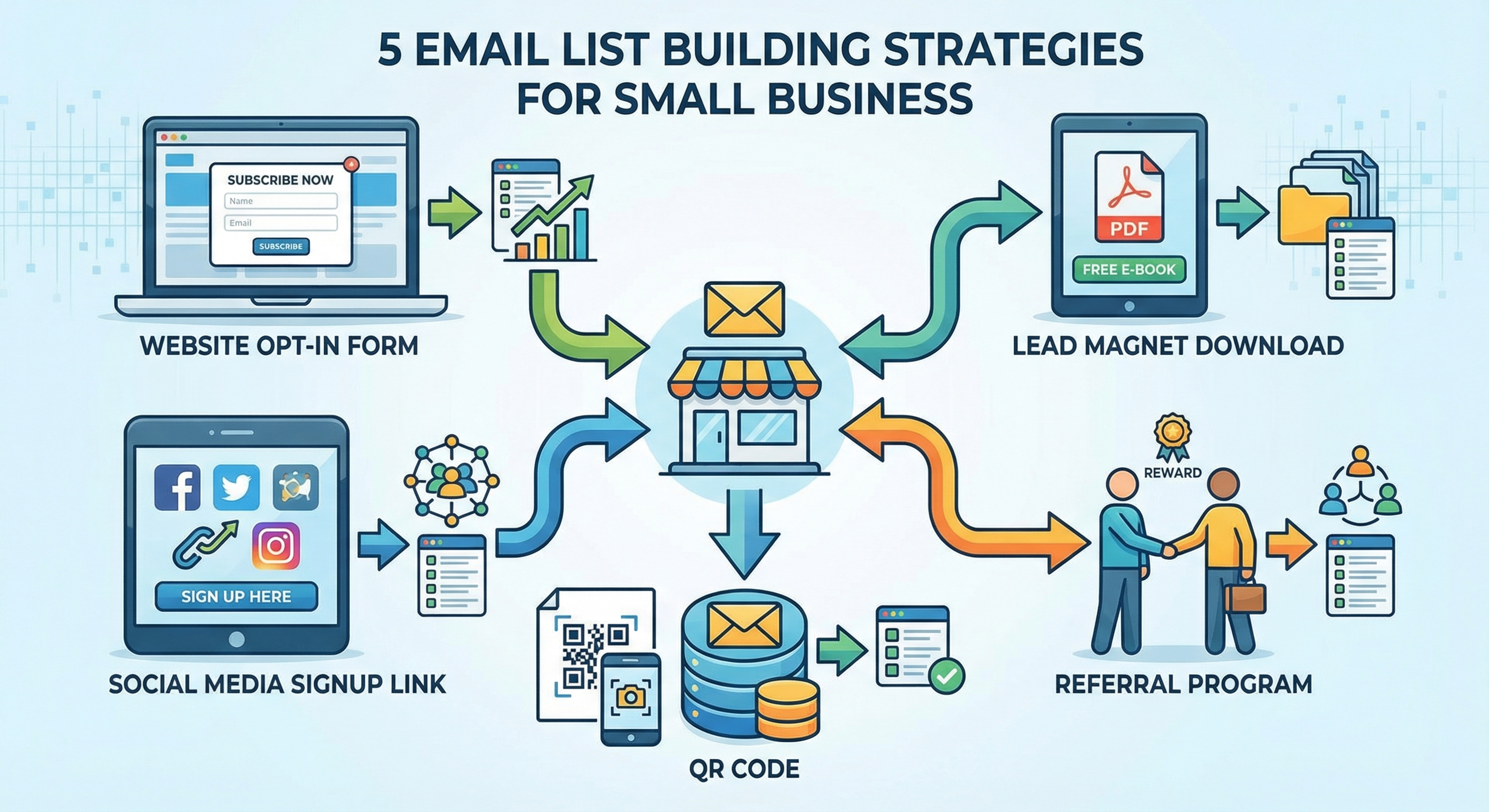
1. A Compelling Lead Magnet
A lead magnet is something you give away for free in exchange for an email address. The key word is compelling — it has to be something your ideal customer genuinely wants.
The best lead magnets for small businesses tend to be:
- Checklists and cheat sheets — Simple, actionable, immediately useful. “The 10-Point Pre-Sale Home Checklist” for a real estate agent. “The First-Month Baby Essentials Checklist” for a pediatric practice.
- Discount codes or offers — Direct and honest. “Get 15% off your first service when you subscribe.” Works especially well for retail, salons, and service businesses.
- Free guides or reports — Slightly longer format, ideal if your business involves education. “5 Questions to Ask Before Hiring a Contractor.”
- Free consultations or assessments — Particularly effective for professional services. The “free consultation” becomes the list entry point.
- Templates or tools — If you can create something reusable (a budget template, a planning spreadsheet), the perceived value is high.
The worst lead magnets are vague newsletters (“Subscribe for updates!”) and generic eBooks nobody asked for. Be specific about what they get and why it helps them.
2. Well-Placed Opt-In Forms on Your Website
Your website visitors are already warm — they found you, they’re reading about you. Don’t let them leave without giving you a way to stay in touch.
The highest-converting form placements are:
Above the fold on your homepage — Visible immediately, no scrolling required. Keep it simple: headline, 1-2 bullet points about what they get, email field, button.
In-line within blog content — If someone reads halfway through a blog post, they’re engaged. A contextual opt-in at that point (“Enjoying this? Get our weekly tips directly to your inbox.”) converts well.
Exit-intent popups — These appear when a visitor’s cursor moves toward closing the tab. They catch people before they leave and, when the offer is relevant, convert better than most static forms.
Dedicated landing pages — For each major lead magnet, build a standalone page with one job: get the email. No navigation. No distractions. Just the offer and the form. You can link this from social media, ads, and email signatures.
Keep the form itself short. Name (optional) + email is all you need. Every additional field reduces conversions.
3. Social Media as a Traffic Driver, Not a List Replacement
Social media isn’t where you collect email addresses — it’s where you drive people to the places where you do. The mistake most businesses make is treating social as the destination.
Effective approaches:
- Link-in-bio with a lead magnet offer — Make your bio link point to a landing page with a compelling opt-in, not just your homepage.
- Stories and posts that explicitly promote your lead magnet — “I just put together a free checklist for [problem your audience has]. Link in bio to grab it.”
- Mention your newsletter in content — If you post valuable content on social, occasionally let people know there’s even more in your email list.
- Run social ads directly to a lead magnet landing page — This is one of the most efficient uses of a small ad budget, because the CPA (cost per acquisition) for an email subscriber is far lower than for a direct sale, and an email subscriber has lifetime value.
4. In-Person and QR Code Capture
If your business has any physical presence — a storefront, a service location, events, trade shows — you have collection opportunities that purely online businesses don’t.
A simple QR code linking to your opt-in landing page, placed on:
- Business cards
- Receipts
- Packaging and bags
- Signage in your location
- Event materials
…can add subscribers steadily without any ongoing effort. Add a clear incentive (“Scan to get 10% off your next visit”) and the conversion rate goes up significantly.
In-person events — local markets, networking events, community activities — also offer direct opportunities. A tablet with a simple sign-up form, or a physical sign-up sheet, can capture names and emails from people who’ve just had a positive in-person interaction with your business. That’s high-quality list growth.
5. Referral Programs That Reward Existing Subscribers
Your current subscribers, if they’re happy, are your best recruiters. A simple referral mechanism — “Refer a friend, both of you get 10% off” — can turn a passive list into an active growth engine.
Most email platforms (Mailchimp, Klaviyo, ActiveCampaign) support this natively or via integrations. Even a low-tech version — “Forward this email to a friend who’d find it useful” with a link to your opt-in page — can generate meaningful growth over time.
Building a Lead Magnet That Actually Converts
This deserves its own section because the lead magnet is the linchpin. If it’s weak, nothing else in your list-building strategy will work well.
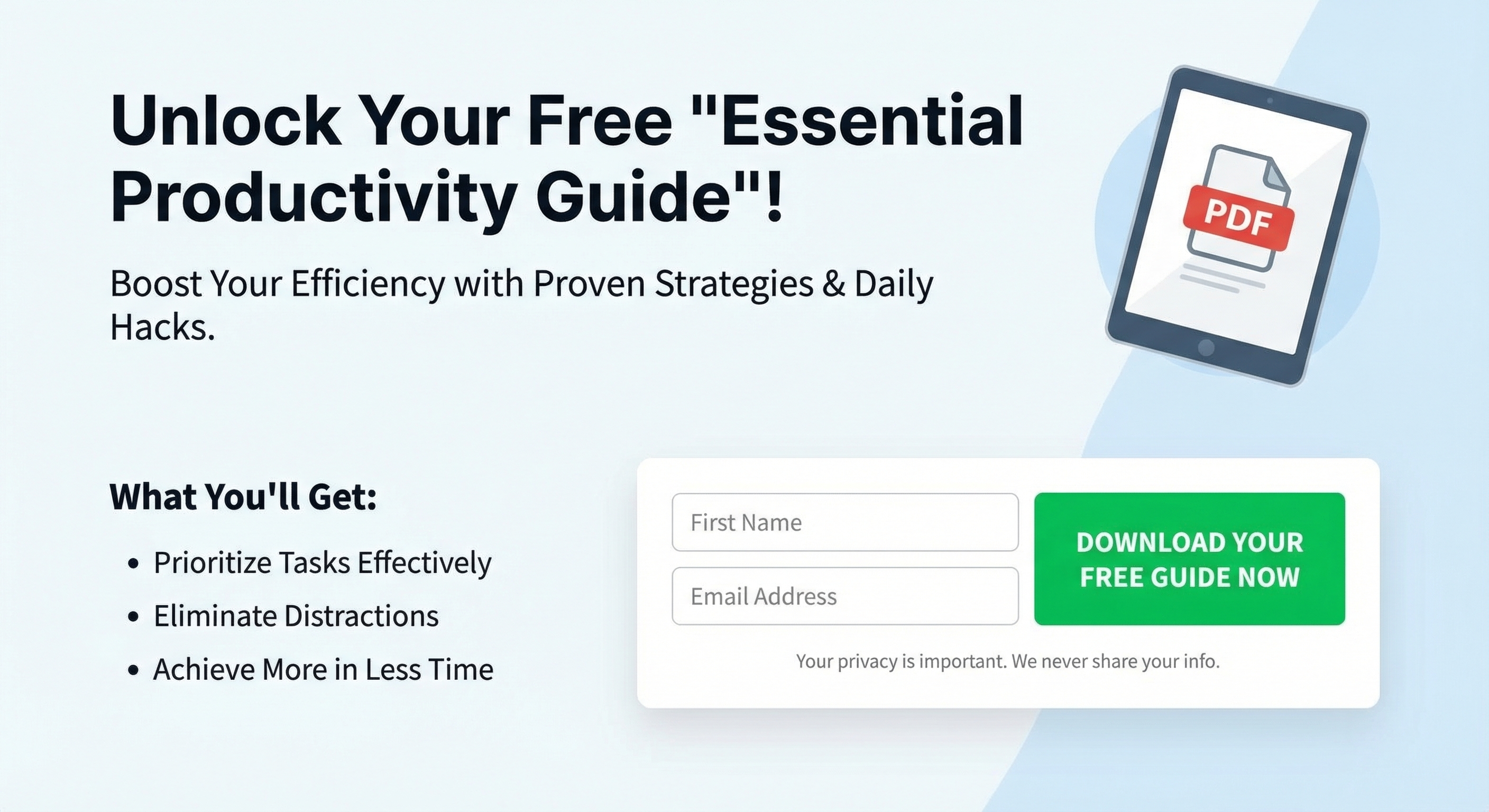
A high-converting lead magnet landing page has these elements:
A specific, benefit-driven headline. Not “Download Our Free Guide.” Try: “The 5 Questions Homeowners Ask Before Hiring a Plumber — And What the Answers Should Tell You.” The specificity signals this isn’t generic filler.
A clear visual of what they’re getting. Even if it’s a digital download, a mockup image of the “book” or “checklist” increases perceived value and conversion rate.
3-5 bullet points of specific benefits. What will they know, be able to do, or have after consuming this? Make each bullet concrete.
A strong call-to-action button. “Download Now” is fine. “Get My Free Checklist” is better. First-person language (“my”) consistently outperforms third-person (“your”).
A brief privacy note. “We respect your privacy. Unsubscribe anytime.” This single line removes a significant barrier for skeptical visitors.
No navigation menu. On a dedicated landing page, every link away from the form is an escape hatch. Remove them.
Test different versions of your headline and button copy. Even small changes can double conversion rates.
What to Send After Someone Subscribes
Getting the email is step one. What you do with it determines whether your list becomes a revenue driver or a graveyard of disengaged contacts.
The critical window is the first 7-14 days after someone subscribes. This is when your open rates are highest, when they remember who you are, and when first impressions form. Waste it and you’ve lost most of the opportunity.
A simple welcome sequence:
Day 0 — Deliver the lead magnet. If you promised a checklist, send it immediately. Don’t make them wait. Include a brief, genuine note about who you are and what they can expect from you. Keep it human.
Day 2 — Share something immediately useful. A quick tip, a short story, a piece of advice they can act on. No selling. Just value.
Day 5 — Tell your story. Who are you? Why did you start this business? What do you genuinely believe about helping your customers? This builds the emotional connection that turns subscribers into loyal customers.
Day 7-10 — Make a soft offer. By now they’ve received value and know who you are. A gentle invitation to book a consultation, try a service, or take advantage of an offer lands much better than it would on day one.
After the welcome sequence, consistency matters more than frequency. A monthly email that always delivers value beats a weekly email that’s sometimes good and sometimes a sales pitch. Find a rhythm you can sustain.
Tools to Build and Manage Your List
You don’t need an expensive platform to start. These tools cover most small business needs:
Mailchimp — Free for up to 500 subscribers, easy to use, good landing page builder. The right choice for most businesses starting from zero.
Klaviyo — More powerful automation and segmentation, built for e-commerce. Better choice once you’re selling products online and want to segment by purchase behavior.
ActiveCampaign — Best-in-class automation for service businesses. More complex to set up, but the automation capabilities are exceptional once you scale.
ConvertKit — Popular with content creators and service providers. Clean interface, strong for nurture sequences.
Flodesk — Flat monthly fee regardless of list size, beautifully designed templates. Good choice for businesses where aesthetic presentation matters.
Start with whatever’s free. Migrate to a paid platform with more automation when your list hits 1,000+ subscribers and you have a clear idea of what automations you need.
Measuring What Matters
Once your list is growing, track these numbers:
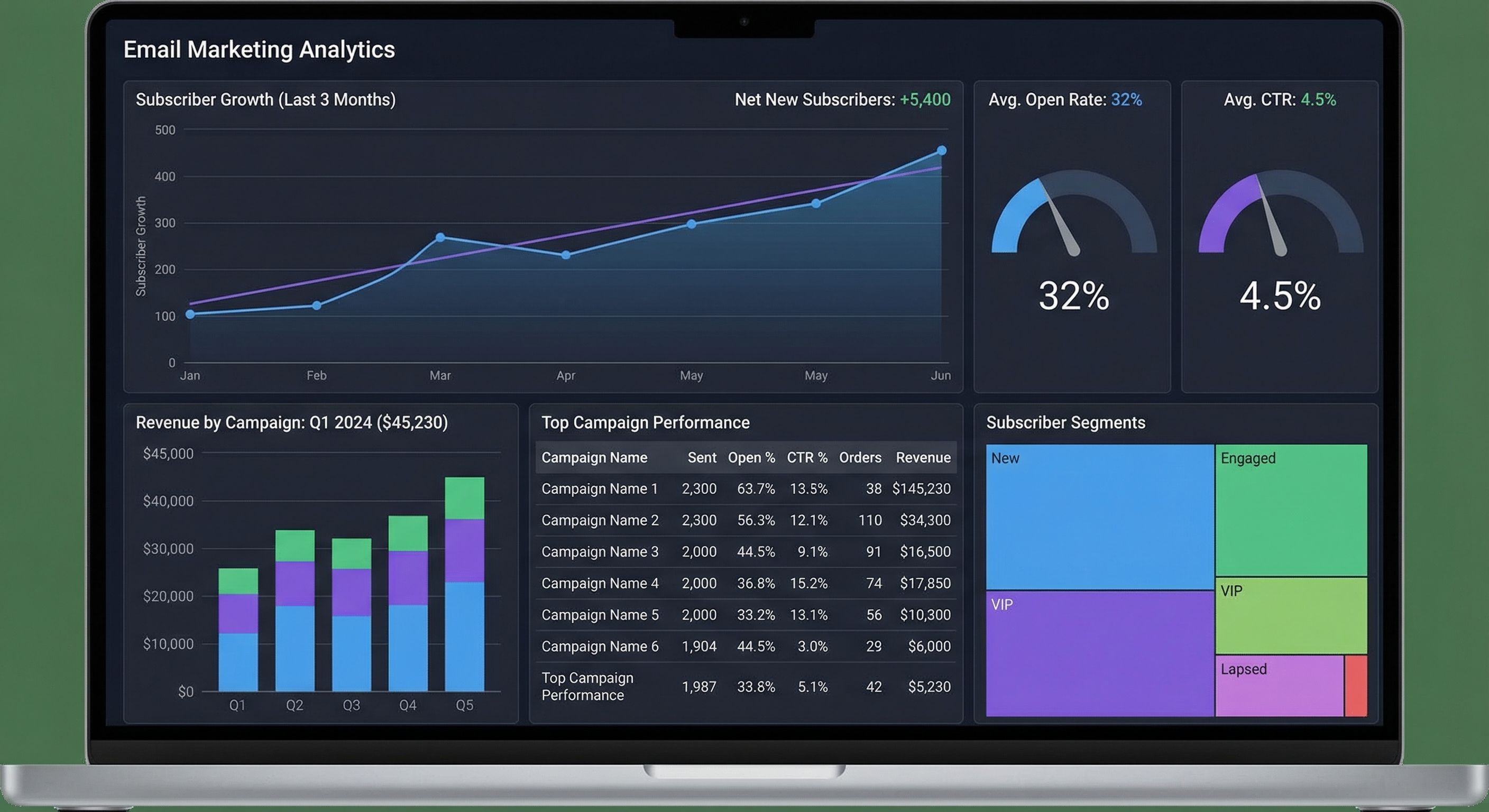
List growth rate — How many new subscribers are you adding each month? Are you growing or flat? If flat, which collection point is underperforming?
Open rate — For small business email, 25-35% is healthy. Below 20% suggests your subject lines need work or your list has gone stale.
Click-through rate — The percentage of openers who clicked something. 2-5% is typical. Low CTR with high open rate means your content is engaging but your calls to action aren’t compelling.
Unsubscribe rate — Under 0.5% per send is normal. Spikes after specific emails tell you what content or frequency isn’t working.
Revenue per subscriber — The ultimate metric. Divide total revenue attributed to email by your list size. Track this over time. As your nurture sequences improve, this number should go up.
Most email platforms show you all of these automatically. Check them after each send, not obsessively, but consistently. Patterns over time tell you more than any single data point.
Common Mistakes That Kill List Growth
Even well-intentioned list-building efforts often fail for a handful of predictable reasons:
Buying an email list. It seems like a shortcut, but it’s not. Purchased lists have terrible deliverability, damage your sender reputation, and often violate anti-spam laws. Every subscriber on your list should have opted in voluntarily.
Having a generic opt-in with no clear value. “Sign up for our newsletter” tells someone exactly nothing about why they should. Always lead with the benefit.
Letting the list go dormant. If you’re not sending at least once a month, you’re losing the relationship you worked to build. Inconsistent senders get forgotten — and when they do show up, subscribers mark them as spam.
Only emailing when you’re selling. If every email is a pitch, subscribers tune out or unsubscribe. The rule of thumb: for every promotional email you send, send two or three that are purely valuable.
Ignoring mobile. More than 60% of emails are opened on mobile devices. If your emails don’t render well on a phone, a majority of your list is having a bad experience. Use responsive templates and preview on mobile before every send.
Building Your First 500 Subscribers: A 30-Day Plan
Abstract strategies are easy to agree with and hard to execute. Here’s a concrete starting point:
Week 1 — Set up the infrastructure. Choose your email platform, create one lead magnet, build a simple landing page. This is a one-time investment that pays off for years.
Week 2 — Optimize your website. Add an opt-in form above the fold on your homepage. Add a contextual form to your most-visited blog posts. Install an exit-intent popup on key pages.
Week 3 — Drive traffic. Share your lead magnet on every social channel you use. Add your landing page to your bio links. Tell your existing customers about it (in person, via text, in a conversation). Send a personal email to contacts who might genuinely benefit.
Week 4 — Review and iterate. Check your form conversion rates. Which placements are working? Where are people dropping off? Adjust the offer, headline, or placement based on what the data shows.
After month one, you’ll have a working system. Add subscribers consistently, send value consistently, and the list grows consistently. There’s no magic threshold — just compounding returns over time.
The Bigger Picture
Your email list connects directly to almost every other marketing system in your business. When you understand how these pieces fit together, the investment in list-building becomes obvious.
A strong list amplifies your content marketing strategy — every piece of content you publish gets distributed to an audience that already trusts you. It makes your email marketing automation more powerful, because automated sequences only work if there are people to receive them. It feeds your CRM automation workflows, turning subscribers into leads and leads into customers through systematic follow-up. It multiplies the impact of your automated follow-up sequences and your review generation efforts.
None of those systems work particularly well if you have no audience. Your email list is the audience.
Start building it today — even if that means just setting up a Mailchimp account and adding one opt-in form to your website this week. Small, consistent steps compound into something significant.
Ready to grow your business with better marketing systems? Get in touch with the Monsoft Solutions team — we help small businesses and aesthetic practices build the digital infrastructure that turns subscribers into customers.
Frequently Asked Questions
How many subscribers do I need before email marketing becomes worth it?
Even 100 engaged subscribers is worth sending to. The question isn’t size — it’s engagement. 200 subscribers who open every email and regularly buy from you are worth more than 5,000 who never engage. Start now and grow from where you are.
Is it legal to add existing customers to my email list?
This varies by country. In the US under CAN-SPAM, you generally can email existing customers, but providing a clear unsubscribe mechanism is required. Under GDPR (EU), you typically need explicit consent. When in doubt, ask for permission — it’s better for deliverability anyway, since opt-in subscribers engage far more than added contacts.
How often should I email my list?
Consistency matters more than frequency. Weekly is ideal if you can maintain quality. Monthly is better than sporadic. Find a pace you can sustain indefinitely and stick to it. Subscribers will come to expect and look forward to your emails if you’re reliable.
What’s the fastest way to grow a list from zero?
Running a targeted social media ad to a lead magnet landing page is typically the fastest way to build momentum. Even a small budget — $5-10/day — can generate consistent subscriber growth if the offer is compelling and the audience targeting is right. Combine that with optimizing your website opt-ins and you’ll see results within days.
Should I clean my list regularly?
Yes. Remove subscribers who haven’t opened an email in 6-12 months (after sending a re-engagement campaign to try to win them back). A smaller, engaged list delivers better open rates, better deliverability, and better ROI than a large, stale one.