
Your online reputation isn’t what you say about your business—it’s what Google says when someone searches your name. And in 2026, 93% of consumers read online reviews before making a purchase decision, with most trusting reviews as much as personal recommendations.
One bad review at the top of your results can cost you 30 or more potential customers before you even know it’s there. One great reputation strategy can become the most powerful (and cheapest) marketing engine your business has ever had.
Whether you run an aesthetic practice fielding consultation requests or a plumbing company in Fort Myers fielding emergency calls, your online reputation directly determines how many of those searches turn into revenue. This guide gives you a practical, step-by-step system for building, monitoring, and protecting the reputation your business deserves.
What Is Online Reputation Management?
Online reputation management (ORM) is the practice of actively monitoring, influencing, and improving how your business appears across the internet—in search results, review platforms, social media, and anywhere else potential customers form opinions before contacting you.
It’s not about hiding problems or gaming reviews. Effective ORM means building a genuine, consistent presence that reflects the quality of your work, responding to feedback quickly, and creating systems that generate positive reviews from the satisfied customers who might never think to leave one on their own.
Why Your Online Reputation Matters More Than Ever
Reviews Drive Revenue
The numbers are hard to ignore:
- Businesses with a 4.0+ star rating earn significantly more clicks than those below 4.0.
- A one-star increase on review platforms can drive a 5-9% increase in revenue.
- 88% of consumers won’t engage with a business that has unaddressed negative reviews.
For aesthetic practices, the stakes are even higher. Patients considering a $10,000+ procedure research extensively—your reviews, before-and-after results, and how you handle criticism all factor into their decision. We’ve seen practices transform their consultation booking rates simply by improving their review profile, as detailed in our patient review management guide.
Search Visibility Depends on It
Google’s local search algorithm heavily weights reviews—both quantity and quality. Businesses with more reviews and higher ratings consistently rank higher in the local map pack. If you’ve been working on Google Business Profile optimization, your reputation strategy is the missing multiplier.
Trust Is the New Currency
In a world where anyone can build a professional website, reviews and reputation are the differentiators. Your potential customers are comparing you to competitors side by side, and the business with 47 five-star reviews will almost always beat the one with 3 reviews—regardless of who actually does better work.
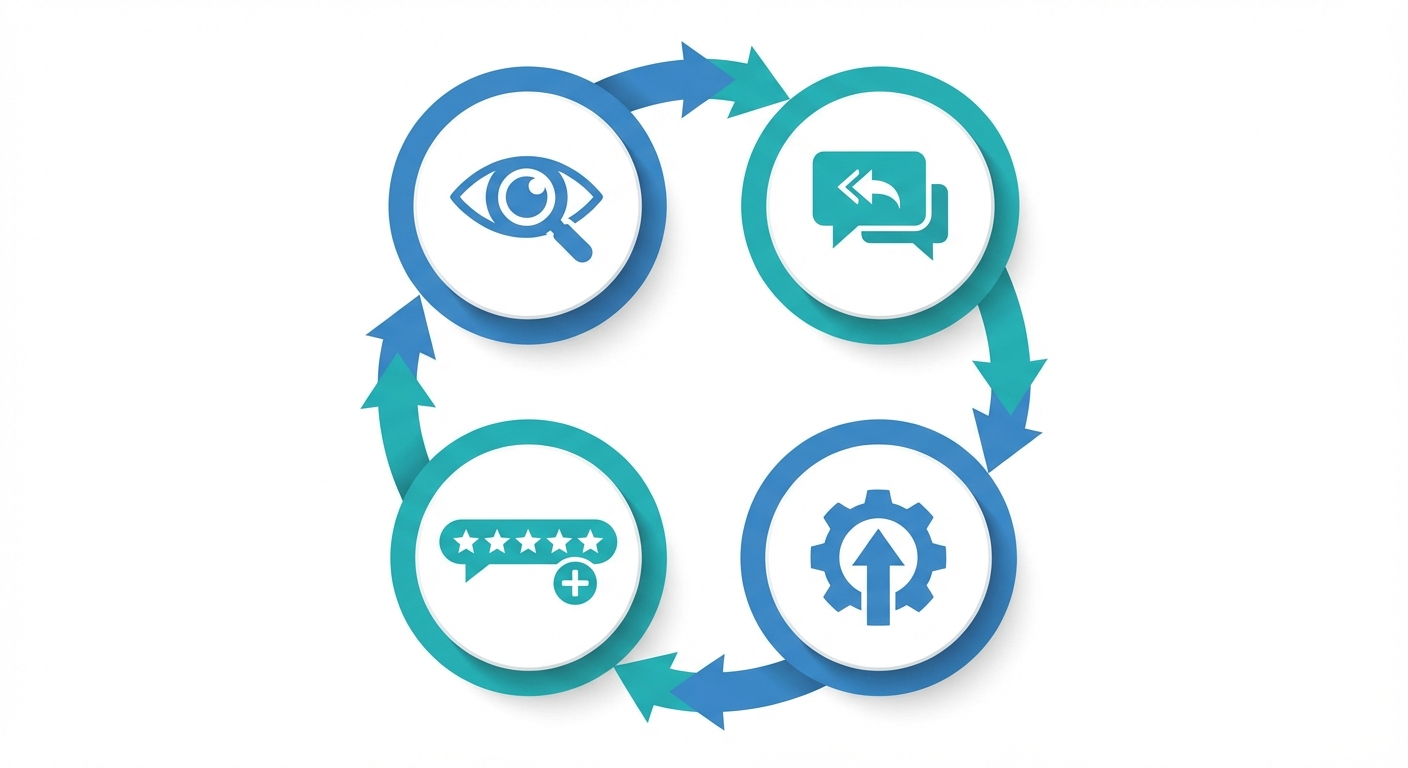
The 4-Step Reputation Management Framework
Building a strong online reputation isn’t a one-time project. It’s a continuous cycle with four key phases:
Step 1: Audit Your Current Reputation
Before you can improve anything, you need to know where you stand:
- Google your business name. What appears on page one? Reviews, social profiles, directory listings?
- Check your ratings across all platforms: Google Business Profile, Yelp, Facebook, industry-specific sites (Healthgrades for medical, Angi for home services, etc.).
- Read your reviews. Not just the star rating—the actual words. What themes emerge? Common praises? Recurring complaints?
- Search “[your business] reviews” and “[your business] complaints.” You might find feedback on platforms you didn’t know about.
Create a simple scorecard:
| Platform | Total Reviews | Average Rating | Last Review Date | Unanswered Reviews |
|---|---|---|---|---|
| — | — | — | — | |
| Yelp | — | — | — | — |
| — | — | — | — | |
| Industry-specific | — | — | — | — |
This baseline tells you exactly where to focus first.
Step 2: Respond to Everything
Every review deserves a response—positive and negative. Here’s why and how:
For positive reviews:
- Thank them by name.
- Reference something specific about their experience.
- Keep it genuine and brief—no templated responses that all look identical.
“Thank you, Sarah! We’re glad the consultation process felt so smooth. Dr. Martinez enjoys working with patients who come prepared with great questions. We look forward to seeing you at your follow-up.”
For negative reviews:
- Respond within 24 hours. Speed signals that you care.
- Acknowledge the issue without being defensive.
- Take the conversation offline. Provide a direct phone number or email.
- Never argue publicly. You’re writing for the hundreds of future customers reading, not just the reviewer.
“We’re sorry to hear about your experience, Mike. This isn’t the standard we hold ourselves to. I’d like to understand what happened and make it right—please reach out to me directly at [phone/email]. —[Name], Owner”
The audience effect: Remember, your responses aren’t just for the reviewer. Every potential customer reads how you handle criticism. A thoughtful, professional response to a negative review often builds more trust than a dozen five-star ratings.
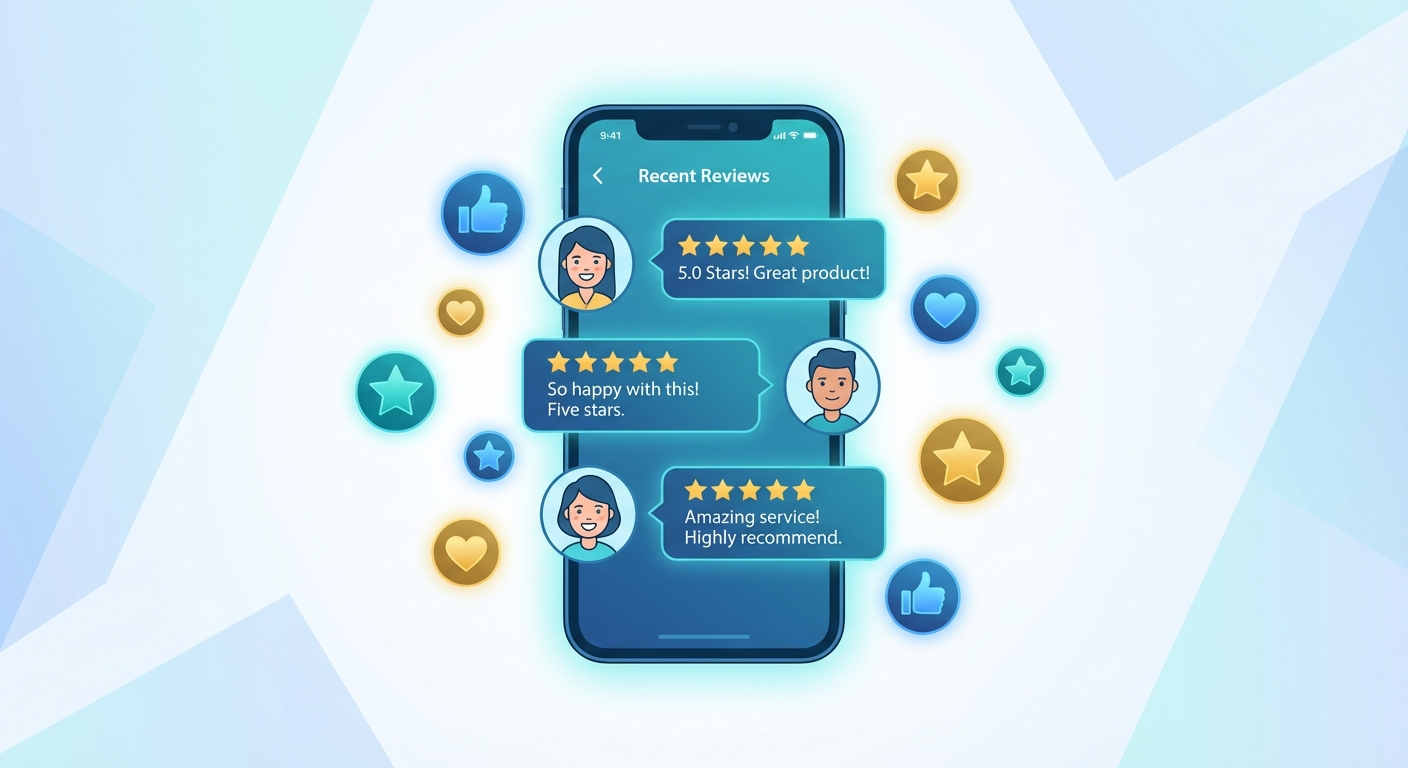
Step 3: Generate Reviews Consistently
The biggest mistake businesses make? Waiting for reviews to happen organically. Happy customers rarely leave reviews unless you make it easy and timely.
The best time to ask: Immediately after a positive interaction—when the work is done, the patient is thrilled with results, or the customer just complimented your team.
How to systematize it:
- Automate the ask. Use your CRM or follow-up sequences to send a review request 24-48 hours after service completion. Our review generation automation guide covers the full technical setup.
- Make it one-tap easy. Send a direct link to your Google review page—not your homepage, not your Google listing. The fewer clicks, the higher the completion rate.
- Use multiple channels. Email for some customers, SMS for others. Text messages consistently outperform email for review requests (60%+ open rate vs. 20%).
- Train your team. Your front-desk staff, technicians, and service teams should know how and when to ask. A simple “If you were happy with the work today, a Google review would really help us out” works surprisingly well.
Volume matters. A business with 200 reviews and a 4.6 average looks far more credible than one with 8 reviews and a perfect 5.0. Recency matters too—Google and consumers alike value fresh reviews over old ones.
For aesthetic practices navigating HIPAA considerations, generating reviews requires extra care around patient privacy. Our guide on HIPAA-compliant social media marketing covers the compliance boundaries you need to respect.
Step 4: Monitor and Protect Continuously
Reputation management isn’t “set and forget.” You need ongoing monitoring:
- Set up Google Alerts for your business name, owner name, and key staff.
- Check review platforms weekly. Set a recurring 15-minute block—Monday morning works well.
- Track trends, not just individual reviews. If three customers mention long wait times in the same month, that’s a signal worth acting on internally.
- Monitor social media mentions. People often talk about businesses on social platforms without tagging them directly.
When you spot a problem pattern: Don’t just manage the reviews—fix the root cause. The best reputation management is simply running a better business. If reviews consistently mention a specific issue, address it operationally first, then let the improved reviews follow naturally.
Reputation Management for Different Business Types
For Local Service Businesses
Local businesses in Southwest Florida—whether you’re an HVAC company in Cape Coral or a salon in Naples—live and die by local reviews. Your priorities:
- Google Business Profile is #1. Most customers find you through Google Maps and local search. Focus your review generation efforts there first.
- Respond to reviews quickly. Local customers notice when a business is engaged. It signals you’re active and trustworthy.
- Leverage seasonal patterns. During snowbird season (November through April), you’re serving a surge of new customers who don’t have an existing relationship with local businesses. These customers rely heavily on reviews to make decisions, making this your highest-ROI period for review generation.
If you’re already using AI phone answering to capture calls you’d otherwise miss, consider adding an automated review request as part of your post-service workflow.
For Aesthetic Practices
Reputation carries unique weight in aesthetics because patients are making high-stakes decisions about their appearance:
- Before-and-after galleries are a form of reputation management. They’re social proof in visual form. Pair them with patient testimonials when possible—our gallery best practices guide covers how to do this effectively.
- Quality over quantity. Detailed reviews that describe the consultation experience, staff professionalism, and results matter more than a quick “5 stars!”
- Handle negative reviews with extra care. Never reference a patient’s treatment or medical history in your response—that’s a HIPAA violation. Keep responses general and move the conversation to a private channel immediately.
- Platform diversity. Beyond Google, claim and optimize your Healthgrades, RealSelf, and Vitals profiles. Many patients search these platforms specifically when researching procedures.
Common Reputation Mistakes to Avoid
- Buying fake reviews. Platforms are increasingly sophisticated at detecting them—and the penalty when caught destroys more trust than the fake reviews ever built. Google has been actively removing suspicious reviews and penalizing businesses caught gaming the system.
- Ignoring negative reviews. Silence reads as agreement. An unanswered negative review tells future customers you don’t care.
- Copy-paste responses. “Thank you for your feedback!” repeated 50 times looks lazy. Personalize every response, even if briefly.
- Only asking happy customers for reviews. This feels counterintuitive, but making the review request part of your standard process (not cherry-picking) builds a more authentic and defensible review profile.
- Neglecting non-Google platforms. Your reputation exists across the internet. Industry platforms, Yelp, Facebook, the BBB—customers find you on all of them.
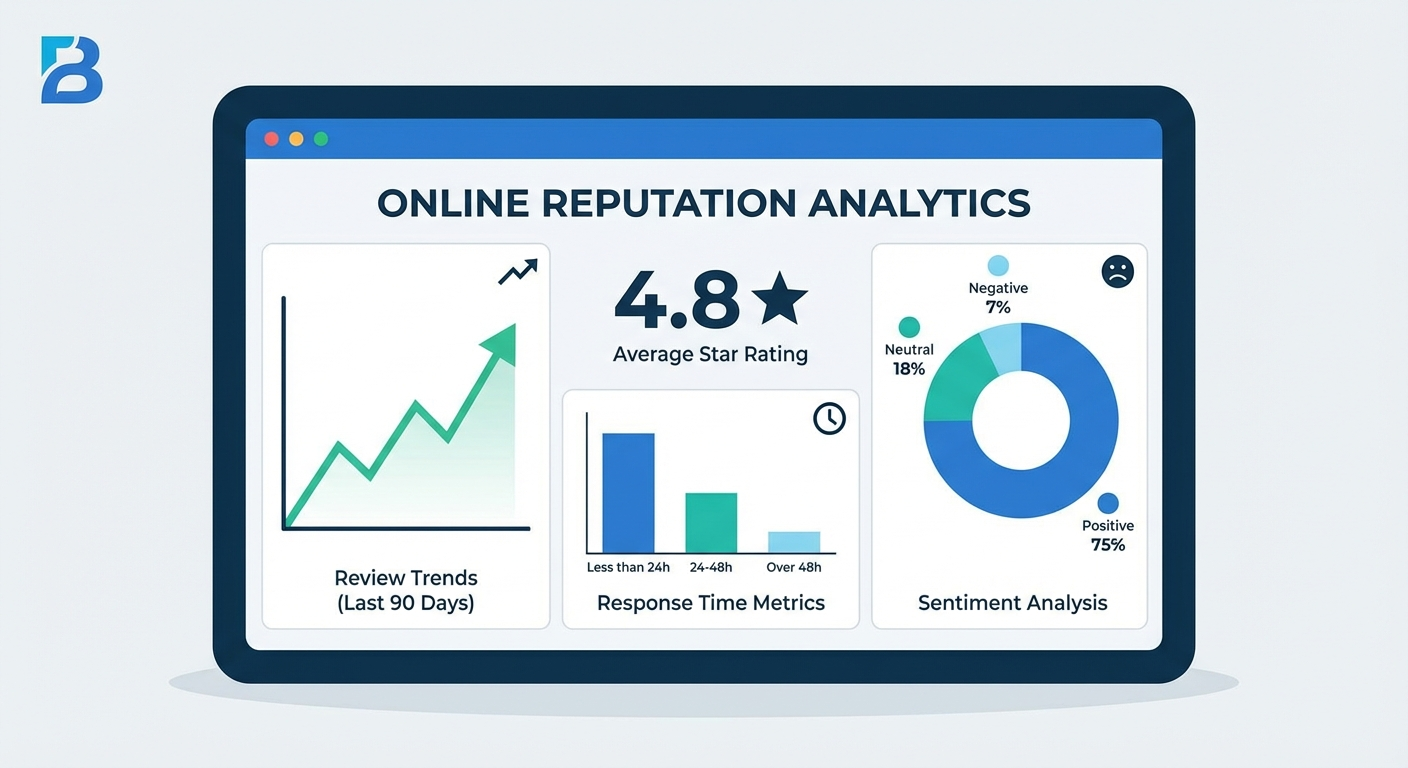
Measuring Your Reputation Health
Track these metrics monthly to gauge progress:
| Metric | What It Tells You | Target |
|---|---|---|
| Average star rating | Overall satisfaction | 4.5+ across platforms |
| Review volume (monthly) | Consistency of review generation | 5-10+ new reviews/month |
| Response rate | How engaged you are | 100% (respond to every review) |
| Response time | How quickly you address feedback | Under 24 hours |
| Review recency | Freshness of your profile | New reviews within last 2 weeks |
| Sentiment trend | Whether satisfaction is improving or declining | Stable or improving |
If your email marketing automation already includes post-service sequences, adding a review request step gives you the consistency column for free.
Frequently Asked Questions
How do I remove a fake or unfair Google review?
You can flag reviews that violate Google’s policies (spam, fake, conflict of interest, off-topic) through your Google Business Profile. Google reviews the report and may remove it within a few days to a few weeks. However, you cannot remove a review simply because it’s negative. Focus on responding professionally and generating enough positive reviews to push it down.
How many reviews do I need to look credible?
There’s no magic number, but research suggests a minimum of 10-15 reviews to establish initial credibility, with 40+ reviews creating a strong competitive advantage. More importantly, reviews should be recent—a business with 20 reviews from the past 3 months looks more trustworthy than one with 100 reviews that stopped 2 years ago.
Should I respond to every single positive review?
Yes. Responding to positive reviews encourages more customers to leave feedback, signals to Google that your profile is active, and builds a sense of community around your brand. Keep responses genuine and varied—mention specific details when you can, and thank the reviewer by name.
Can negative reviews actually help my business?
Paradoxically, yes. A profile with exclusively 5-star reviews can look suspicious to savvy consumers. A few lower ratings mixed with thoughtful responses demonstrate authenticity and show how you handle problems. The key is how you respond—a professional, empathetic reply to criticism often impresses potential customers more than the negative review deters them.
Your online reputation is working for you or against you right now—there’s no neutral. The businesses that actively manage their reputation consistently outperform those that leave it to chance. Start with a 30-minute audit this week, respond to every outstanding review, and build a system that generates new ones automatically. Talk to our team about setting up automated reputation management for your business, or explore our automation services to see how we can help you build a 5-star presence that grows on autopilot.