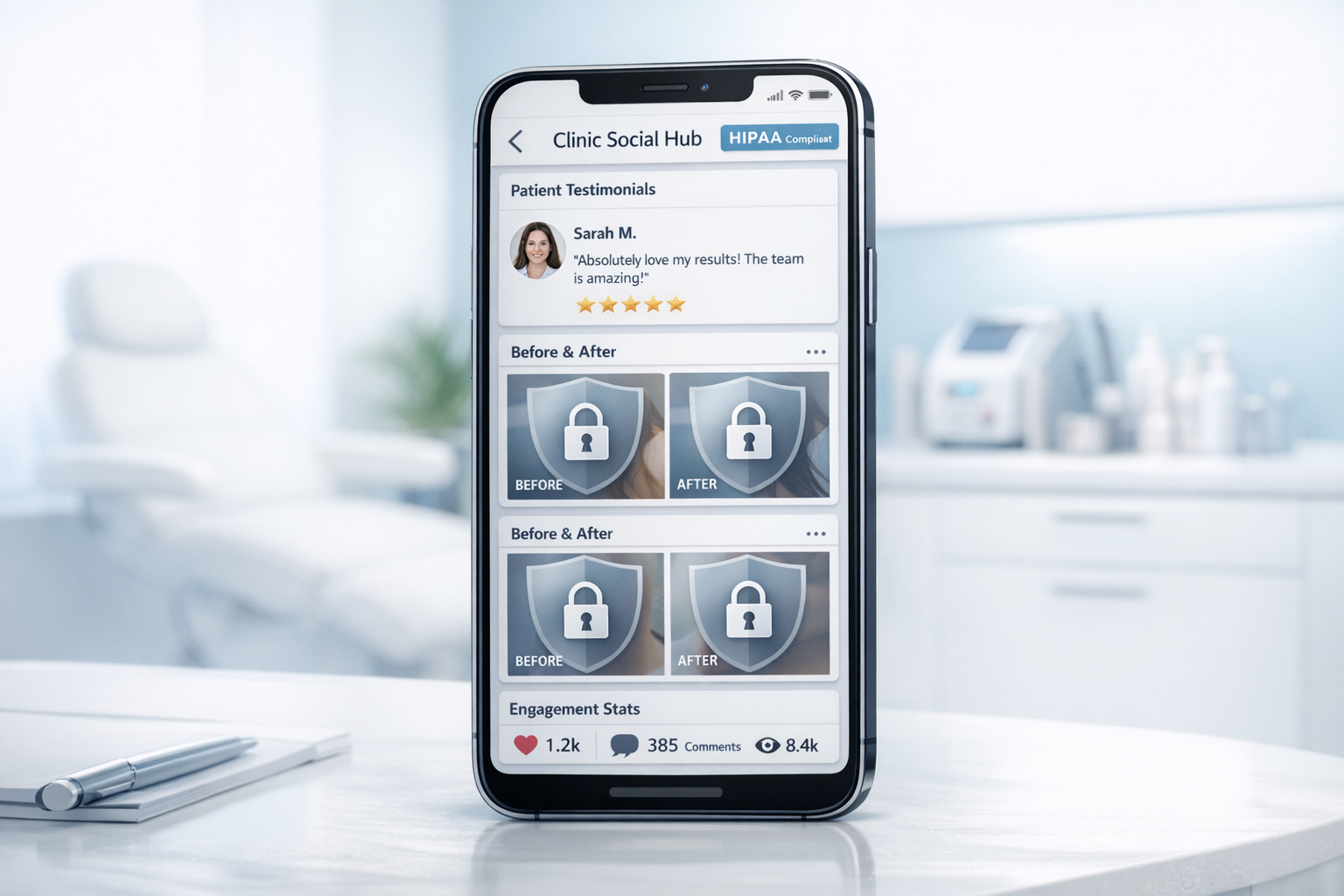
Your competitor just posted a stunning rhinoplasty transformation on Instagram. The comments are flooding in. The consultation requests are piling up. And you’re sitting there wondering: can I even do that without getting fined?
You’re right to be cautious. A single HIPAA violation from a social media post can cost your practice between $100 and $50,000 per incident—with annual maximums reaching $1.5 million. In 2024 alone, the HHS Office for Civil Rights settled multiple cases involving social media-related PHI disclosures by healthcare providers.
But here’s what most practice owners get wrong: HIPAA doesn’t prohibit social media marketing. It prohibits careless social media marketing. The practices that are growing fastest on Instagram, TikTok, and Facebook aren’t ignoring compliance—they’ve built systems that make compliant posting effortless. This guide shows you exactly how to do the same.
What HIPAA Actually Says About Social Media
HIPAA-compliant social media marketing means promoting your aesthetic practice on platforms like Instagram, Facebook, and TikTok while fully protecting patient health information (PHI). It requires written patient authorization before sharing any identifying content, securing all digital communications, and training every team member who touches your social accounts. Violations can result in fines up to $1.5 million per incident category per year.
Let’s clear up the biggest misconception first: HIPAA doesn’t mention social media. The law was written in 1996, before most platforms existed. What HIPAA does regulate is the use and disclosure of protected health information (PHI)—and that applies regardless of the medium.
What Counts as PHI on Social Media?
PHI includes any individually identifiable health information. On social media, this means:
- Patient photos — Even without a name attached, a face is identifying information
- Treatment details — “Our patient just had her third Botox session” reveals health information
- Appointment confirmations — Replying “See you Tuesday for your consultation!” on a public post
- Before-and-after images — Unless you have explicit written authorization
- Comments and DMs — Responding to a patient’s question about their treatment publicly
- Check-ins and tags — A patient tagging your clinic doesn’t give you permission to discuss their care
The Authorization Requirement
The key distinction: patients can share their own health information freely. If a patient posts their own before-and-after photos and tags your practice, that’s their right. But you cannot confirm, comment on, or amplify that post in a way that acknowledges them as a patient without written authorization.
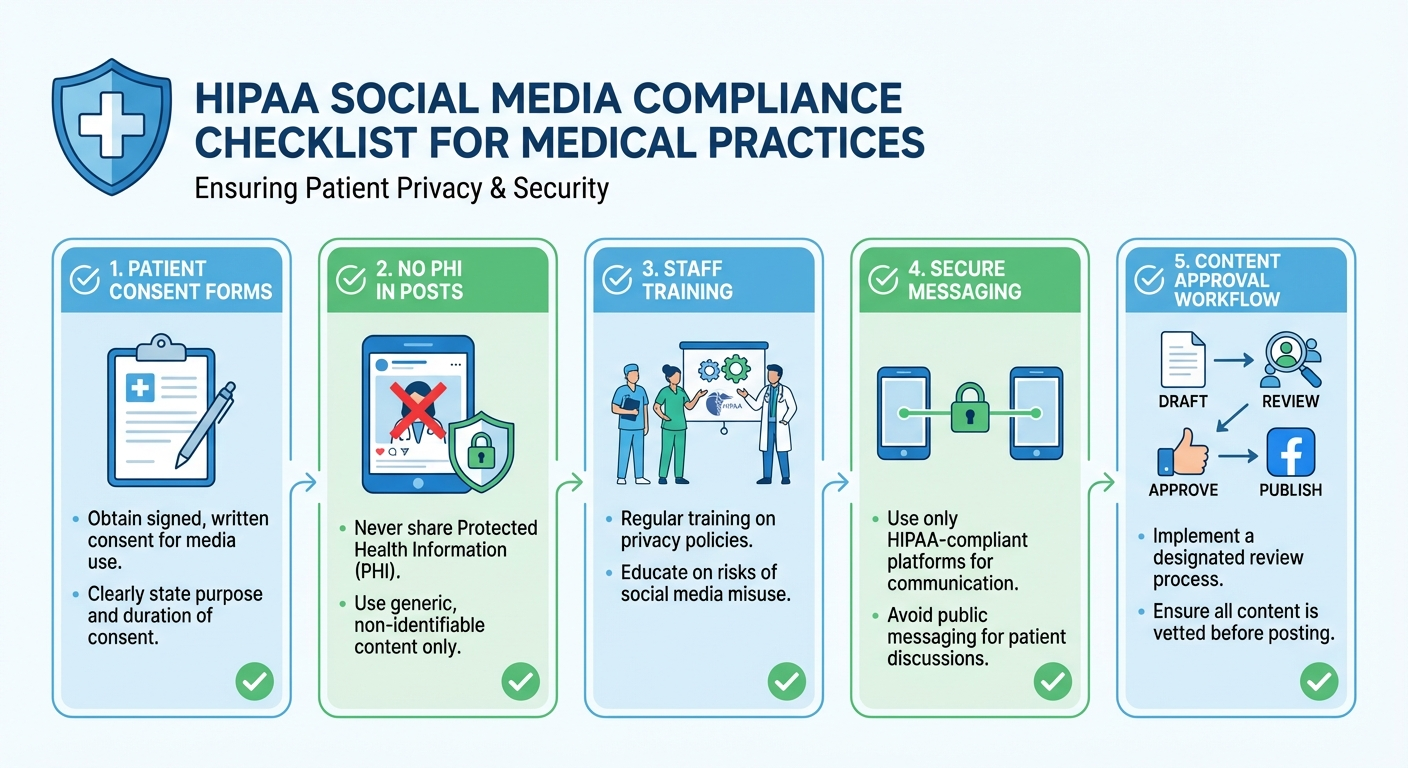
This authorization must be:
- Written and signed — Verbal consent is not sufficient
- Specific — It should detail exactly what will be shared and on which platforms
- Voluntary — You cannot make treatment contingent on signing
- Revocable — Patients can withdraw consent at any time
Building Your HIPAA-Compliant Content Strategy
Now that you understand the rules, let’s build a content strategy that works within them—and actually drives consultations.
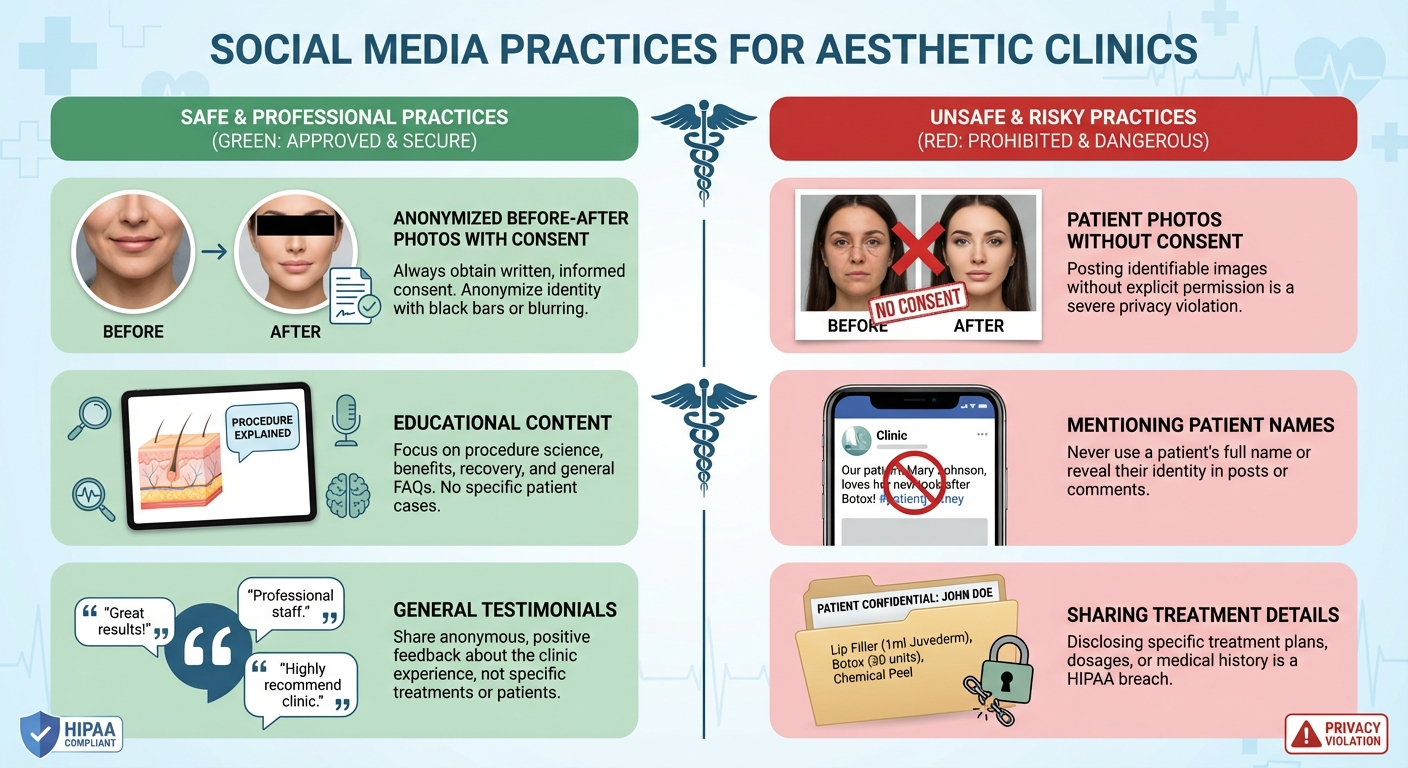
Content That’s Always Safe
Some content types carry virtually zero HIPAA risk. Start here:
- Educational content — “5 Things to Consider Before a Facelift” teaches without revealing patient info
- Procedure explainers — Walk through what a treatment involves using illustrations or stock imagery
- Team spotlights — Introduce your surgeons, nurses, and staff. Patients book with people they trust
- Facility tours — Showcase your clean, modern practice. A quick video walkthrough builds confidence
- Industry news — Comment on new techniques, FDA approvals, or treatment innovations
- General testimonials — “Our patients love their results” without identifying anyone specific
Content That Requires Authorization
These high-performing content types need explicit written consent:
- Before-and-after photos — The gold standard for aesthetic marketing, but requires a signed media release
- Patient testimonials with identity — Video or written testimonials where the patient is identifiable
- Treatment journey content — Following a patient through their experience (with detailed consent)
- Case studies — Detailed procedure outcomes with patient-identifiable information
The Media Release Form
Your media release should be a separate document from your general consent forms. Include:
- Specific platforms where content will appear (Instagram, Facebook, website, etc.)
- Types of content authorized (photos, video, written testimonials)
- Duration of authorization (or specify indefinite with right to revoke)
- Right to revoke and the process for doing so
- No-coercion statement confirming the patient’s decision is voluntary
Pro tip: Create a streamlined digital consent workflow using a tablet at check-in. Patients are more likely to consent when the process is quick and professional—not when you’re chasing them with a clipboard post-procedure.
Platform-Specific Compliance Strategies
Each social media platform has unique features that create different compliance considerations. Here’s how to navigate the major ones.
Instagram is the dominant platform for aesthetic practices, and for good reason—it’s visual, high-engagement, and where your prospective patients are spending their time.
Safe practices:
- Use a business account with controlled comments and DM settings
- Never respond to comments or DMs that reveal patient status
- Use Instagram Stories for educational content (they disappear but can be screenshotted—keep them compliant)
- Create Highlights for procedure categories using compliant content
- Use Reels for short educational videos and facility tours
Common mistakes:
- Replying to a comment with “Thanks for choosing us for your procedure!” — this confirms patient status
- Reposting a patient’s story without written authorization
- Using Instagram’s “Close Friends” feature to share patient content (it’s still disclosure)
Facebook’s group and review features create unique challenges.
Safe practices:
- Set your page to review comments before they’re public
- Create a standard response template for reviews that doesn’t confirm treatment details
- Use Facebook Groups for general education, not patient discussion
- Leverage Facebook Ads with compliant creative (educational content, general results)
Watch out for:
- Patient reviews that mention specific treatments — you can thank them for the review without confirming details
- Facebook’s automatic “memories” or “on this day” features with tagged content
- Staff members sharing patient-related content on personal accounts
TikTok
TikTok’s algorithm rewards authentic, educational content—which happens to be the safest type for HIPAA compliance.
Winning strategies:
- “Day in the life” content showing your practice (without patients in treatment)
- Myth-busting videos about common procedure misconceptions
- Educational content explaining techniques, recovery timelines, and expectations
- Trending audio with compliant visuals
Avoid:
- Filming in treatment rooms with patients present (even in the background)
- Reacting to patient-submitted content that identifies them
- Live streams where patients might appear unexpectedly
Staff Training: Your Biggest Vulnerability
Here’s an uncomfortable truth: most social media HIPAA violations come from well-meaning staff, not malicious intent. A front desk coordinator snaps a photo of a happy post-op patient and shares it to the practice’s Instagram story. An aesthetician responds to a Facebook comment confirming a patient’s appointment. A nurse shares a “transformation Tuesday” post using a patient photo from their personal phone.
None of these people intended to violate HIPAA. All of them did.
What Every Team Member Must Know
Every person with access to your social media accounts—or who might create content—needs training on:
- What constitutes PHI — Go beyond the obvious. A face is PHI. A voice is PHI. An appointment confirmation is PHI
- The authorization process — Who can obtain consent, where forms are stored, how to verify consent before posting
- Comment and DM protocols — Exactly how to respond (and not respond) to patient interactions online
- Personal vs. professional accounts — Staff cannot share patient information on personal social media either
- Incident reporting — What to do if someone accidentally posts something non-compliant (hint: delete immediately, report to privacy officer, document everything)
Creating a Social Media Policy
Document your practice’s social media policy in writing. Key elements:
- Approved posters — Name the specific people authorized to post on practice accounts
- Content approval workflow — Who reviews content before it goes live?
- Response templates — Pre-approved language for common comment and DM scenarios
- Personal account guidelines — What staff can and cannot share about work
- Breach protocol — Step-by-step response if a violation occurs
The Content Calendar That Works
Consistency drives social media growth, and a structured content calendar keeps you compliant by planning ahead rather than posting reactively.
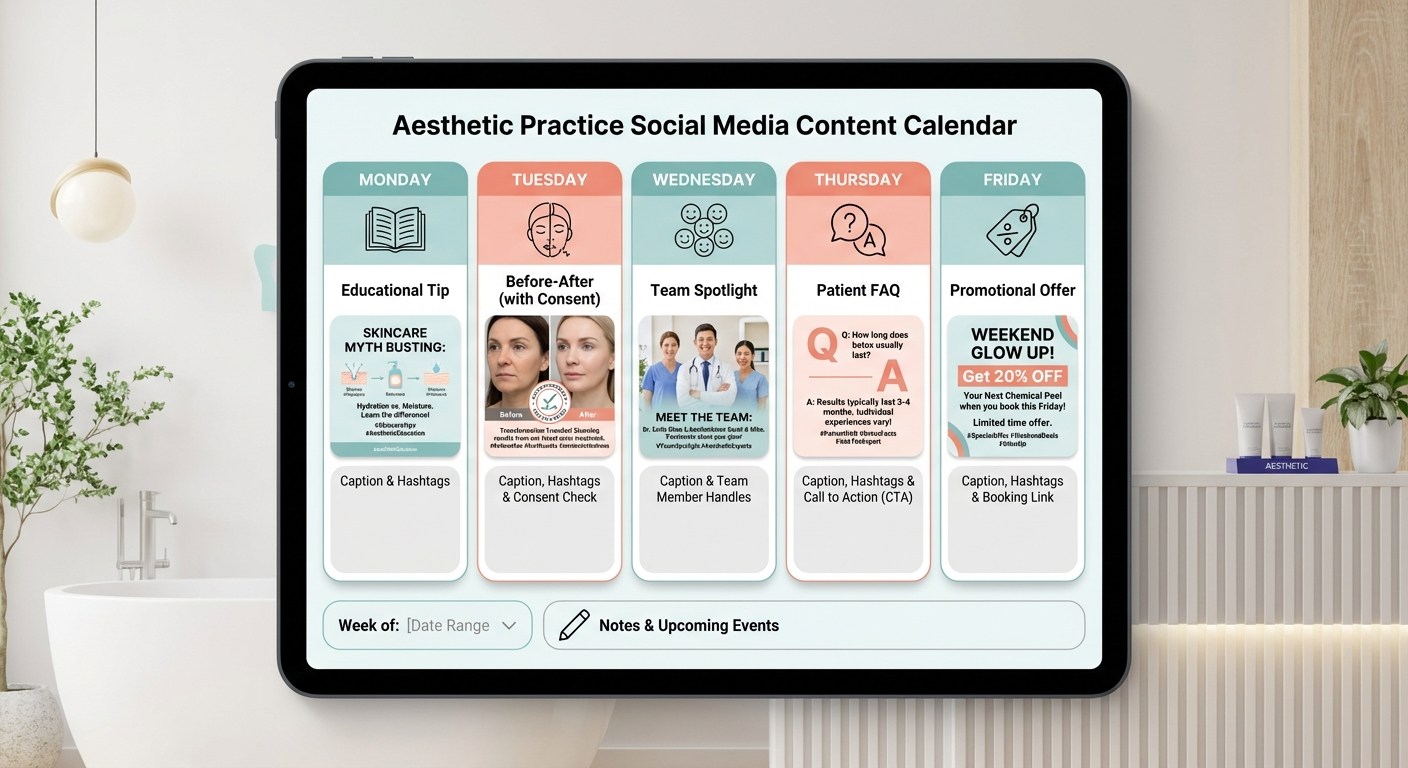
A Sample Weekly Framework
| Day | Content Type | HIPAA Risk | Example |
|---|---|---|---|
| Monday | Educational tip | Low | ”3 questions to ask during your facelift consultation” |
| Tuesday | Before/after (with consent) | Medium | Authorized patient transformation with media release on file |
| Wednesday | Team spotlight | None | ”Meet Dr. Rivera, our board-certified plastic surgeon” |
| Thursday | FAQ / Myth-busting | Low | ”Does rhinoplasty hurt? Here’s what to actually expect” |
| Friday | Behind the scenes | Low | Facility tour, equipment showcase, or team culture content |
| Saturday | Patient testimonial (with consent) | Medium | Authorized video or quote testimonial |
Batch Content Creation
Block out one day per month for content creation:
- Photograph 3-5 consented patients — Build a library of authorized before/after content
- Film 4-8 educational clips — Short videos that can be repurposed across platforms
- Write caption templates — Draft and approve captions in advance
- Schedule 2-4 weeks ahead — Use a scheduling tool so nothing goes out without review
This approach means your daily social media takes 15 minutes of posting and engagement instead of hours of content creation.
Automating Compliance Without Killing Engagement
Manual compliance checking doesn’t scale. As your social media presence grows, you need systems.
Content Approval Workflow
Build a simple but enforceable process:
- Content creator drafts post (staff member, marketing coordinator, or agency)
- Compliance check — Does the content include any PHI? Is authorization on file for any identifiable patients?
- Designated reviewer approves — One or two authorized people give final sign-off
- Schedule and publish — Only after approval
- Post-publish monitoring — Watch comments and DMs for compliance issues
Tools That Help
- Social media management platforms (Hootsuite, Sprout Social) — Built-in approval workflows before publishing
- Consent management systems — Digital authorization forms with searchable databases
- Comment moderation — Auto-hide comments containing keywords that might indicate PHI
- AI-powered monitoring — Flag potential compliance issues in real time
Our automation services can help you build a content workflow that keeps compliance checks running in the background so your team can focus on creating great content.
Measuring Results Without Compromising Privacy
You need to track what’s working—but even analytics can create compliance concerns if you’re not careful.
Safe Metrics to Track
- Engagement rate — Likes, comments, shares, and saves per post
- Follower growth — Tracking audience growth over time
- Website traffic from social — Use UTM parameters to track clicks to your consultation page
- Consultation requests — Track how many inquiries mention social media as their source
- Content performance by type — Which content categories drive the most engagement?
What NOT to Track Publicly
- Don’t share patient conversion data that could identify individuals
- Don’t post about specific patient outcomes tied to social media campaigns
- Don’t screenshot DM conversations (even positive ones) without consent
The Metrics That Matter Most
For aesthetic practices, vanity metrics like follower count matter less than:
- Cost per consultation booked from social media
- Consultation-to-procedure conversion rate from social leads
- Patient lifetime value of social media-sourced patients
- Content types that drive the highest quality leads
Common Mistakes That Get Practices in Trouble
Learn from others’ expensive errors:
Mistake #1: The “Thank You” Reply
A patient leaves a glowing Google or Facebook review mentioning their procedure. A well-meaning staff member replies: “Thank you, Sarah! We’re so glad your tummy tuck turned out beautifully!”
The problem: The practice just confirmed Sarah’s patient status and treatment details publicly.
The fix: Use a generic response: “Thank you for your kind words! We’re committed to exceptional results for everyone who walks through our doors.”
Mistake #2: The Unauthorized Before/After
A practice posts an incredible rhinoplasty transformation. The patient verbally said it was fine. No written consent on file.
The problem: Verbal consent doesn’t satisfy HIPAA. If the patient later objects, the practice has no legal protection.
The fix: Always obtain written authorization before sharing. No exceptions.
Mistake #3: The Background Patient
A staff member films a TikTok in the waiting room. In the background, a patient is visible checking in.
The problem: Being present at a medical facility can imply patient status—especially a specialty practice.
The fix: Film in controlled spaces. If patients might appear in the background, either clear the area or get everyone’s consent.
Mistake #4: The Oversharing Employee
A nurse posts on her personal Instagram: “Just assisted on the most amazing Brazilian butt lift! My patient is going to love her results 🍑”
The problem: Even without naming the patient, this could be identifying in context (the nurse’s followers may know who was scheduled that day).
The fix: Social media policy must explicitly cover personal accounts. Staff should never reference specific patient procedures, even anonymously.
Getting Started This Week
You don’t need to overhaul everything overnight. Here’s your four-week implementation plan:
Week 1: Foundation
- Draft or update your social media policy
- Create a HIPAA-compliant media release form
- Audit existing social media content for potential violations
Week 2: Training
- Conduct a 60-minute staff training session
- Assign designated social media posters and approvers
- Set up comment moderation on all platforms
Week 3: Content System
- Build your first month’s content calendar
- Schedule a batch content creation day
- Set up a content approval workflow (even a simple shared document works)
Week 4: Launch and Monitor
- Begin posting with your new compliant workflow
- Monitor comments and DMs daily
- Review your first week’s engagement data and adjust
Frequently Asked Questions
Can I repost a patient’s social media post about my practice?
Only with explicit written authorization. Even though the patient chose to share publicly, your reposting constitutes a disclosure by a covered entity. Get a signed media release that specifically covers reposting on your practice accounts before sharing.
Do HIPAA rules apply to my practice’s social media DMs?
Yes. Direct messages discussing patient care, treatment plans, or health information are subject to HIPAA. Use DMs only to direct patients to secure communication channels. Never discuss specific treatments, diagnoses, or health details via social media messaging.
What should I do if a staff member accidentally posts PHI on social media?
Delete the content immediately, document the incident with screenshots and timestamps, notify your HIPAA privacy officer, and follow your breach notification procedures. If the disclosure affected more than 500 individuals, you must notify HHS within 60 days.
Are stock photos of models safe to use for before-and-after content?
Stock photos are safe from a HIPAA perspective since they don’t involve actual patients. However, using stock photos as fake before-and-afters is misleading and could violate FTC guidelines and state medical advertising laws. Label stock imagery clearly as illustrative.
Social media is one of the most powerful marketing channels for aesthetic practices—but only when you get the compliance piece right. The good news is that building a HIPAA-compliant social media system isn’t about restricting your marketing. It’s about creating a sustainable framework that lets you post confidently, grow your audience, and convert followers into consultations without the constant anxiety of a potential violation.
Need help building a compliant social media automation system for your practice? Get in touch with our team to discuss how we can streamline your content workflow while keeping patient privacy protected. You might also want to explore our guide on building before-and-after galleries that win new patients or learn about patient review management strategies that complement your social media efforts.