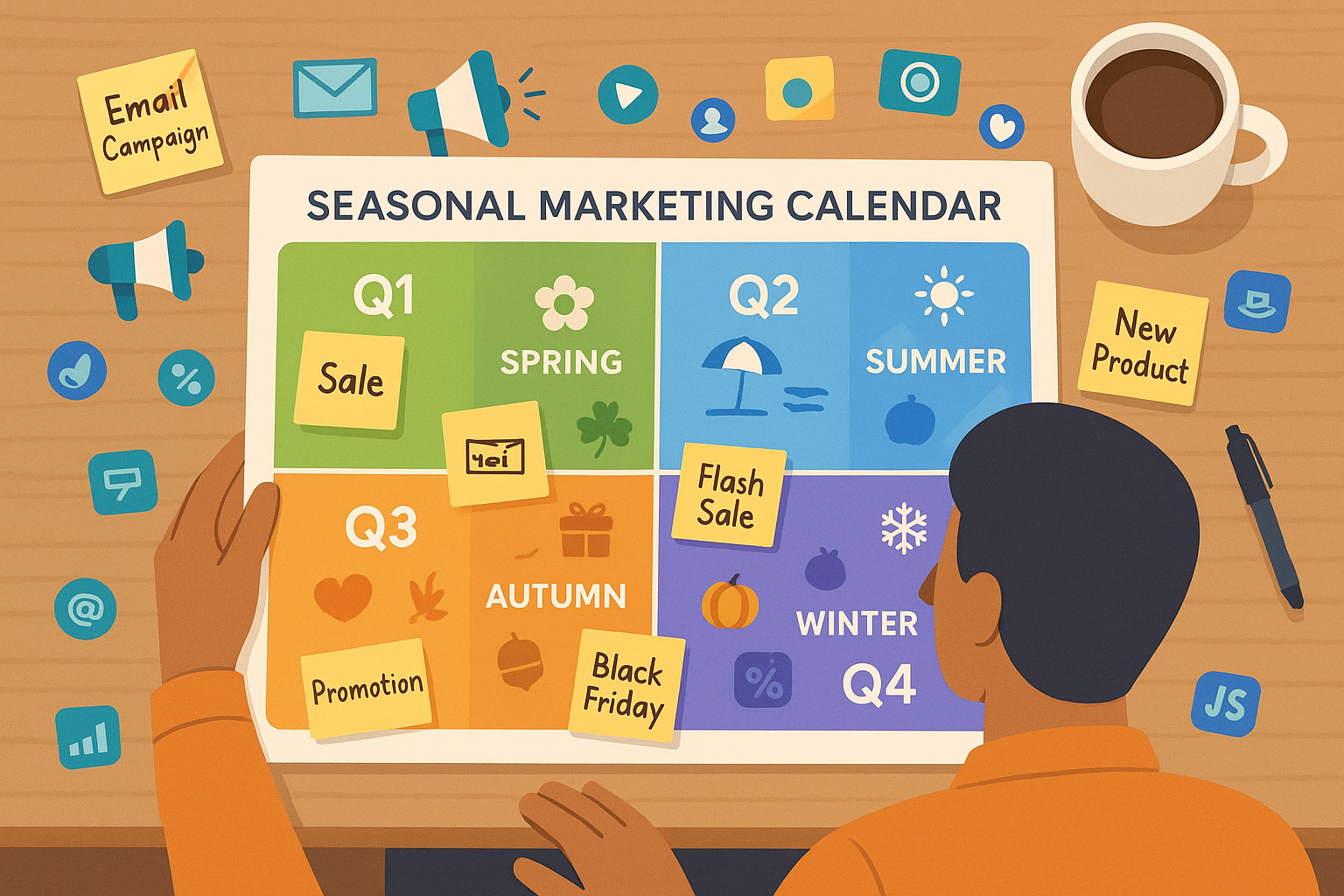
Most small business marketing is reactive. A slow week hits, you throw together a last-minute promo, blast it to your list, and hope for the best. It works sometimes—but it’s exhausting, inconsistent, and leaves serious revenue on the table.
A seasonal marketing calendar changes the game. Instead of scrambling, you’re working ahead. Instead of guessing what to promote, you’re capitalizing on the moments your customers are already primed to buy. The businesses that consistently outperform their local competitors aren’t necessarily spending more—they’re planning more.
This guide walks you through building a seasonal marketing calendar that actually gets used, from the key dates that matter to the campaign types that convert.
Why Seasonal Marketing Outperforms Random Campaigns
There’s a reason retailers start planning holiday campaigns in July. Consumer spending patterns are deeply tied to the calendar. People spend more in November and December. They invest in themselves in January. They buy gifts in February and May. They spend on home and outdoor in spring. They treat themselves and others according to a rhythm that repeats every year.
Seasonal campaigns work because they align with existing intent rather than trying to create it from scratch. When your marketing meets a customer at the moment they’re already in a buying mindset—Valentine’s Day gift ideas, New Year’s resolution services, back-to-school season—the conversion rate is dramatically higher than interrupting them with an offer they weren’t looking for.
Beyond conversion rates, a calendar gives you:
Consistency. Customers see you regularly throughout the year, not just when you’re desperate for business. Consistent visibility builds the mental availability that drives customers back when they’re ready to buy.
Content planning clarity. When you know April is spring transformation season, you know what emails, social posts, and SMS messages you need to create—weeks in advance, not hours before.
Better margins. Last-minute campaigns mean rushed execution, cut corners, and often, steep discounts just to move volume. Planned campaigns let you optimize offers, test creatives, and build anticipation that supports full-price selling.
Staff alignment. Your team can prepare for busy periods rather than being blindsided by them. Better prep means better customer experience, which means better reviews.
The Seasonal Framework: How to Think About Your Year
Break your year into four marketing quarters, each with distinct consumer psychology:
Q1 (January–March): Fresh Starts and Self-Investment
January brings the highest search volume of the year for self-improvement, wellness, fitness, and personal transformation. Consumers are motivated, aspirational, and primed for services that help them become who they want to be.
What works: New Year offers, “invest in yourself” messaging, transformation packages, goal-setting content.
Who benefits most: Fitness studios, wellness clinics, med spas and aesthetic practices, coaches and consultants, dental practices, hair salons.
February is Valentine’s Day season—the second highest gifting holiday of the year. Don’t overlook gift cards, couples packages, and “treat yourself” messaging that extends Valentine’s beyond romantic gifts to self-care.
March brings spring awareness (St. Patrick’s Day, first day of spring, spring break) and a natural sense of renewal.
Q2 (April–June): Spring Energy and Warm-Season Prep
Spring is when consumers start investing in appearance and experience for the warmer months ahead. Outdoor services ramp up. People start thinking about summer bodies, summer wardrobes, summer travel.
What works: Spring refresh offers, outdoor and home improvement promotions, pre-summer transformation packages, Mother’s Day campaigns (the third highest gifting holiday of the year).
Who benefits most: Aesthetic practices, fitness, landscaping, home services, retail, restaurants.
Memorial Day weekend launches the summer spending season—it’s an excellent anchor for a sale event.
Q3 (July–September): Summer Momentum and Fall Preview
Mid-summer is often slower for service businesses as families travel and routines shift. Smart businesses use this period for referral campaigns, loyalty reward redemptions, and content that builds anticipation for fall.
What works: Customer appreciation events, referral campaigns, summer flash promotions, “back to school” prep.
August and September bring back-to-school energy even for consumers without kids—it’s a psychological “fresh start” moment. Labor Day is another reliable anchor for end-of-summer promotions.
Q4 (October–December): Peak Season and Holiday Campaigns
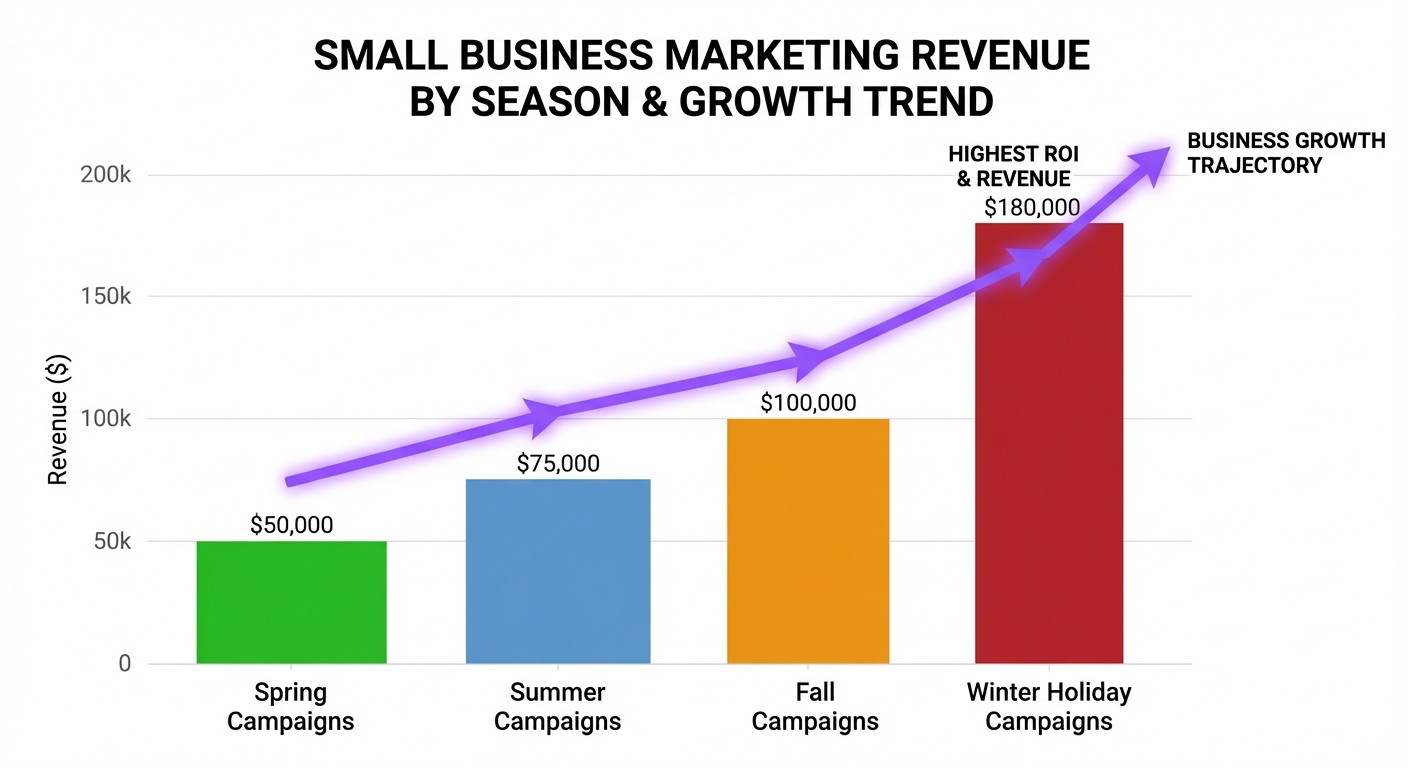
The highest-revenue quarter for most consumer businesses. Halloween, Thanksgiving, Black Friday/Small Business Saturday, and the full December holiday season create a sustained period of elevated spending and gifting intent.
What works: Halloween promotions (October), Thanksgiving gratitude content and “early holiday” deals, Black Friday/Cyber Monday offers, holiday gift guide content, December booking pushes, gift card campaigns.
Critical note: Don’t wait until December to launch your holiday marketing. Start in October. Customers who plan ahead—and the ones who spend the most—are making decisions before Thanksgiving.
The 20 Dates Every Local Business Should Plan For
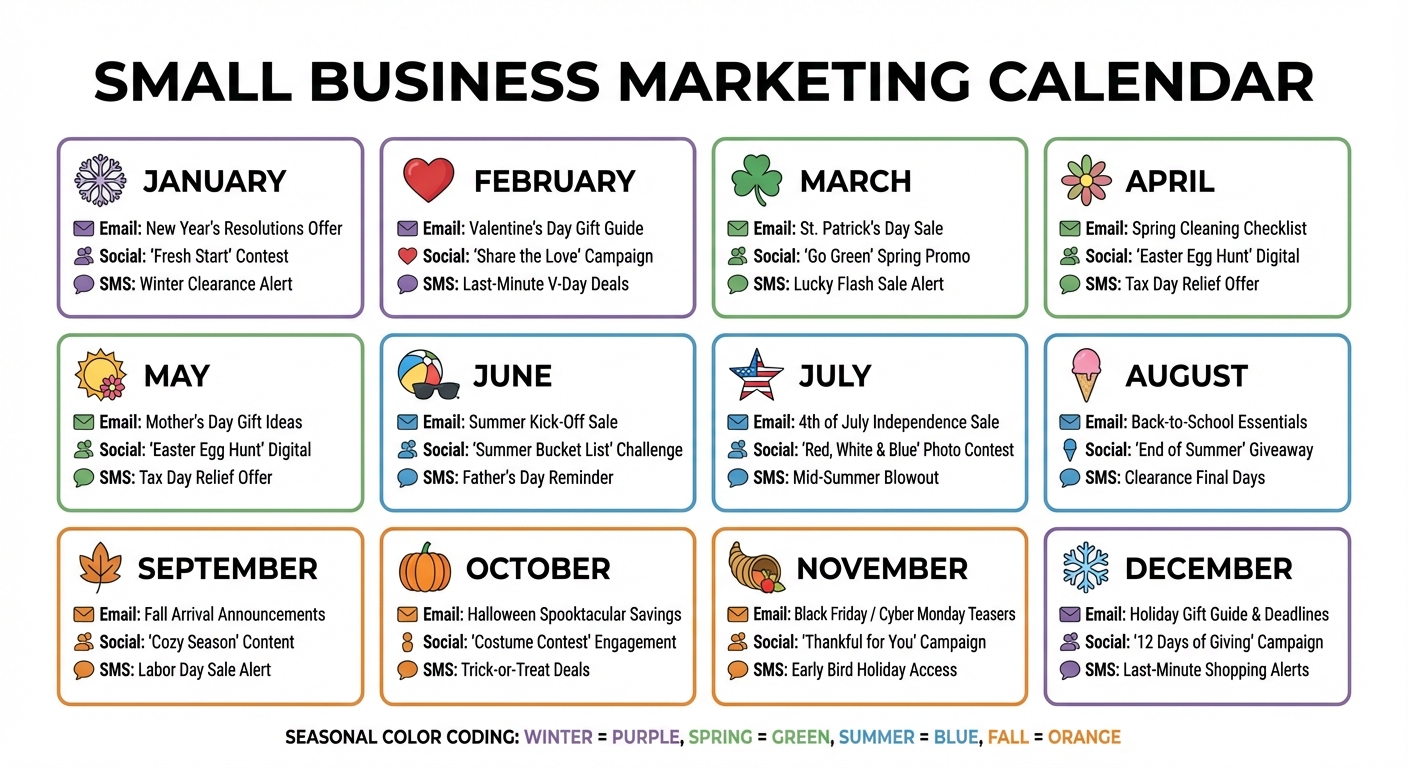
Not every holiday is worth a campaign. Focus on dates with proven consumer spending behavior and relevance to your business type:
| Date | Campaign Opportunity | Business Types |
|---|---|---|
| Jan 1–15 | New Year transformation offers | Wellness, fitness, aesthetics, dental |
| Feb 14 | Valentine’s Day gifts/packages | Any service, retail, restaurants |
| Mar 1 | Spring “fresh start” promotions | Home, beauty, wellness, apparel |
| Apr 1–30 | Earth Day, spring cleaning, spring looks | Home services, outdoor, beauty |
| 2nd Sun in May | Mother’s Day gift cards and packages | Spa, salon, aesthetics, restaurants |
| May 26 | Memorial Day weekend sale | Retail, food & bev, outdoor |
| 3rd Sun in June | Father’s Day (under-leveraged by most) | Any business with male audience |
| Jul 4th | Independence Day weekend | Food, outdoor, retail |
| Aug–Sep | Back to school / late summer refresh | Apparel, education, services |
| Sep 1 | Labor Day end-of-summer sale | Retail, home, outdoor |
| Oct 1–31 | Halloween/fall aesthetic | Beauty, aesthetics, retail, food |
| Nov 1 | Pre-holiday “shop early” messaging | Any business |
| Nov 28 | Black Friday sale | Retail, services, gift cards |
| Nov 29 | Small Business Saturday | All local businesses |
| Dec 1–15 | Gift card push + holiday packages | Any service-based business |
| Dec 26–31 | ”Treat yourself” + New Year preview | Wellness, aesthetics, fitness |
Pro tip: Local and regional events often outperform national holidays for truly local businesses. Festivals, farmers markets, neighborhood events, high school sports playoffs—align your campaigns with what your community actually cares about.
Building Your Calendar: A Step-by-Step Process
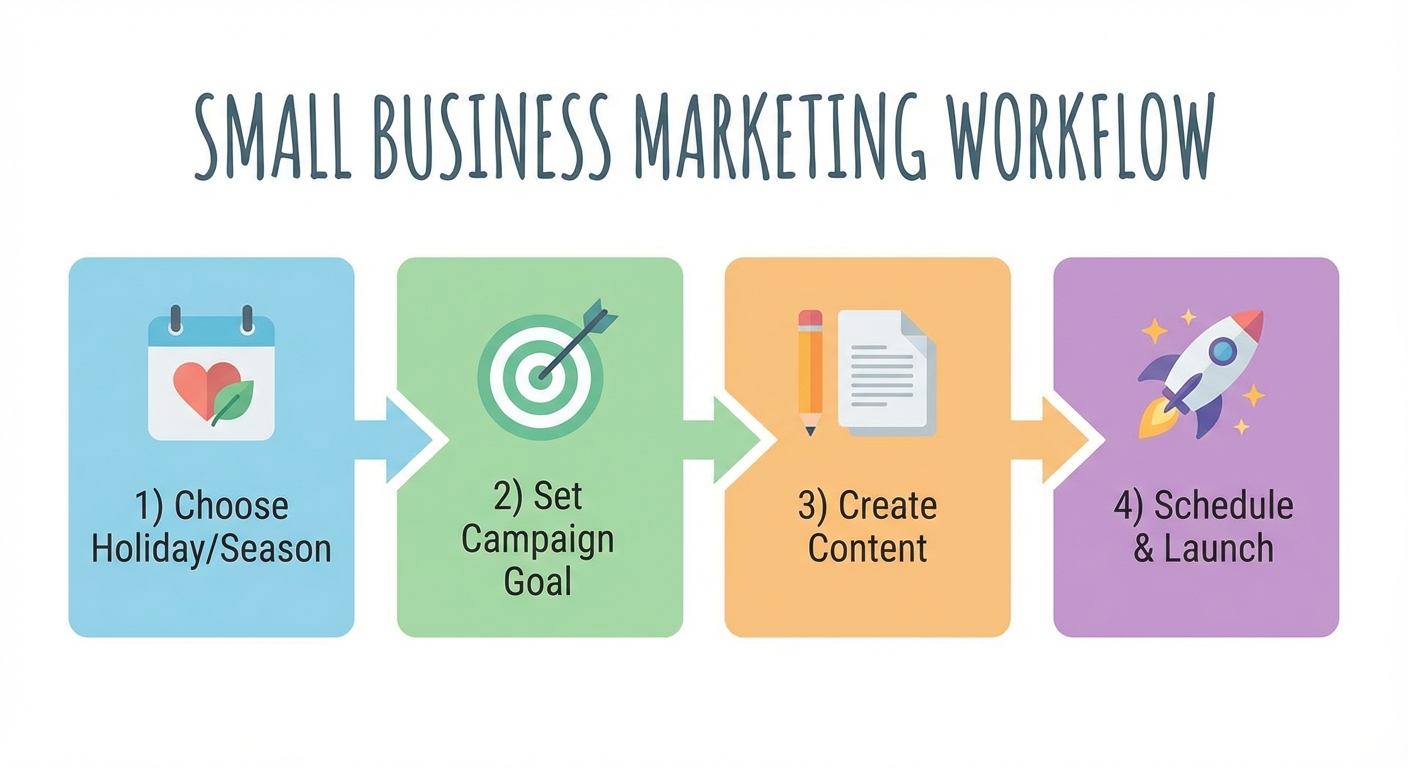
Step 1: Anchor Your Year with 8–12 Campaign Dates
Start with a blank 12-month grid. Pick 8–12 dates you’ll plan campaigns around. Don’t try to do everything—you’ll burn out and produce mediocre work. Pick the dates most relevant to your business type and customer base.
For a med spa: New Year’s (January), Valentine’s Day (February), Mother’s Day (May), summer body prep (June), fall/harvest season (October), holiday gift cards (December).
For a restaurant: Valentine’s Day, Mother’s Day, Father’s Day, summer patio season, Thanksgiving, holiday parties (December), New Year’s Eve.
For a home services business: Spring prep (March), summer exterior season (May–June), hurricane prep (if Florida), fall maintenance (September), pre-holiday repairs (November).
Step 2: Work Backward from Each Date
Every campaign needs lead time. For major holidays, you need to be in front of customers before they’ve already made their plans. Use this rough timeline:
- 8 weeks before: Decide offer, messaging angle, and creative direction
- 6 weeks before: Create assets (email graphics, social posts, landing page or booking link)
- 4 weeks before: Start early awareness content (social posts, blog, teaser email)
- 2 weeks before: Main campaign launch (email blast, paid ads, SMS)
- 1 week before: Urgency push (last chance messaging, countdown)
- Day of: Day-of reminder for subscribers
For smaller campaigns (flash sales, local events), a 2–3 week runway is enough.
Step 3: Choose Your Channels for Each Campaign
Not every campaign needs every channel. Decide upfront what you’re deploying for each date:
- Email: Core channel for every campaign—low cost, high control, reaches your existing audience
- SMS: High urgency campaigns, appointment reminders, day-of pushes (see our SMS marketing guide)
- Social media: Awareness and brand-building; schedule posts in advance to avoid scrambling
- Paid ads: When you want to reach beyond your existing audience; tie Google/Meta ads to your highest-value seasonal offers (more on local advertising strategy here)
- In-store/in-office: Table tents, signage, front desk conversations—don’t neglect the people already in your building
- Google Business Profile: Update your business description, post seasonal offers directly on your GBP listing (here’s how to optimize your GBP for local visibility)
Step 4: Plan Your Offer Structure
Seasonal campaigns work best when the offer matches the seasonal psychology. Some frameworks:
Transformation offers (Q1 and spring): Package deals or series of treatments that promise a before/after result by a specific date. “Get ready for summer by June 1.” Urgency and aspiration combined.
Gifting offers (Valentine’s, Mother’s Day, holidays): Gift cards, packages, and “buy for someone you love” messaging. Make it easy to gift—clear options, beautiful presentation, simple purchase flow.
Appreciation and loyalty offers (any low-demand period): Reward existing customers with early access, loyalty double-points days, or VIP pricing during your slow season. Deepens relationships when you don’t need new customers to carry the month.
Urgency-limited offers (flash sales, Black Friday): Time-limited deals that create FOMO. Keep discounts meaningful (10% moves nobody; 25–30% moves people), and be honest about expiry.
Your Monthly Planning Template
For each campaign month, answer these six questions before you do any creative work:
- What’s the seasonal moment? (Holiday, seasonal shift, local event, business milestone)
- Who’s the primary audience? (Existing customers, lapsed customers, new prospects)
- What’s the goal? (Bookings, gift card sales, product revenue, new customer acquisition)
- What’s the offer? (Discount, package, bonus, event, free add-on)
- What channels? (Email, SMS, social, paid ads, in-store)
- What does success look like? (X bookings, $X gift card revenue, X new email subscribers)
Fill this out for each of your 8–12 campaign dates before January starts. It takes maybe 2 hours—and it saves you dozens of hours of reactive scrambling throughout the year.
Tools to Manage Your Marketing Calendar
You don’t need an enterprise marketing stack. Here’s what actually works for most local businesses:
Planning and scheduling:
- Google Sheets or Notion: Free, flexible, and shareable with your team. Build a simple 12-month grid with campaign details, deadlines, and status.
- Trello or Asana: If you prefer card-based planning with assignees and due dates.
- Later or Buffer: For social media scheduling—queue your seasonal posts weeks in advance.
Email automation:
- Klaviyo, Mailchimp, or ActiveCampaign: Build your seasonal emails ahead of time, schedule them to send automatically. Connect your email sequences to your automated follow-up system so new contacts flow into your seasonal promotions automatically.
SMS:
- SimpleTexting, Postscript, or OpenPhone: Schedule seasonal SMS blasts and automate triggered messages (appointment reminders, reward alerts).
Paid ads:
- Set up your seasonal campaigns 2–3 weeks in advance in Google Ads and Meta Ads Manager. Use your campaign calendar to pre-write ad copy and design creatives, then schedule campaigns to activate and pause automatically.
Booking and CRM:
- Whatever platform you use for appointments (Vagaro, Square, Jane, etc.)—block promotional capacity before major holidays. Nothing worse than launching a Valentine’s Day campaign when you’re already booked out.
Seasonal Marketing for Aesthetic and Medical Practices
Aesthetic practices have a particularly strong seasonal marketing opportunity because their services map almost perfectly onto consumer self-investment cycles.
January: Body contouring, skin rejuvenation, and “new year, new you” packages. January is the highest-intent month for aesthetic treatments—patients who’ve been thinking about something for months finally book. Make it easy with a clear New Year offer, a streamlined consultation booking flow, and before/after content that shows what’s possible.
February: Valentine’s Day self-care and couples packages. Injectable refreshes, skin treatments, and luxury add-ons positioned as self-love gifts. Gift cards are especially powerful—many patients will buy gift cards for a friend or partner, then book themselves as well.
May–June: Pre-summer body and skin prep. Laser treatments, body contouring, CoolSculpting, facial rejuvenation—anything that shows results by summer. Create a “Summer Ready” package with a target completion date. For more on packaging services, see our treatment package marketing guide.
October: “Glow Season” — harvest aesthetics, hydration treatments, and skin prep for holiday photos. This is also when botox and filler patients start booking their holiday refresh appointments. October outreach to lapsed patients captures a significant portion of year-end revenue.
November–December: Gift card push is critical. Position gift cards as the “perfect gift that’s always the right size.” Consider a gift card bonus—“Buy a $250 gift card, get a $25 bonus card.” Also: holiday party prep (skin, lashes, hair), and pre-holiday booking campaigns for repeat patients.
HIPAA note: When automating seasonal outreach, keep email and SMS content general (don’t reference specific treatments received). Drive patients to book, not to a message that could expose protected health information. Review our HIPAA-compliant marketing practices guide before building your automation sequences.
Measuring Your Seasonal Campaign Performance
Track these metrics for every major campaign:
| Metric | What It Measures | Target Benchmark |
|---|---|---|
| Email open rate | How compelling is your subject line? | 25–40% for service businesses |
| Email click rate | Are recipients taking action? | 3–6% average |
| Bookings attributed | Direct revenue impact | Track via UTM links or ask at booking |
| Gift card revenue | Gifting campaign performance | Compare YoY |
| Revenue per campaign | Overall ROI | Set a revenue goal per campaign |
| SMS opt-out rate | Is frequency and relevance calibrated? | Under 2% per campaign |
| New customer acquisition | Are seasonal campaigns reaching new people? | Track source at intake |
After each major campaign, spend 15 minutes doing a quick debrief: What worked? What underperformed? What would you do differently? Add notes to your calendar document so next year’s version of the campaign starts from a better baseline.
The businesses that consistently improve their seasonal campaigns year over year don’t get better by accident—they track, reflect, and adjust.
Common Mistakes That Kill Seasonal Campaigns
Starting too late. The most common. If you’re writing your Valentine’s Day email on February 12, you’ve already missed the window. Customers who plan ahead—the ones who spend the most—made their decisions 2–3 weeks ago. Build the calendar, set deadlines with buffer.
Discounting when you don’t need to. Seasonal campaigns don’t require big discounts. Sometimes the campaign just needs urgency: “Book your holiday package before December 15—we fill up every year.” Create scarcity through limited availability, not always through price cuts.
Treating all holidays the same. Mother’s Day and Father’s Day are different psychologically. Valentine’s Day gifting and Valentine’s Day self-care are different audiences. Tailor the messaging to the actual intent behind the holiday, not just the date.
Ignoring your existing customers. New customer acquisition is expensive. Your seasonal campaigns should have a version for your existing list—often with better offers and earlier access. Loyal customers appreciate being treated like insiders.
No offline component. If you have a physical location, your calendar should include in-store elements: signage, front desk talking points, table card promotions. The customer standing in front of you is the easiest sale you’ll ever close.
Launching once and going quiet. A single email doesn’t make a campaign. Most people don’t act on the first message. Plan a sequence: awareness, main push, urgency reminder. Three touchpoints across two weeks outperforms one blast every time.
Your 90-Day Launch Plan
If you have no seasonal marketing calendar today, here’s how to get one running fast:
Week 1–2: Audit and anchor
- List the 6–8 holidays/seasons most relevant to your business
- Review what you did last year and what results you have
- Plot your campaign dates on a 12-month grid
Week 3–4: Build Q2 and Q3 campaigns first
- You’re starting in February/March, so Q1 campaigns may already be underway
- Build out the Mother’s Day, Memorial Day, and summer campaigns now while you have time
- Create templates for email, SMS, and social that can be reused and adapted each season
Month 2: Automate what you can
- Set up email and SMS campaign drafts in your platforms, scheduled to send on the right dates
- Connect your booking system to your campaigns with direct booking links
- Brief your front desk or team on upcoming campaigns so they can support the conversation
Month 3: Review and refine
- After your first campaign runs, do a quick debrief
- Adjust your Q3 and Q4 campaigns based on what worked
- Make sure your holiday campaign assets are ready before October (yes, October)
A seasonal marketing calendar isn’t complicated—it’s just intentional. The businesses that consistently show up at the right moment, with the right offer, to the right audience don’t have magic marketing. They have a plan.
Whether you’re running a salon, a med spa, a dental practice, or a local service business in Southwest Florida, the calendar is the same. What changes is how you show up for your specific customers on those dates.
If you’re ready to build a seasonal marketing system—from campaign planning to automation to execution—Monsoft Solutions works with local businesses and aesthetic practices to make consistent, high-performing marketing the norm, not the exception. Let’s start with a conversation.