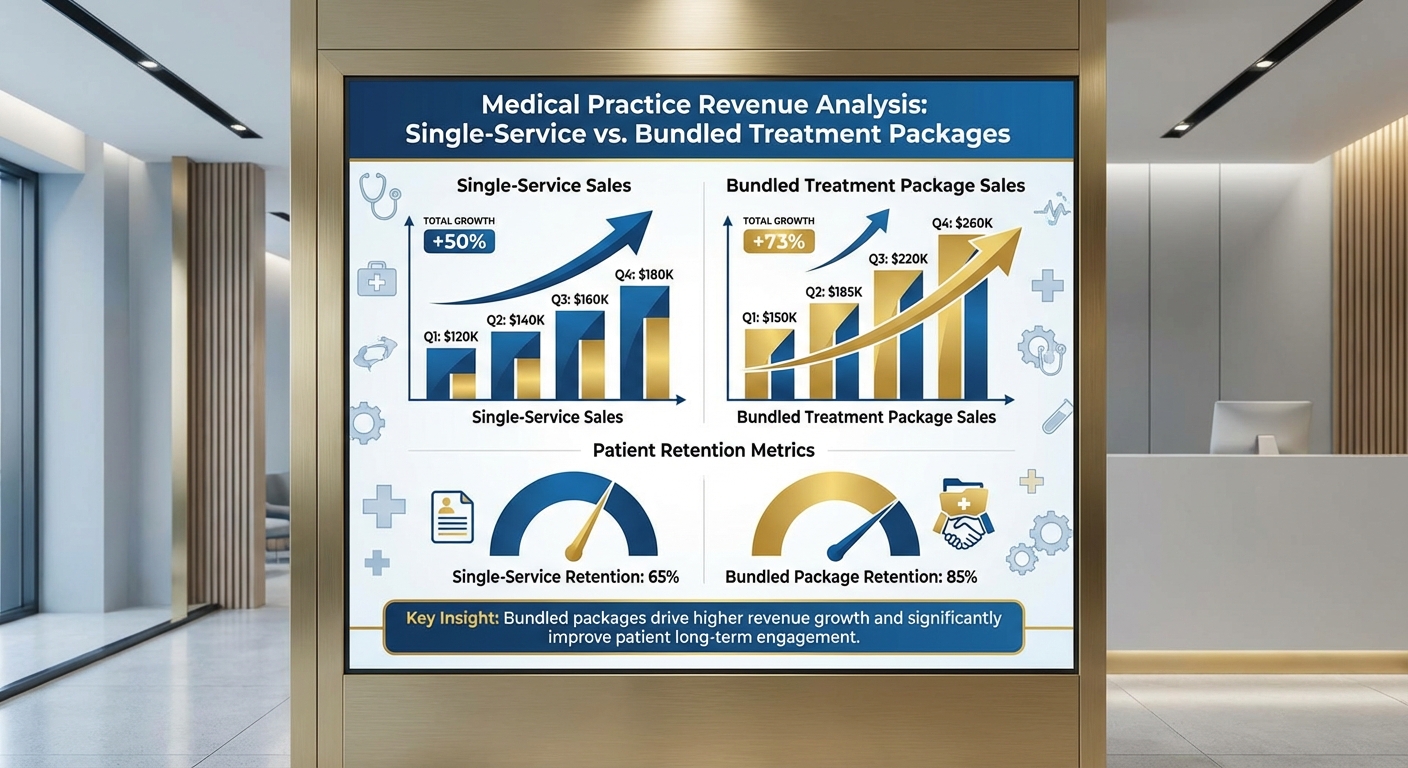
A patient who books a single Botox session is worth something. A patient who commits to a three-treatment anti-aging package, adds a monthly skincare membership, and refers two friends is worth a completely different number—often 5-10x more over the course of a year.
Treatment packages are one of the highest-leverage revenue strategies available to med spas and aesthetic practices. They increase average transaction size, improve patient retention, smooth out booking calendars, and reduce the cost of acquisition over a patient’s lifetime. And yet most practices either don’t offer them, or offer them as an afterthought buried in a price list nobody reads.
This guide covers how to design treatment packages that make sense for your practice, price them effectively, and market them in ways that actually move the needle on bookings and revenue.
Why Treatment Packages Work
Before getting into the mechanics, it’s worth understanding why patients say yes to packages—and why the economics work out for your practice.
Patients want results, not individual sessions. When someone comes in for a laser resurfacing treatment, they’re not thinking “I want one session of laser.” They’re thinking “I want smoother skin.” Most aesthetic results require a series of treatments. A package that delivers the full result is more aligned with what the patient actually wants than selling them one session at a time and hoping they rebook.
Prepayment reduces cancellation and no-show rates. A patient who has paid for a 3-session package has skin in the game. They’ve invested. No-show rates for pre-purchased packages typically run 30-50% lower than for single-session bookings—a meaningful operational improvement.
Packages create predictable revenue. A $1,500 package purchased today shows up in your revenue now, even if the treatments span three months. This smooths out seasonal volatility—something that matters a lot in Southwest Florida markets where patient volume swings significantly between snowbird season and summer.
Bundling reduces price sensitivity. Patients comparison-shop individual treatments. They’re less likely to comparison-shop a curated package with a distinctive name and a clearly defined outcome. When you bundle intelligently, you move the conversation from “how much is one unit?” to “which package is right for me?”
The Three Package Archetypes
Not all treatment packages are built the same. The most effective med spa package menus include at least two of these three archetypes:
Results-Based Packages
These packages are organized around a specific outcome the patient wants: clearing acne, reducing fine lines, treating hyperpigmentation, or achieving a particular body contouring result.
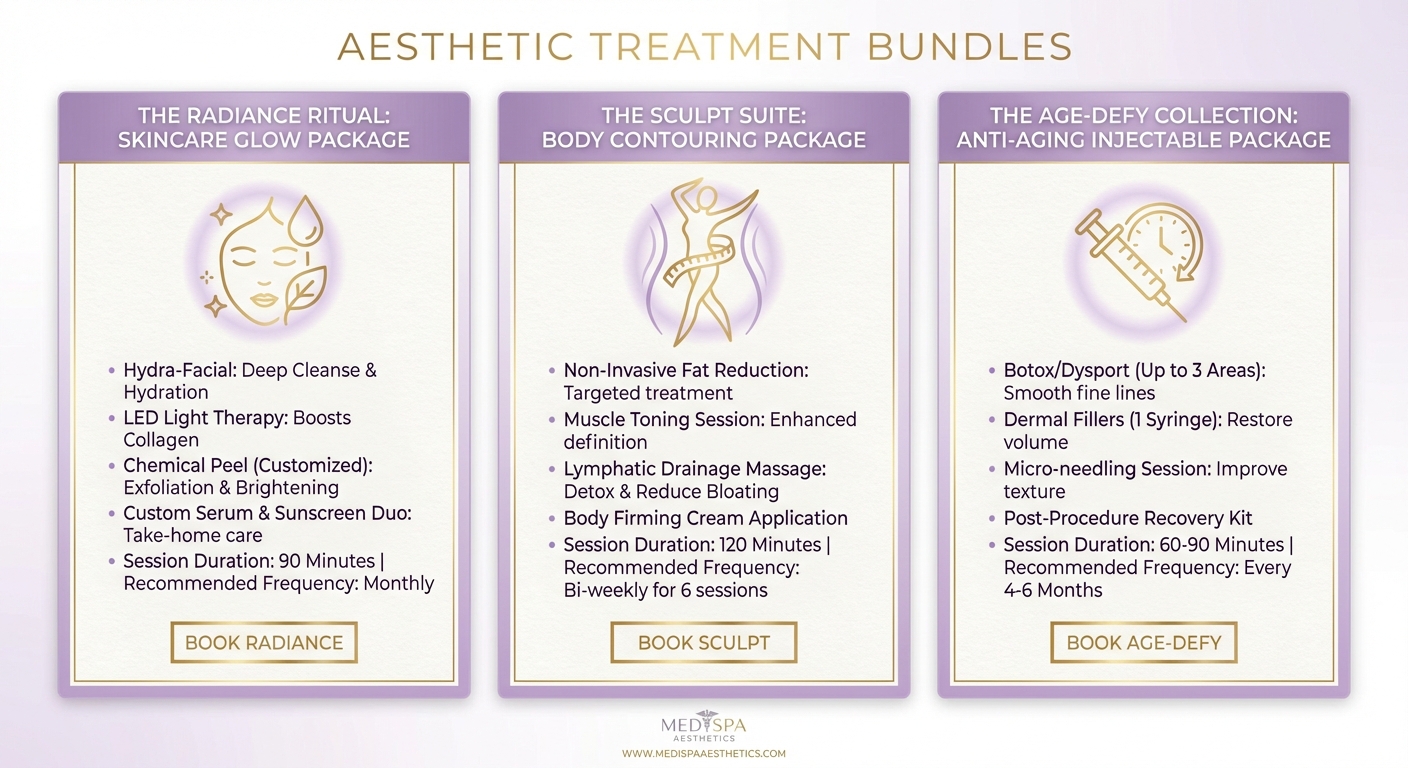
Example: The Clear Skin Protocol — 3 chemical peels + 2 LED phototherapy sessions + a medical-grade starter skincare kit. Priced as a complete acne treatment course, not a menu of items.
Results-based packages sell the outcome, not the procedure. This framing is far more compelling for the patient and far easier to explain at the front desk.
Frequency-Based Membership Packages
These work like a subscription: patients pay monthly for a defined set of services at member pricing, typically with a 3- or 6-month commitment.
Example: The Glow Membership — $199/month for one hydrafacial or custom facial per month + 15% off all retail products + complimentary eye treatment with each visit.
Memberships create predictable monthly recurring revenue and anchor patients to your practice. A patient enrolled in a monthly membership doesn’t casually try a competitor’s Groupon deal—they’re already committed and receiving ongoing value.
Occasion-Based Packages
These are timed around patient milestones: wedding prep, milestone birthdays, post-baby body restoration, pre-vacation skin treatments.
Example: The Big Day Package — Bridal skin prep sequence: 3 custom facials + 1 microneedling session + 1 smoothing treatment, designed for 12 weeks of lead time before a wedding.
Occasion-based packages tend to have the highest urgency of any package type. A bride doesn’t delay—she has a date on the calendar. This urgency compresses the sales cycle and reduces the “I’ll think about it” objection.
How to Price Your Packages
Pricing is where most practices leave money on the table—either by discounting too aggressively or by not discounting enough to make the bundle feel worthwhile.
The 10-15% bundle discount rule. A package should offer the patient roughly 10-15% savings compared to booking the same treatments individually. Less than 10% and the package doesn’t feel like a deal. More than 20% and you’re training patients to wait for packages before booking anything—and you’re compressing your margin.
Anchor with your highest-perceived-value item. Price the package around your most expensive component. A $1,800 package that includes your $1,200 filler treatment and two $350 follow-up appointments feels like a logical bundle. A $900 package assembled from lower-cost treatments feels like a discount menu.
Tier your package menu. Offer three price points: an entry-level results package (accessible, builds the relationship), a mid-tier comprehensive package (your primary upsell target), and a premium VIP package (signals high value, makes the mid-tier look reasonable by comparison). This is classic pricing psychology—the middle option wins the majority of conversions.
Include at least one non-treatment element. Adding a medical-grade skincare product, a complimentary consultation, or a priority booking benefit to a package increases perceived value without significantly increasing your cost of delivery. The patient feels they’re getting more than just the sum of the treatments.
Marketing Your Packages: 6 Strategies That Work
Writing a package and putting it on your price sheet is not a marketing strategy. Here’s how to actively sell them:
1. Introduce Packages at the Consultation
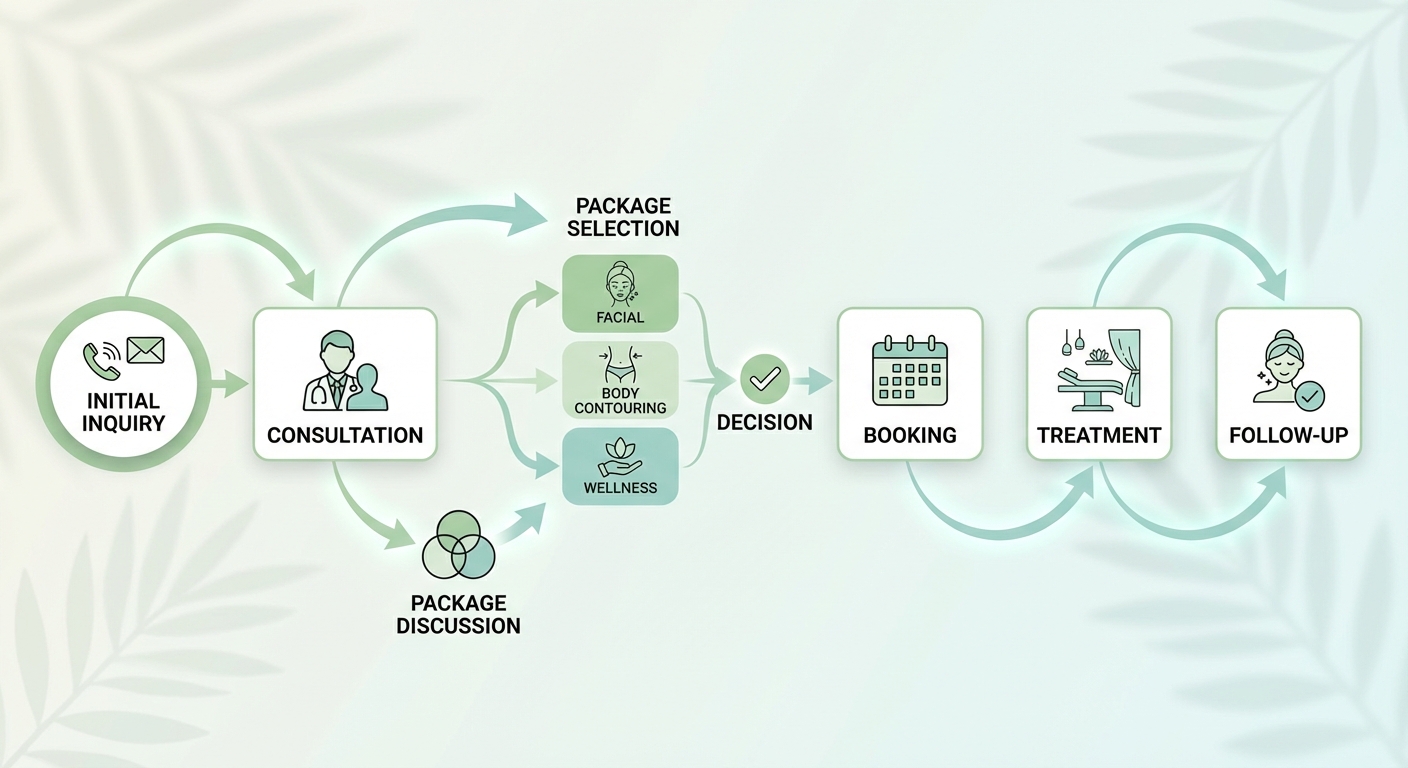
The consultation is your single best opportunity to present a treatment plan—which is a natural container for a package. After your clinical assessment, present the recommended course of treatment as a cohesive package rather than a list of individual services.
Script for your providers: “Based on what you’re looking to achieve, I’d recommend a 3-session series of [treatment]. We have a package that covers the full course—it’s actually what most of my patients who want real results start with. Would you like me to have the front desk walk you through what that looks like financially?”
This framing makes the package feel medically appropriate, not salesy.
2. Use Before/After Results in Package Marketing
Patients buy results. Your before/after gallery is your most powerful sales tool for treatment packages—particularly for multi-session results that wouldn’t be visible after a single appointment.
Build specific before/after cases around your packages. “This patient completed our Clear Skin Protocol. Here’s what her skin looked like at week 2, week 6, and after the final treatment.” Sequential before/afters show the journey, which makes the package narrative tangible.
3. Email Campaigns to Existing Patients
Your existing patient list is your highest-converting audience for package promotions. These are people who already trust you, have already experienced your work, and have already made a purchase decision.
A simple email marketing automation sequence for package launches might look like:
- Day 1: Announce the package with the outcome story and a patient testimonial
- Day 3: Share before/after results for the featured treatment area
- Day 7: Urgency email (“Limited openings this month for our Clear Skin Protocol”)
- Day 10: Last-chance follow-up with a direct booking link
This sequence typically outperforms any paid advertising campaign you’ll run to cold audiences.
4. Train Your Front Desk to Present Packages
Most package conversions happen at the front desk, not through digital marketing. Your receptionist is your highest-volume sales touchpoint—but only if they’re equipped to have a package conversation.
Give your front desk team a simple package presentation framework:
- Connect to a goal: “Are you looking for more of an ongoing maintenance approach or targeting a specific result?”
- Present the relevant package: “We have a package designed specifically for [stated goal]—would you like to hear about it?”
- Name the savings: “It’s about 12% less than booking those sessions individually.”
- Make booking easy: “I can hold that time for you right now if you’d like to get started.”
Role-play this quarterly. Package presentation confidence is a trainable skill.
5. Seasonal and Limited-Time Offers
Urgency drives package decisions. Two times per year—typically in the lead-up to snowbird season (October/November) and around spring/summer—run a limited availability package promotion.
The key word is limited: limited spots, limited time, or a limited package formulation. “We’re offering 20 spots for our Pre-Season Skin Reset Package this October” creates natural urgency. Practices that run year-round “sale” packages train patients to wait and devalue the bundle.
6. SMS Campaigns for Past Patients
Patients who haven’t booked in 3-6 months are strong package prospects. They know your work, they’ve lost momentum, and they often need a specific reason to re-engage. A package offer gives them that reason.
An SMS to lapsed patients might read: “Hi [Name], it’s [Practice Name]. We’ve been thinking about your skin goals—we just launched a new 3-session renewal package that’s perfect for where you left off. Want to see the details?”
Keep it personal, keep it brief, and link directly to a landing page or booking flow. For HIPAA-compliant SMS marketing for aesthetic practices, see our guide on automating patient communications.
Building the Package into Your Operations
A package sells once. It delivers over multiple visits. Your operations need to support the patient experience between those visits.
Automate appointment sequencing. When a patient purchases a 3-session package, their next two appointments should be scheduled before they leave. If that’s not possible, automate the follow-up: a booking reminder 3-4 weeks after the first session that says “Time to schedule your session 2—here’s a link to pick your time.”
Track package progress in your CRM. Every patient on a package should have a visible treatment plan in your system. Providers who can see “this is session 2 of 3—patient said last time they felt X” deliver better care and better retention. Manual tracking in paper charts doesn’t scale.
Create a completion moment. When a patient finishes their final package session, acknowledge it. A brief note from the provider, a follow-up call, or an automated email with their progress summary and a recommendation for next steps makes the completion feel like an accomplishment rather than just a checkout transaction. This is the moment to present the next package.
Build referral asks into the package journey. Package patients are your highest-satisfaction cohort—they’ve committed to results, they’ve seen progress, and they’re emotionally invested. The post-session 2 touchpoint (not the end—you want them excited, not ready to move on) is the natural moment to say: “You’ve been getting great results. Do you know anyone else who’s been wanting to try something similar? We love working with people your friends send us.” This one conversation, systematized across your practice, fills appointment slots with referred patients who arrive pre-sold.
Measuring Package Performance
A package program without measurement is just hope. Track these metrics monthly:
| Metric | What It Measures | Target |
|---|---|---|
| Package attach rate | % of new patients who purchase a package | 30–50% |
| Package conversion at consultation | % of consults that convert to a package | 40–60% |
| Package revenue as % of total revenue | Share of revenue from packages vs. single services | 35–55% |
| Completion rate | % of purchased packages completed | 70–85% |
| Patient lifetime value: package vs. single | Revenue per patient over 12 months | Packages 2–4x single |
| Referral rate from package patients | New patients from package patient referrals | Track quarterly |
The most important leading indicator is package attach rate at consultation. If less than 30% of new patients who go through a consultation leave with a package, the issue is either in your package design (not compelling enough), your pricing (perceived value mismatch), or your presentation (front desk or provider isn’t making the offer consistently).
Common Package Marketing Mistakes
Offering too many packages. More than 4-5 packages on your menu creates decision paralysis. Patients who can’t decide easily default to a single session. Curate aggressively—your top 3 performing packages should represent 80% of your package revenue.
Naming packages after procedures instead of outcomes. “3-Session Laser Package” doesn’t sell. “The Skin Renewal Series” sells. Names that describe what the patient will experience or achieve are always stronger than names that describe the clinical modality.
Not training your team to present packages. Digital marketing can drive inquiries, but most package conversions happen in person. If your front desk isn’t making the offer, it doesn’t matter how good your packages are.
Discounting so aggressively that margin disappears. A 30% bundle discount sounds generous but may be unsustainable, especially for capital-intensive treatments like lasers. Know your break-even discount level before you set package pricing.
No expiration policy. Unlimited validity packages create liability on your books and give patients no urgency to complete. A 12-month expiration from purchase date is a reasonable standard—patients have time, but not infinite time.
Getting Started: Your 30-Day Package Launch Plan
If your practice doesn’t currently offer structured treatment packages, here’s a realistic launch sequence:
Week 1: Design
- Identify your 3 highest-demand treatment types
- Create one results-based package for each
- Set pricing at 10-12% below à-la-carte equivalent
- Name each package around the outcome, not the procedure
Week 2: Internal training
- Train providers on how to introduce packages during consultations
- Train front desk on the presentation framework
- Add packages to your booking system with clear product codes
Week 3: Soft launch to existing patients
- Email your existing patient list with the new packages
- Offer an early-access incentive for the first 20 bookings
- Brief staff on the frequently asked questions they’ll receive
Week 4: Full launch
- Update your website with package details and pricing
- Run an SMS campaign to lapsed patients
- Post before/after content on social media tied to your package outcomes
- Start measuring weekly attach rates
The practices that consistently grow revenue year over year aren’t doing something dramatically different from their competitors—they’ve just systematized the patient experience well enough that every consultation ends with a treatment plan, every patient understands the value of committing to a course, and every team member can present a package without hesitation.
Treatment packages are the infrastructure for that kind of practice. If you’re ready to build a package program or integrate it with your patient communication and booking automation, Monsoft Solutions works with aesthetic practices across the country to build the systems that turn first-time patients into long-term clients. Get in touch and let’s talk about what’s possible.
Frequently Asked Questions
How many treatment packages should a med spa offer?
Keep your menu to 3-5 core packages. More than that creates decision paralysis and makes it harder to train your team to present options confidently. Curate your highest-performing treatments into clear packages and retire anything that isn’t converting.
Should I offer treatment packages online or only at the consultation?
Both, but lead with the consultation. Online package visibility drives inquiries and signals value, but the actual conversion happens when a provider or front desk member makes a personalized recommendation. Make packages available to book online, but make sure they’re also being actively presented at every consultation.
How do I handle patients who don’t complete their purchased package?
Set a 12-month expiration policy from purchase date. Automate reminder messages at the 6-month, 9-month, and 11-month marks. If a patient is approaching expiration without completing, offer a 30-minute complimentary consultation to re-engage and adjust the treatment plan if their goals have changed.
What’s the best way to introduce packages to existing patients?
Email is the highest-converting channel for existing patients. A simple 3-email sequence that tells the outcome story, shows before/after results, and includes a clear booking link typically outperforms any paid campaign. For lapsed patients (3-6 months inactive), add an SMS touchpoint.
Do treatment packages work for injectables like Botox and filler?
Yes, though they require different framing. “3-session anti-aging program” or “full facial rejuvenation plan” sells better than “3 syringes of filler” because it frames the purchase around results rather than units. Always present the clinical rationale—a provider recommendation for a course of treatment feels medical, not transactional.