
You finally raised your prices — and immediately lost two clients. So you dropped them back down, told yourself the market just couldn’t bear it, and went back to undercharging for your work.
Sound familiar? It’s one of the most common traps service business owners fall into. The problem usually isn’t your prices. It’s how you’re presenting them.
Pricing psychology is the science of how people perceive value and make buying decisions. When you understand the mental shortcuts your prospects use to evaluate your prices, you can structure your offers to feel like obvious value — even at premium rates. You stop competing on price and start winning on perceived worth.
This guide covers the key principles of pricing psychology for service businesses, with practical tactics you can start using this week.
Why Price Perception Matters More Than the Number Itself
Here’s a counterintuitive truth: the actual dollar amount of your price matters less than how that price is presented.
A $500 service can feel outrageously expensive if presented poorly, or like an absolute steal if framed correctly. The value isn’t in the number — it’s in the context around it.
Consider two landscaping companies:
- Company A charges $350 for lawn care and presents it as “lawn mowing and edging.”
- Company B charges $350 for the same work and presents it as “professional property maintenance to protect your curb appeal and home value.”
Same price. Same service. Completely different perceived value.
This is the foundation of pricing psychology: help your prospects see the transformation you deliver, not just the tasks you complete.
1. Anchor High to Make Your Actual Price Feel Like a Deal
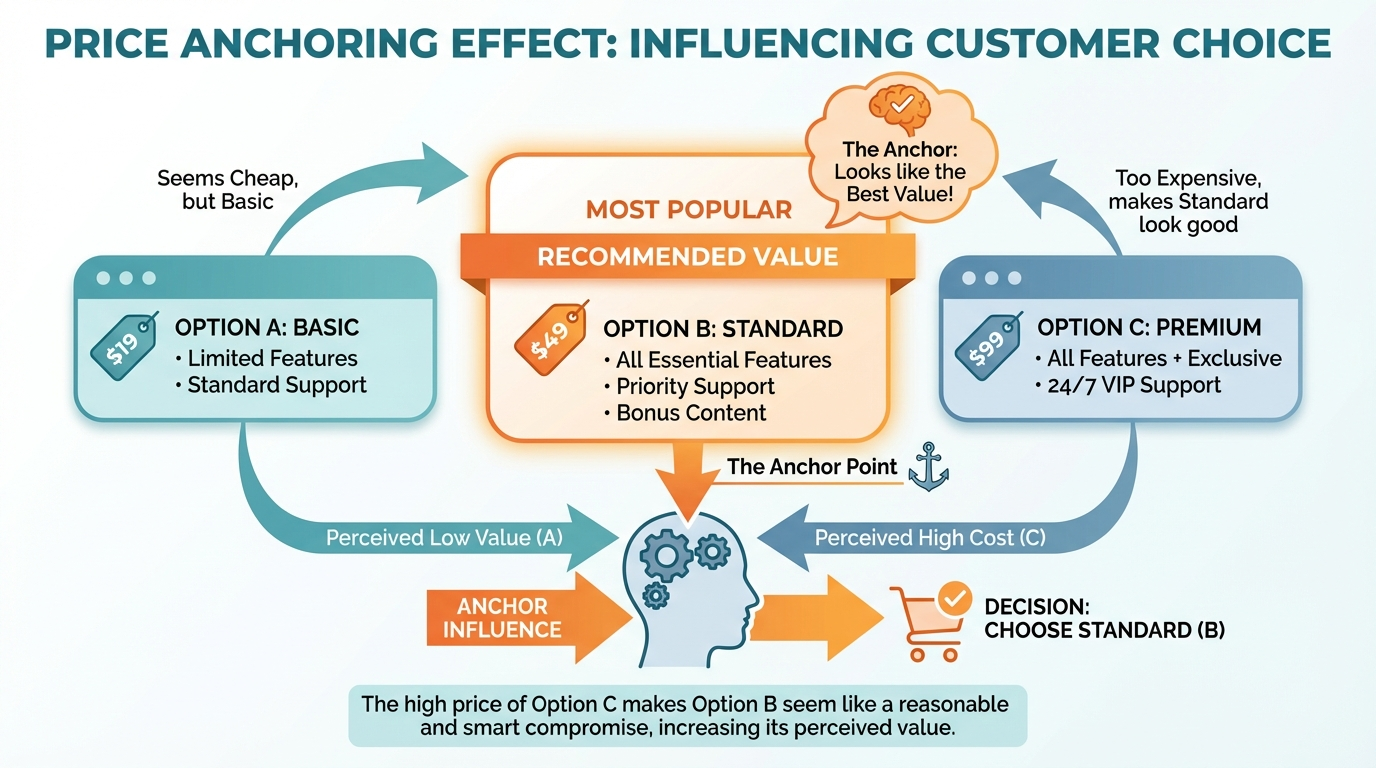
Anchoring is one of the most powerful pricing principles. It works like this: the first number a prospect sees becomes the reference point for everything that follows.
If you present a premium $2,500 package first, your $1,200 standard package feels reasonable by comparison. If you lead with the $1,200 package, it becomes the anchor — and anything below it seems cheap.
How to use anchoring in your business:
- Always present your highest-priced package first
- Mention the cost of not solving the problem (e.g., “the average business loses $X per month by not addressing this”)
- Reference competitor prices that are higher, or what it would cost to do it in-house
- Include a “premium” tier even if most clients choose the mid-tier option
The goal isn’t to sell the premium option every time. It’s to make your preferred option feel like the smart, reasonable choice by comparison.
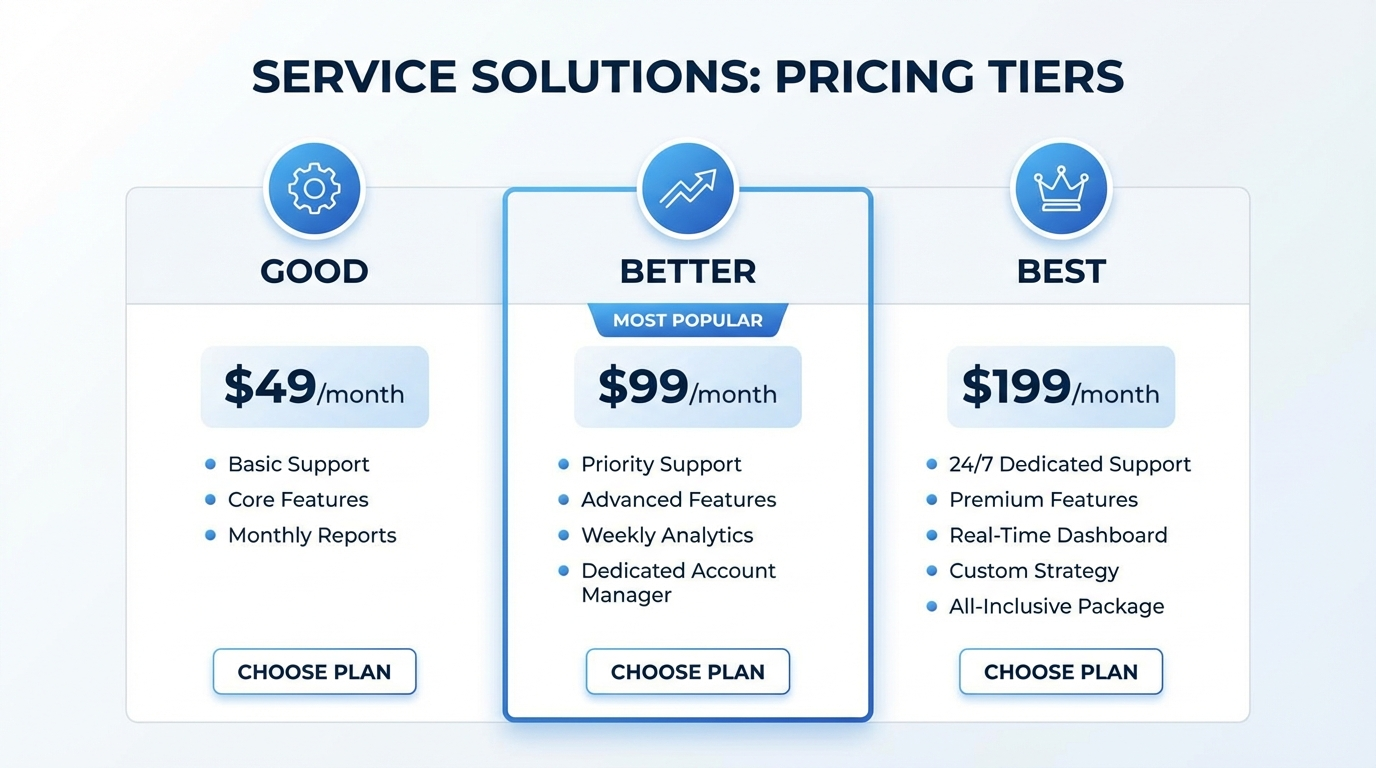
2. Use the Power of Three: The Decoy Effect
When given two choices, people often pick the cheaper option. When given three, something interesting happens — they tend to pick the middle.
This is the decoy effect, also called the Goldilocks principle. The three-option structure works because the middle option suddenly looks “just right” compared to the extremes on either side.
For a med spa offering facial treatments:
| Package | Price | What’s Included |
|---|---|---|
| Refresh | $149 | Single facial, basic skincare consult |
| Renew ⭐ Most Popular | $299 | Facial + microdermabrasion + personalized skincare plan |
| Revive | $549 | Full facial package + 3 follow-up treatments + priority booking |
Most clients will choose Renew. The basic option signals that the service might feel incomplete. The premium option feels like a stretch. The middle feels like the smart, balanced choice.
Key tactics for the three-option structure:
- Label the middle option “Most Popular” or “Best Value”
- Make the gap between options feel meaningful (don’t cluster prices too close together)
- Make the premium option genuinely premium — add real value, not just a higher price
- Ensure the basic option is complete enough to satisfy, but limited enough to create curiosity about the upgrade
This structure also shifts the conversation from “should I hire you?” to “which package makes sense for my situation?” — a far better position to be in.
3. Reduce Price Sensitivity With Value Framing
Price sensitivity drops dramatically when prospects understand exactly what they’re getting and why it matters.
“Website design” for $3,500 might feel expensive. “A conversion-optimized website designed to generate 20+ new leads per month for your business” at $3,500 feels like a potential investment with a clear return.
Value framing principles:
Lead with outcomes, not deliverables. Instead of “we’ll create 12 social media posts per month,” say “we’ll keep your business top-of-mind with your ideal clients so that when they’re ready to buy, they think of you first.”
Quantify the benefit where possible. Numbers make outcomes feel concrete. “Our clients typically see a 30% increase in booked appointments within 90 days” is far more compelling than “we’ll help you grow your practice.”
Break it down to the cost per day. A $1,200/month service sounds significant. Positioned as “$40 a day — less than a tank of gas — for a system that handles your follow-up while you sleep,” it becomes much easier to justify.
Connect price to prevention. What does it cost NOT to solve this problem? A landscaping business might say: “Neglected properties in this area can reduce resale value by 5-10%. Our $200/month maintenance plan protects a $400,000+ investment.” That reframe makes $200/month feel like cheap insurance.
4. Eliminate Price Shock With Transparent Packaging
Nothing kills a deal faster than sticker shock at the end of a sales conversation.
When you present price at the wrong moment — before the prospect understands the value — you guarantee a cost-focused reaction. When you present it at the right moment, after they understand what they’re getting and why it matters, it lands completely differently.
The sequence matters:
- Diagnose first. Ask questions to understand their specific situation, goals, and what they’ve tried before.
- Present the solution. Explain what you’d do, why your approach works, and what results they can expect.
- Bridge to the investment. “For everything we just talked about — the setup, ongoing management, and monthly reporting — the investment is X.”
- Let it breathe. Don’t immediately justify or backpedal. Present with confidence and stay quiet.
This sequence does two things: it makes the price feel earned (you did the work to understand their situation), and it prevents you from self-sabotaging by over-explaining the moment you see a flinch.
5. Use Social Proof to Validate Your Price Point
One of the fastest ways to reduce price resistance is showing your prospects that people like them are already paying your rates — and getting results.
When a prospect hears your price, the unconscious question isn’t just “is this worth it?” It’s “is this what people like me pay for something like this?”
How to use social proof in pricing conversations:
- Name-drop your client type: “Most of our clients are service businesses doing between $500K and $2M in annual revenue — similar to where you are now.”
- Reference results: “Our last client at this package level was a medical spa in Cape Coral. Within four months they had reduced no-shows by 40% and added $8K/month in revenue from reactivated clients.”
- Use testimonials near your pricing page. Don’t just put testimonials on a general reviews page — place specific outcome-focused testimonials right next to your pricing information.
- Show the range: If you’ve worked with businesses that invested more than your asking price, mention it. “We have clients investing $4,000/month for full-service management — this package is designed for businesses that want a more targeted approach.”
For more on leveraging social proof effectively, check out our guide to social proof marketing for small business.
6. Offer Payment Plans Strategically
Payment plans aren’t just about making your service “affordable.” They’re a tool for removing the friction of a large upfront commitment — and for serving clients who’d rather spread cash flow than part with a lump sum.
A $6,000 website feels significant. Six payments of $1,000 feels manageable. The math is identical; the psychology is not.
Smart payment plan practices:
- Offer monthly payment options for any project over $2,000
- Consider a small premium for extended payment plans (e.g., 6% more for 6-month plans) — this rewards clients who pay upfront and covers your cash flow risk
- Make the monthly option easy to find, but present the full-pay option first (with the savings clearly shown)
- For recurring services, offer a discount for annual prepay: “Save $200 when you pay annually” converts more prospects and improves your cash flow predictability
One caution: Don’t offer payment plans to avoid having a pricing conversation. If your prospect needs a payment plan because they genuinely can’t afford your service, that’s a different problem. Payment plans should extend access to clients who could pay full price but prefer not to.
7. Stop Discounting — Start Bonusing
When you discount your service, you’re telling the market two things: your price was arbitrary, and the relationship starts with you giving something away.
Discounting trains clients to wait for deals, attracts price-sensitive buyers who are harder to serve, and erodes the perception of quality. Once you’ve discounted for a client, it’s nearly impossible to raise prices without friction.
Instead: add value rather than subtract price.
If a prospect is on the fence at $2,500, don’t drop to $2,200. Instead, say: “If you’d like to get started this week, I can add [bonus deliverable] at no charge — that typically adds another $300-400 in value.”
Good bonuses for service businesses:
- A free strategy session or audit
- Faster turnaround / priority scheduling
- An additional deliverable that’s low-cost for you but high-value for them
- Extended support (e.g., 60 days instead of 30)
- Access to templates, guides, or resources they’d otherwise buy separately
This approach protects your price integrity while still creating a reason to move forward now. It also signals confidence — you’re not reducing what you’re worth, you’re layering on more value.
8. Price Confidently and Handle Objections From a Position of Strength
Here’s the truth that no pricing guide can give you: your confidence when presenting price affects how it’s received more than almost anything else.
If you wince, apologize, or immediately offer to “see what I can do,” you’re telegraphing doubt. Prospects feel it. They start to wonder if the price is actually justified.
Confidence tactics:
- Practice saying your price out loud until it feels completely normal
- Use “the investment is X” rather than “it costs X” — the word investment shifts the frame
- After presenting price, stop talking. Silence is not your enemy.
- When someone says “that’s a bit more than I expected,” resist the urge to immediately justify or drop. Instead try: “That’s fair — can you tell me more about what you were expecting?”
For handling the “it’s too expensive” objection specifically, the most powerful response is a question: “Compared to what?” This opens a conversation about what they’ve tried before, what they’re comparing you to, and whether there’s a real fit issue or just a framing gap.

Putting It All Together: A Pricing Conversation Framework
Here’s a simple framework that incorporates the principles above:
Step 1 — Qualify and diagnose. Before you ever mention price, understand what they’re dealing with. Ask about their current situation, their goals, and what they’ve already tried.
Step 2 — Present the solution, not the service. Describe what you’d do in terms of outcomes, not tasks. Make them see the transformation, not the transaction.
Step 3 — Anchor with your premium option. Present your three packages, leading with the highest. Let them ask questions about each.
Step 4 — Present price with confidence. “Based on what you’ve described, most of my clients in a similar situation start with the [middle] package — the investment for that is X per month.”
Step 5 — Add social proof. Follow the price with a specific success story from a comparable client.
Step 6 — Create urgency without gimmicks. If there’s a genuine reason to act now (a limited slot, a promotion, or your calendar), mention it. Artificial urgency backfires.
Step 7 — Handle objections from strength. Ask questions before defending. Understand the real issue before you respond.
This framework works whether you’re selling a $500 service or a $5,000 engagement. The principles scale.
Your Pricing Sets Expectations
One final point that’s often overlooked: your price is a signal. Low prices attract clients who prioritize cost. Higher prices attract clients who prioritize results, expertise, and partnership.
The clients who haggle you down to rock-bottom rates are often the most demanding to work with and the least likely to refer you. The clients who pay premium rates without blinking have typically bought based on trust, reputation, and confidence — and they tend to be easier to serve and more loyal.
Raising your prices isn’t just about revenue. It’s about filtering for the clients who will get the most value from working with you, and who will treat you like the professional you are.
If you’re ready to level up your marketing systems alongside your pricing strategy, Monsoft Solutions helps service businesses in Southwest Florida build the automation, reputation, and lead generation infrastructure to support sustainable growth. Start a conversation with our team to see how we can help.
Related reading: How to Build a Customer Loyalty Program That Works | CRM Automation for Small Business | Automated Follow-Up Sequences That Convert | Email Marketing Automation for Small Business