A first-time customer is worth something. A loyal customer who comes back again and again, refers friends, and defends your business online? That’s a different category entirely.
Research consistently shows it costs 5–7x more to acquire a new customer than to retain an existing one. Yet most small businesses spend the majority of their marketing budget chasing new leads while doing almost nothing to systematically reward the customers they already have. A well-designed loyalty program flips that equation—and it doesn’t require a franchise budget or a software team to build one.
This guide covers how to design, launch, and run a customer loyalty program that actually generates repeat business—whether you run a salon, a med spa, a dental practice, a coffee shop, or any local service business.
Why Most Loyalty Programs Fail
Before building yours, understand why so many punch cards collect dust in people’s wallets.
They’re too hard to track. Paper punch cards get lost. Manual stamp systems create friction for staff and customers alike. If redeeming a reward takes more than two steps, most people won’t bother.
The reward isn’t worth it. “Earn 500 points to get $5 off” sounds good until customers do the math and realize they need to spend $2,500 to save $5. The reward has to feel attainable and genuinely valuable.
There’s no emotional layer. Transactional programs (“earn points, get discount”) drive behavior in the short term but don’t build loyalty—they build price sensitivity. The best programs make customers feel like insiders, not bargain-hunters.
No communication after sign-up. Someone joins your loyalty program, earns a few points, then forgets it exists because you never reminded them. Regular, personalized communication is what converts casual sign-ups into loyal advocates.
Get these four things right and your loyalty program becomes one of the highest-ROI marketing investments you’ll make.
The 4 Core Loyalty Program Models
Pick the model that fits your business type and customer behavior:
1. Points-Based Programs
Customers earn points per dollar spent (or per visit), then redeem them for discounts, free services, or products.
Best for: Retail, salons, spas, restaurants, coffee shops—any business with frequent, moderate-value transactions.
Example: Earn 1 point per $1 spent. 100 points = $10 off your next visit. A customer who spends $50/month earns a $10 reward every two months—a 17% effective retention rate on that customer’s annual spend.
Key design rule: Keep the earning rate visible and the redemption threshold achievable within 3–5 visits. If it takes a year to earn anything, engagement collapses.
2. Tiered (VIP) Programs
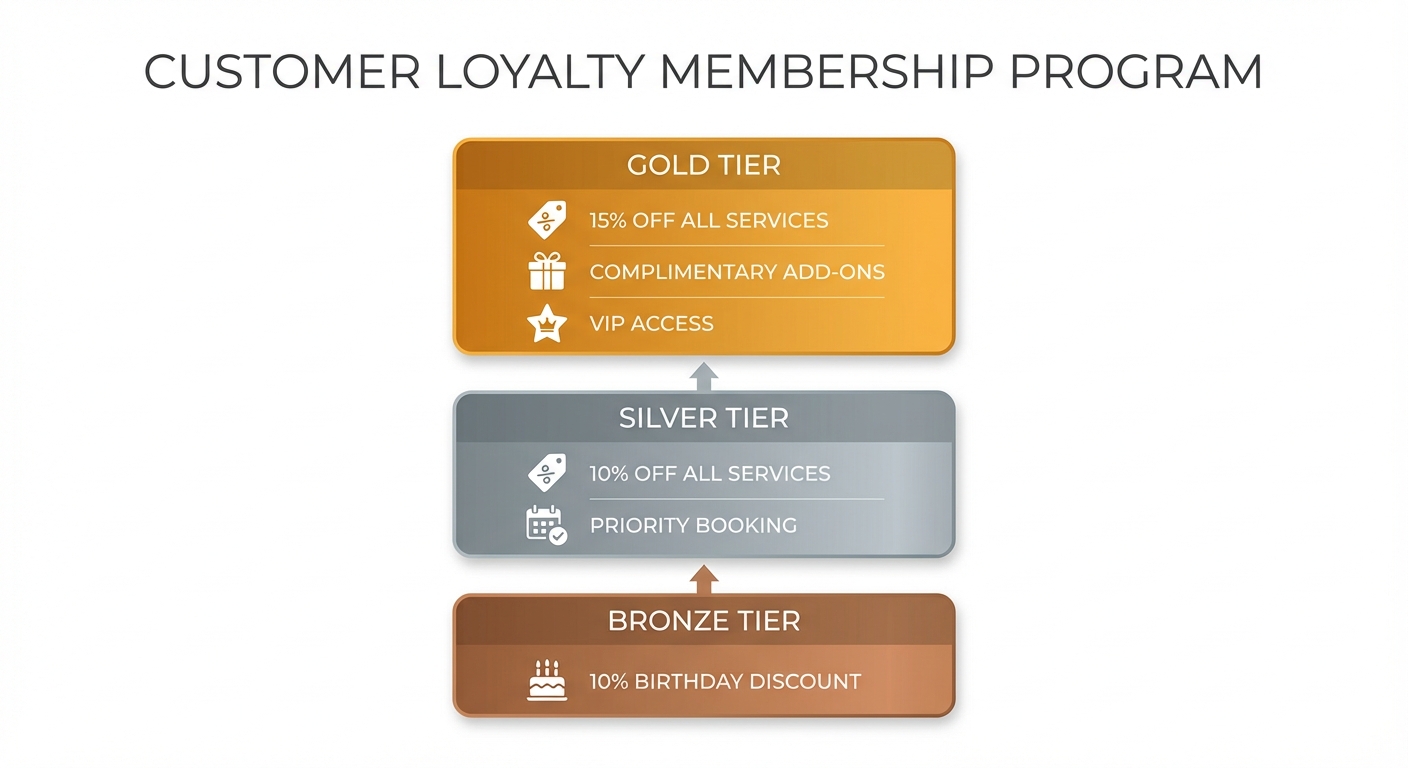
Customers unlock escalating benefits as they spend more—Bronze, Silver, Gold, Platinum, or whatever names fit your brand.
Best for: Businesses with wide variation in customer spend—med spas, aesthetic practices, higher-end salons, fitness studios.
Example: Bronze (0–$500 annual spend): 10% off birthday service. Silver ($501–$1,500): 10% off all services + priority booking. Gold ($1,501+): 15% off + complimentary add-ons + VIP access to new treatments.
Why it works: Tiered programs tap into status psychology. Customers don’t just want discounts—they want to feel recognized. “Gold Member” communicates something that “10% off” doesn’t.
3. Subscription / Membership Programs
Customers pay a flat monthly or annual fee for ongoing benefits: discounted services, free add-ons, members-only pricing.
Best for: Med spas, dental practices, fitness studios, salons with regular service cadences (cuts, facials, lashes, etc.).
Example: $49/month membership: one facial per month at member price, 20% off all retail products, complimentary lip treatment quarterly.
Why it works: Predictable recurring revenue. Members spend 2–3x more than non-members annually because they’re already invested. This model also deepens the relationship—members feel ownership in your business.
4. Visit-Based (Stamp) Programs
The digital evolution of the paper punch card. Customers get credit for each visit regardless of purchase amount.
Best for: High-frequency, lower-average-ticket businesses—coffee shops, lunch spots, nail bars, blow dry bars.
Example: 10th visit free. Simple, clear, and fast to explain at checkout.
Key design rule: Make stamp programs digital. Paper punch cards have ~40% redemption rates because they get lost. Digital stamp programs average 70%+ because customers keep them on their phones.
What Rewards Actually Drive Behavior
Not all rewards are created equal. The right reward depends on your business type and what your customers actually value.
Discounts and credits are the most common and have clear, immediate appeal. The downside: they train customers to wait for deals. Use them as the base layer but layer in experiential rewards above a certain threshold.
Free services or products feel more generous than equivalent discounts (a $75 free facial feels more valuable than $75 off, even though the economic value is identical). Use these for your top-tier rewards.
Priority access costs you nothing and is often more valued than discounts by busy customers. “Skip the waitlist,” “first access to appointment cancellations,” or “early access to seasonal promotions”—these rewards signal VIP status without margin impact.
Surprise and delight moments (a complimentary add-on during a visit, a handwritten birthday card, a free upgrade) create emotional loyalty that transactional rewards can’t replicate. Layer these in unpredictably—they hit harder when unexpected.
Community perks work especially well for aesthetic practices and wellness businesses: early access to new treatments, invitations to client appreciation events, “bring a friend” double-points days. These make loyalty social, which multiplies its power.
Choosing a Loyalty Platform
You need a platform to run your program digitally. Paper systems don’t scale and don’t give you data. Here’s a breakdown of the most practical options for small businesses:
| Platform | Best For | Price | Standout Feature |
|---|---|---|---|
| Square Loyalty | Businesses using Square POS | $45–$105/mo | Seamlessly integrated with Square |
| Stamp Me | Simple stamp card programs | Free–$45/mo | Easiest digital punch card setup |
| Yotpo Loyalty | E-commerce + retail | From $199/mo | Deep Shopify integration |
| Belly (now Fivestars) | Brick-and-mortar local businesses | Custom | Multi-location, rich analytics |
| Vagaro Loyalty | Salons, spas, fitness studios | Included in Vagaro plan | Natively built into booking platform |
| GlossGenius | Salons and aesthetic practices | Included in some plans | Easy client app loyalty integration |
| Simple Loyalty | Custom builds via your CRM | Varies | Full control via email/SMS automation |
For aesthetic practices: If you’re already using a booking platform like Vagaro, Jane App, or GlossGenius, check if they have a native loyalty module before adding a separate system. Keeping booking, payment, and loyalty in one place eliminates data silos and simplifies staff training.
For retail and food/beverage: Square Loyalty is the easiest entry point if you’re on Square POS. For more flexibility, Stamp Me is cost-effective and gets the job done without a learning curve.
For custom programs: If you’re already using a CRM and email/SMS automation stack, you can often build a lightweight loyalty program natively—point tracking via tags and custom fields, automated reward emails triggered by spend thresholds. More setup work upfront, but full control and no additional subscription.
How to Set Up Your Program: Step by Step
Step 1: Define Your Economics
Before picking a platform, do the math. What’s your average transaction value? How often do customers visit? What margin can you afford to give back?
A rough starting framework:
- Target retention reward rate: 3–8% of annual customer spend
- Points earning structure: 1 point per $1 is the clearest and most popular
- Breakage assumption: 20–40% of earned rewards typically go unredeemed—factor this into your math favorably
Run your numbers on a customer who spends $1,000/year with you. At a 5% reward rate, they earn $50 in benefits annually. That customer spending $1,000/year vs. defecting to a competitor is worth far more than $50—it’s worth the entire $1,000, plus referrals.
Step 2: Name and Brand Your Program
Don’t call it “the loyalty program.” Give it a name that fits your brand:
- Bloom Rewards (spa)
- The Inner Circle (premium wellness)
- Bold Points (creative salon)
- The Glow Club (aesthetics)
A branded program name builds identity around your loyalty ecosystem. Customers talk about “their Bloom Rewards” differently than they talk about “the points thing at that salon.”
Step 3: Set Up Your Platform and Train Staff
Your program is only as effective as your team’s ability to enroll customers. Build enrollment into your checkout flow—it should be a natural part of every first visit, not an afterthought.
Script it for staff:
“Do you have our [Program Name] account? Takes about 30 seconds and you get points on today’s visit.”
Enroll at point of sale, not at the end of a transaction when customers are already mentally out the door.
Step 4: Launch to Existing Customers First
Don’t wait for a perfect launch date. Email your existing customer list before you go live publicly:
“You’re already one of our best customers, so we wanted to give you first access to [Program Name]—our new loyalty program. We’ve credited your account with [50/100/500] points to get you started as a thank-you.”
Pre-loading points gives existing customers immediate buy-in and accelerates your initial enrollment numbers.
Step 5: Automate Your Communication
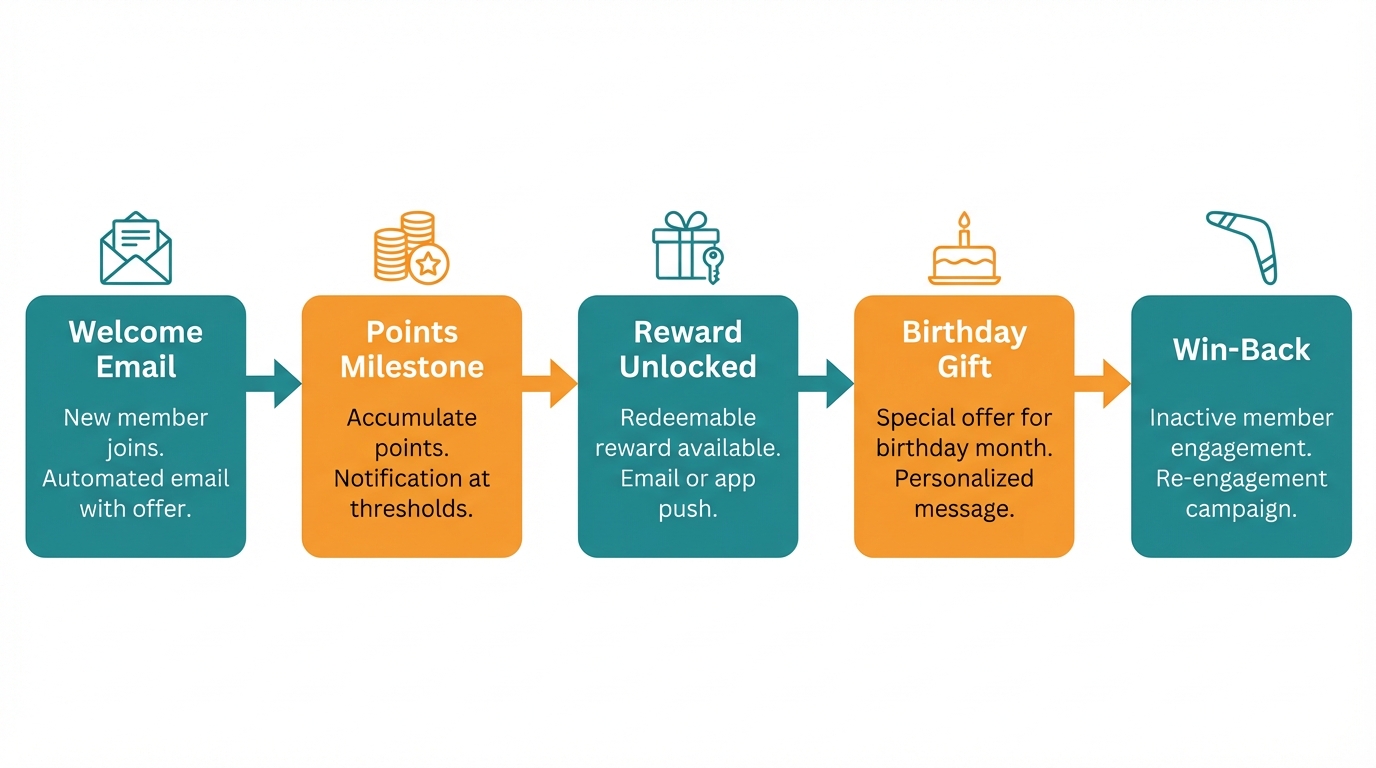
The program lives or dies by your communication cadence. Automate:
- Enrollment confirmation — welcome email/SMS with points balance and how to earn more
- Points milestone alerts — “You’re halfway to your first reward!”
- Reward unlocked notification — “Your $25 credit is ready to use”
- Expiry warnings — “Your points expire in 30 days—book your next visit”
- Lapsed member win-back — “We miss you! Your [X] points are waiting”
- Birthday reward — send automatically, tied to customer’s birthday in your system
This is where connecting your loyalty platform to your email and SMS automation stack pays off. The touchpoints above can run entirely on autopilot once set up. If you’re running automated follow-up sequences already, loyalty communication plugs into the same infrastructure.
Loyalty Programs for Aesthetic and Medical Practices
Aesthetic practices have a unique loyalty opportunity—their services are premium, high-consideration, and inherently personal. Patients who feel valued stay. Patients who feel like a transaction number don’t.
Some specific considerations for med spas, plastic surgery practices, and aesthetics clinics:
Memberships over points. Aesthetic patients often prefer the predictability of a monthly membership over a points system. A $150/month membership might include one injectable treatment at a reduced rate, a skincare product monthly, and priority booking. The patient knows exactly what they’re getting; you get predictable MRR.
Referral integration. Aesthetic patients refer aggressively when they love their results. Build referral rewards directly into your loyalty program: “Refer a friend who completes a treatment—you both earn 500 bonus points.” This turns your loyalty members into your most effective sales channel.
HIPAA-compliant communication. When automating loyalty communications, don’t reference specific treatments or health-related services in text messages or emails without a business associate agreement in place. Keep marketing communications general (“your next appointment is coming up!”) and let clinic-specific communication happen through your HIPAA-compliant patient portal. For more, see our guide on HIPAA-compliant marketing practices.
Event-based loyalty perks. Client appreciation events, first-access evenings for new treatments, and “members-only” injection parties create social engagement around your practice that converts loyal patients into community advocates.
Before/after gallery integration. Offer bonus points to patients who consent to before/after documentation for your gallery. This fills your before/after gallery pipeline while rewarding patients for participation.
Measuring Loyalty Program ROI
A loyalty program that doesn’t have clear metrics is just a cost center. Track these KPIs quarterly:
| Metric | What It Tells You | Target |
|---|---|---|
| Enrollment rate | % of customers who join the program | 40–70% within 90 days |
| Active member rate | % of enrolled members who’ve earned/redeemed in 90 days | 50–65% |
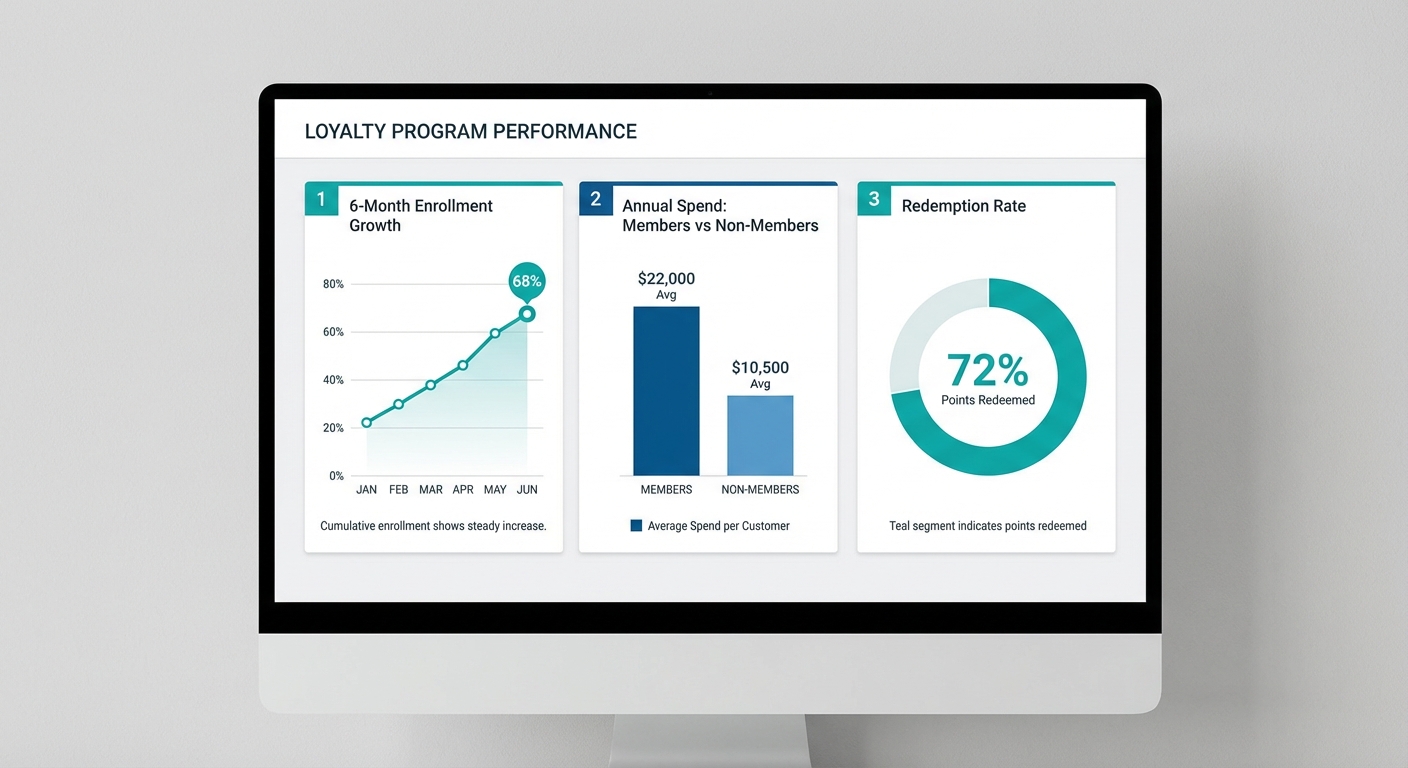
| Average spend per member | vs. non-member spend | Members 1.5–2.5x non-members |
| Visit frequency | Avg. visits/year members vs. non-members | Members 30–50% more visits |
| Redemption rate | % of earned rewards redeemed | 60–80% healthy |
| Churn rate by tier | Which tier retains customers best | Informs tier structure |
| Referrals attributed | New customers from member referrals | Track per quarter |
The most important number: member vs. non-member annual spend. If your loyalty members spend 2x what non-members spend, that’s your north star metric. Everything else is in service of growing that gap.
Run this comparison 90 days after launch and every quarter thereafter. If the gap isn’t widening, your rewards aren’t compelling enough or your communication cadence is off.
Common Mistakes to Avoid
Making it too complicated. If your staff can’t explain how the program works in 15 seconds, redesign it. Customers won’t engage with what they don’t understand.
Ignoring your top spenders. Your top 20% of customers generate 80% of your revenue. Make sure your tier structure or VIP perks specifically reward them—generic one-size-fits-all programs lose your best customers to competitors offering true VIP treatment.
Setting rewards too low. A reward worth less than 3–5% of customer spend isn’t motivating. If redeeming takes 12 months, customers psychologically disconnect from the program within weeks.
Not training your team. The front desk is your loyalty program’s sales force. If they’re not enthusiastically enrolling customers and mentioning points at checkout, your program enrollment will plateau at single digits.
No expiry policy (or expiry that’s too short). Points that never expire create accounting liability and attract gaming behavior. Points that expire in 30 days create anxiety and opt-outs. 6–12 months is the standard sweet spot.
Launching and forgetting. A loyalty program isn’t a “set it and forget it” system. Review your metrics quarterly, survey members, and iterate. What earns engagement in month one often needs refreshing by month six.
Getting Started in the Next 30 Days
Here’s a practical launch sequence for a small business with no loyalty program today:
Week 1: Research and design
- Choose your program model (points, tiered, membership, or stamp)
- Pick a platform that integrates with your existing booking/POS system
- Define your earning rate, reward structure, and tiers
- Name and brand the program
Week 2: Build and test
- Set up the platform and connect it to your booking/payment system
- Build your automated communication sequences (enrollment, milestones, rewards)
- Run internal test enrollments with your staff
Week 3: Soft launch to existing customers
- Email your existing customer list with early access
- Pre-load founder bonus points for your best customers
- Train your team on the enrollment script
Week 4: Full launch and optimization
- Add loyalty sign-up to your website and booking flow
- Promote on social media and in-store signage
- Review your first-week enrollment numbers and adjust communication cadence
By day 30, you’ll have a live loyalty program with real members, automated communications running, and your first data points for optimization.
Customer loyalty programs don’t just drive repeat visits—they change the relationship customers have with your business. A customer with points at stake thinks twice before trying the new place that opened down the street. A Gold Member at your med spa isn’t comparison-shopping your injectables on Groupon.
If you’re ready to design and launch a loyalty program that fits your business model—or integrate it with your existing automation stack—Monsoft Solutions works with local businesses and aesthetic practices across Southwest Florida to build customer retention systems that compound over time. Get in touch and let’s build something worth staying for.