
You’ve seen it in gyms, coffee shops, and Netflix. Now it’s one of the fastest-growing revenue strategies in the medical aesthetics industry: the membership model.
A well-designed med spa membership program transforms your revenue from unpredictable one-off transactions into a reliable monthly income stream. It deepens patient loyalty, smooths out seasonal slow periods, and gives you something gyms and spas have known for decades — people pay for access they intend to use, even when they don’t.
This guide breaks down exactly how to build a membership program that patients actually want, with tier structures, pricing strategies, tech setup, and the marketing tactics to fill it up.
Why Membership Programs Work for Med Spas
The economics are simple: membership programs convert occasional patients into committed ones. But the benefits go deeper than recurring revenue.
Predictable cash flow. Instead of wondering what next month looks like, you know your floor. If 150 patients pay $99/month, that’s $14,850 guaranteed before you open the doors. You can staff appropriately, plan marketing spend, and sleep better.
Higher patient lifetime value. Members visit more frequently than non-members. A patient who books twice a year might turn into one who comes every 4–6 weeks once they have a monthly plan. More visits mean more add-on treatments, more retail purchases, and stronger results — which means better before-and-afters and more referrals.
Reduced no-shows and cancellations. Members feel ownership over their treatment time. Because they’re paying monthly, they’re more motivated to show up and use what they’ve paid for. Most practices report significantly lower cancellation rates among members versus retail patients.
Competitive moat. Once patients are enrolled in your membership, switching to a competitor means giving up benefits they’ve already paid into. Membership programs create a natural retention mechanism that price discounts never can.
Designing Your Membership Tiers
The most common mistake practices make is launching a single membership option. A tiered structure increases average revenue per member while letting patients self-select based on their goals and budget.
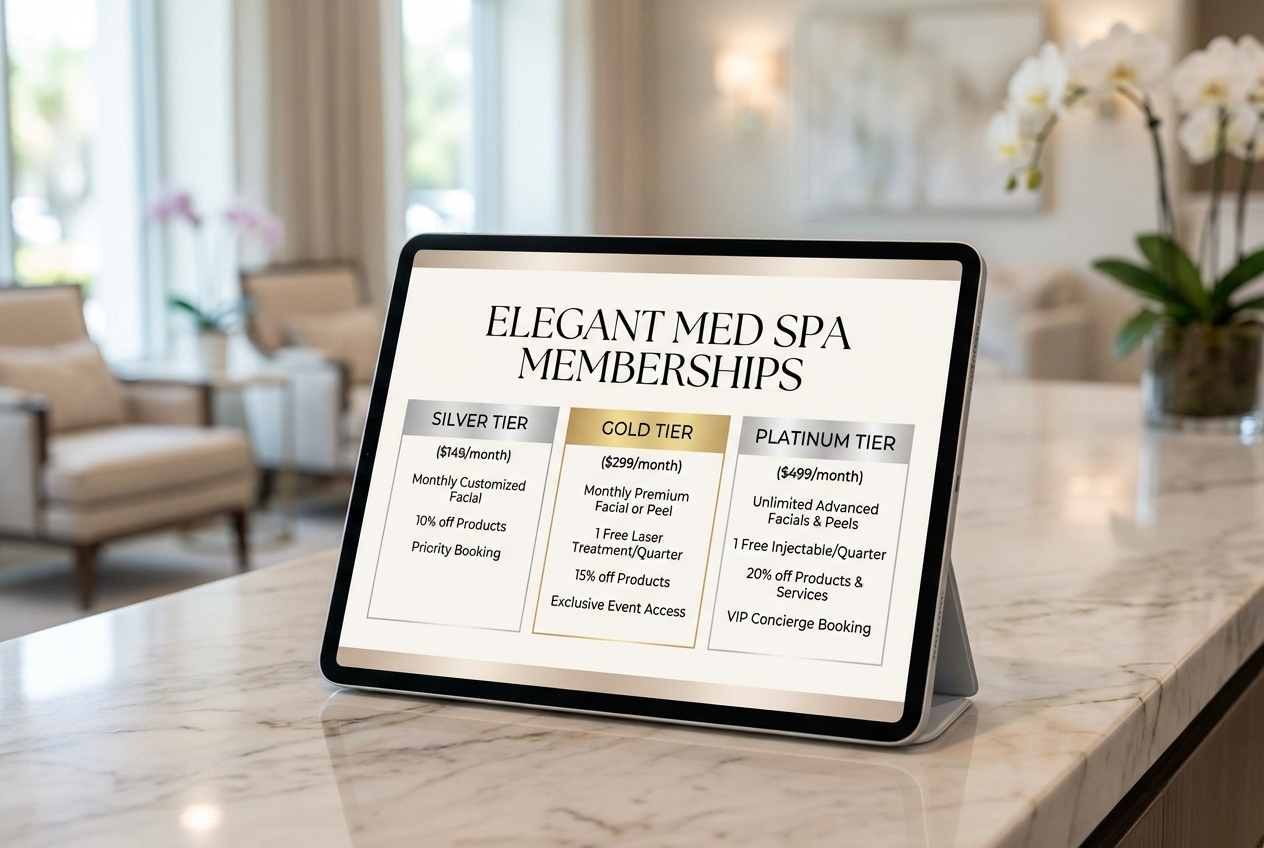
A three-tier model works best:
Tier 1: Essential (Entry-Level)
Price range: $69–$99/month
This is your volume driver — accessible enough to attract new and younger patients who want regular skincare but aren’t ready to commit to major treatments. Focus on:
- One monthly treatment (HydraFacial, chemical peel, or dermaplaning)
- 10–15% discount on retail products
- Priority booking access
- Member-only promotions
Tier 2: Premium (Mid-Level)
Price range: $149–$199/month
This is your highest-converting tier and often your most popular. It hits the Goldilocks zone — clearly better than Essential, clearly more accessible than Platinum. Include:
- One advanced monthly treatment (microneedling, IPL, laser resurfacing)
- Complimentary add-on each visit (LED, growth factor serum, etc.)
- 20% discount on all retail
- Quarterly consultation with your lead provider
- Rollover credits for unused months (up to 1 month)
Tier 3: Platinum (VIP)
Price range: $299–$399/month
This is your loyalty and status tier. Patients who enroll here are committed to their skincare — and often your biggest advocates. Load it with value:
- Two treatments per month
- Injectable credits ($50–$100/month toward Botox, fillers, or other injectables)
- Unlimited complimentary add-ons
- Exclusive access to new treatment launches before general patients
- VIP event invitations (launch parties, educational evenings)
- 25% off all retail and non-included services
- Dedicated patient coordinator
Pricing Your Program for Profitability
Membership pricing is a balancing act: it needs to feel like incredible value for the patient while still generating profit for the practice. A few guidelines:
Price at 70–80% of retail value. If your monthly Essential treatment retails for $130, pricing the Essential membership at $89–$99 gives patients a real reason to join without destroying your margins. Track your cost per treatment and build in at least 40% margin even after member discounts.
Use tiered pricing to drive upgrades. The gap between Essential and Premium should feel small enough that upgrading seems obvious. A $50 jump for significantly more value is a no-brainer for most patients once they see the comparison.
Don’t discount too aggressively upfront. Some practices offer a founding member rate to fill the initial cohort — this works, but cap it. “Founding member pricing for the first 50 enrollees” creates urgency and lets you normalize the standard price afterward.
Factor in churn. Industry average churn for med spa memberships runs 5–10% per month. Build churn assumptions into your pricing model and plan your membership growth goals accordingly.
Setting Up the Tech
You need three things to run a membership program: payment processing, agreement management, and scheduling integration.
Payment processing. Platforms like PatientFi, Alle, Vagaro, and Zenoti all have membership billing built in. If you’re running on a generic EMR, you can layer in a subscription billing tool like Stripe with a simple agreement form. Autopay is non-negotiable — manual invoicing kills retention.
Digital membership agreements. Use a tool like DocuSign or PandaDoc for enrollment agreements that spell out the terms: minimum commitment period (typically 3–6 months), cancellation policy, rollover rules, and what’s included at each tier. This protects you legally and sets clear expectations.
Booking and tracking. Your scheduling software needs to flag member patients so front desk staff know what’s included in their visit. Integrations between your PMS and scheduling tool prevent billing errors and make the member experience feel seamless.
Automated reminders. Members who haven’t scheduled their monthly treatment are churn risks. Set up automated texts or emails at day 15 of each month: “Hey [Name], your [Tier Name] treatment is waiting — here’s a link to book before the month ends.” This alone improves utilization and retention.
For help connecting your payment, scheduling, and CRM tools, explore CRM automation for small business and automated follow-up sequences to keep your membership pipeline warm.

Launching Your Membership Program
The biggest mistake practices make at launch is waiting until everything is perfect. Get your Essential and Premium tiers live, iron out the kinks with your first cohort, then add Platinum.
Pre-Launch: Build the List
Before you announce publicly, identify your best candidates:
- Patients who visit 4+ times per year (already your ideal member)
- Patients who spend $1,500+ annually on treatments
- Anyone who’s asked about discounts or packages
Reach out to these patients personally — a hand-signed card from the physician or a personal email from your patient coordinator — before the general announcement. Giving your best patients “early access” creates goodwill and fills your first cohort without heavy advertising spend.
Launch Week: Create Urgency
Announce to your full patient list and social media with a founding member offer:
- “Founding membership pricing available for the first 60 days — lock in [X]% off the standard rate for as long as you stay enrolled”
- Run an in-office enrollment event (light refreshments, consultations, complimentary mini-treatment for anyone who signs up that day)
- Partner with your front desk: every appointment that week ends with a membership conversation
Your team needs to be trained and enthusiastic. If the person checking out a patient mumbles something about “we also have memberships now,” it won’t convert. Role-play the conversation, make sure everyone can explain each tier confidently, and tie a small incentive to enrollment for front desk staff.
Post-Launch: Keep Filling the Funnel
After launch, membership enrollment becomes a standing offer, not a campaign. Every new patient consultation should include a membership conversation. Build it into your intake process: “Have you heard about our monthly skincare plans?”
Use email marketing automation to nurture non-member patients with monthly content about the benefits — member spotlights, result photos, FAQs, and the occasional “did you know a membership saves you $X per year?” calculation.
Retaining Members Long-Term
Enrollment is only half the battle. Retention is where membership economics really shine.
Deliver on the promise. This sounds obvious, but it’s where most programs fail. If the experience of being a member doesn’t feel measurably better than being a retail patient, churn will be high. Prioritize members in scheduling, greet them by name, remember their treatment history and preferences.
Monthly touchpoints. Beyond their actual visit, members should hear from you monthly. A brief newsletter with skincare tips, a product rec, or a heads-up about new treatments builds the relationship outside the clinic.
Annual reviews. At their anniversary month, schedule a complimentary consultation to review their skin progress and recommend adjustments. This is also your natural upsell moment — patients who’ve seen results are often ready to upgrade tiers.
Win-back campaigns. When a cancellation notice comes in, don’t just process it and move on. Have a win-back script: understand why they’re canceling, and offer a pause option (skip 1–2 months without losing benefits) if cost or life circumstances are the issue. Practices that offer a pause feature report 20–30% fewer full cancellations.
Track your key metrics monthly: new enrollments, active members by tier, churn rate, and average member lifetime value. Use your CRM to flag at-risk members — those who haven’t booked their treatment in 3+ weeks — for proactive outreach. See patient review management for how to build feedback loops that also help improve your program over time.
Using Membership Data to Grow Your Practice
Your membership program is also a research tool. Over time, it tells you:
- Which treatments are most popular (and should be promoted more aggressively)
- Which patients upgrade tiers (and what triggered the upgrade)
- Which acquisition channels bring in members vs. one-off patients
- Seasonal patterns in utilization vs. churn
This data should inform your marketing calendar, service menu, and staff scheduling. If 60% of your Premium members choose microneedling as their monthly treatment, that’s a signal to offer package deals or promote adjacent treatments that complement it.
For deeper insights into how to use your membership data to forecast demand and personalize outreach, explore predictive analytics for small business.

What to Avoid
A few common pitfalls that sink otherwise good membership programs:
Overcomplicating the tiers. Four or five tiers create decision paralysis. Three is the sweet spot. If you’re struggling with the offer, simplify.
Weak cancellation policies. Too easy to cancel and patients leave at the first sign of financial stress. Too hard, and you get chargebacks and angry reviews. A 3-month minimum commitment with 30 days written notice is standard and defensible.
Ignoring compliance. Depending on your state, bundled service agreements and prepaid treatment packages have specific regulations. Work with a healthcare attorney to review your membership agreement before launch, especially if you’re including injectable credits or prescription treatments.
Treating members like everyone else. If a member calls and gets put on hold, or books online and sees no difference from a regular patient, the program loses its value. The intangibles of membership — being known, being prioritized, feeling like a VIP — are what keep people enrolled.
Is a Membership Program Right for Your Practice?
If you’re doing fewer than 100 patient visits per month and are still building your core service menu, launching a membership program may be premature — focus on building visit volume first.
But if you have a consistent patient base, a clear service menu, and a front desk team ready to handle enrollment conversations, a membership program is one of the highest-ROI moves you can make. The practices that do it well see 20–40% of their revenue becoming predictable and recurring within 12–18 months of launch.
The technology is accessible, the patient appetite is there, and the economics are compelling. The only thing left is execution.
Ready to build a retention and revenue engine for your practice? Monsoft Solutions helps med spas and aesthetic practices implement the automation, CRM, and digital marketing systems that make membership programs run — and grow — on autopilot.