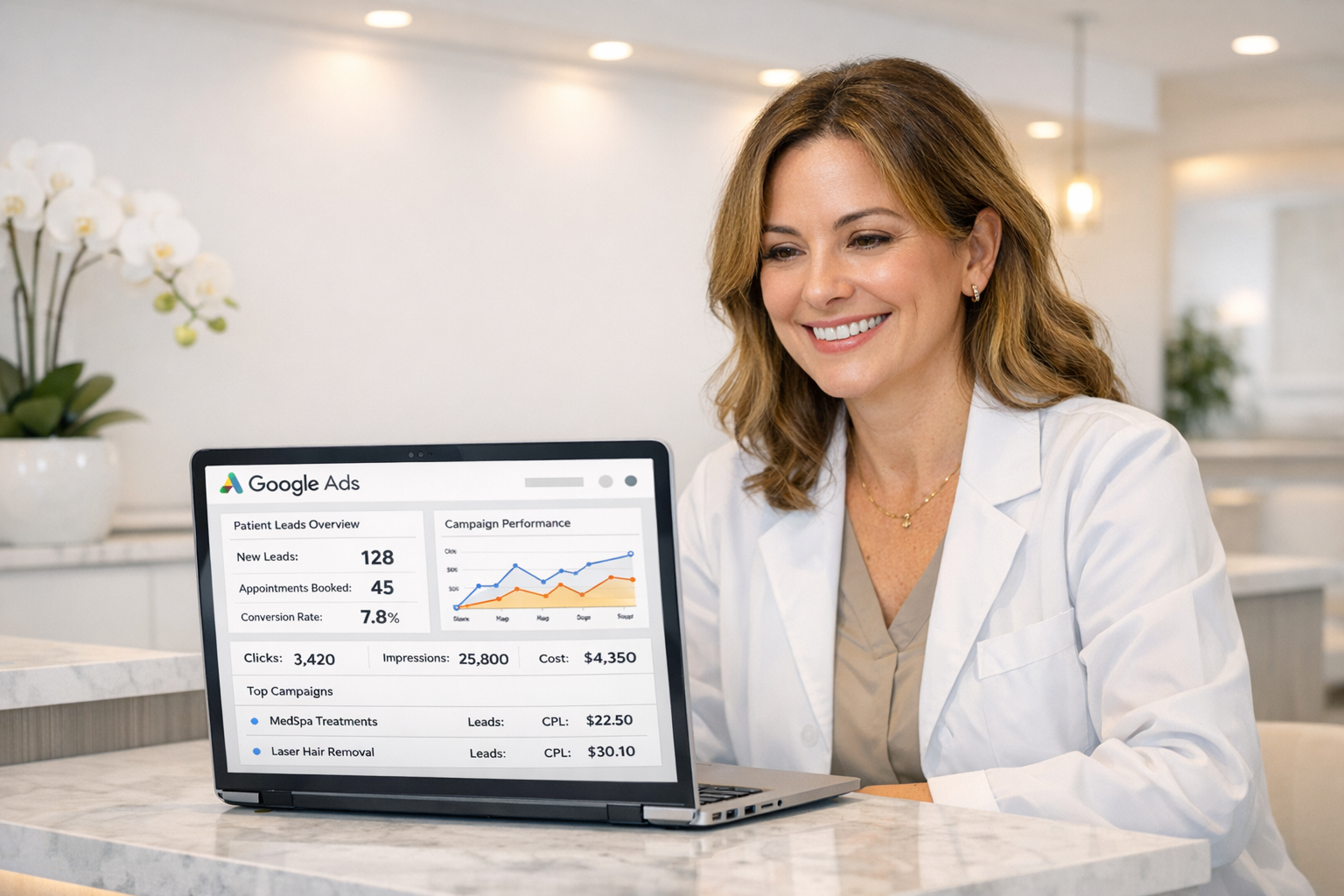
Most medical spas are sitting on untapped revenue. Not because their treatments aren’t good — they are. Not because their staff isn’t skilled — they are. It’s because the people searching for exactly what they offer can’t find them at the moment it matters most.
Google Ads fixes that. When someone types “Botox near me” or “best med spa for laser skin resurfacing in [your city],” Google Ads puts your practice directly in front of them — before they scroll past organic results, before they find your competitor, and when they’re actively ready to book.
This guide covers everything you need to run profitable Google Ads campaigns for your medical spa: keyword strategy, ad copy that converts, landing page best practices, budget management, and the compliance considerations that are unique to the aesthetics industry.
Why Google Ads Is a Game-Changer for Medical Spas
SEO is a long game. Social media builds awareness. But Google Ads delivers something neither can match: high-intent patients who are actively searching for your services, right now.
Consider the intent difference. Someone who sees an Instagram ad for a Hydrafacial is passively scrolling — they weren’t looking for it. Someone who types “Hydrafacial in Naples FL” into Google is searching — they already want it. They’re two very different people, and the Google searcher is far closer to booking.
That’s the core advantage of search advertising for medical spas:
- Immediate visibility — your ad appears within hours of launching a campaign
- Scalable intent capture — you only appear when someone is looking for what you offer
- Precise geographic targeting — reach patients within a specific radius of your practice
- Budget control — spend as little or as much as you want, and pause anytime
- Measurable ROI — track exactly which searches, ads, and keywords generate bookings
The competition in medical aesthetics is fierce, especially in markets like South Florida, Dallas, or Los Angeles. But in smaller and mid-size markets, many med spas still run little to no paid advertising — which means the opportunity to dominate local search is wide open.
Understanding Medical Advertising Restrictions
Before you build your first campaign, you need to understand the rules. Google’s healthcare advertising policies are strict, and violations can get your account suspended.
What you generally cannot do:
- Make before-and-after claims that imply guaranteed results (“You will look 10 years younger”)
- Use personalized health claims targeting users based on sensitive health data
- Advertise prescription drugs without proper certification
- Make misleading claims about treatment safety, efficacy, or recovery time
What you can do:
- Promote non-invasive services freely (facials, laser treatments, Hydrafacial, body contouring)
- Promote injectables (Botox, fillers) with careful, factual language
- Use social proof-style copy (“Thousands of happy patients” is fine; specific health claims require care)
- Highlight accreditations, credentials, and licensed providers
- Promote special offers, consultations, and pricing
The general rule: be factual, avoid guarantees, and don’t make claims you can’t back up in peer-reviewed literature. When in doubt, run copy by a healthcare compliance advisor before launching.
Regarding HIPAA: Google Ads itself doesn’t involve patient health records, so standard HIPAA concerns about PHI don’t apply directly to your campaigns. That said, ensure your landing pages and booking forms have appropriate privacy disclosures and that any remarketing audiences are built on consent-based tracking. For a deeper dive into digital compliance, see our guide on digital marketing for aesthetic practices.
Keyword Strategy: The Foundation of Every Campaign
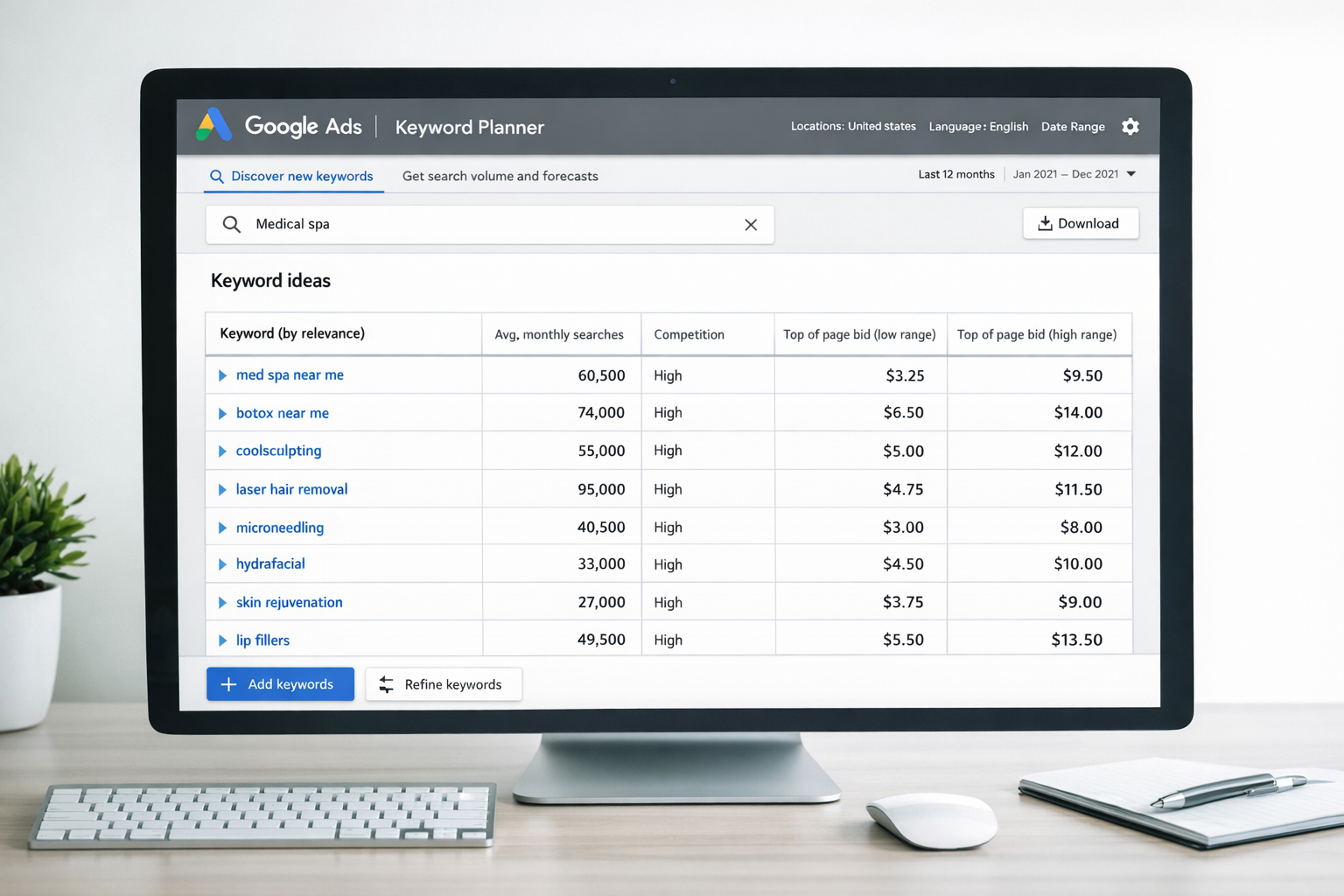
Your keyword strategy determines who sees your ads and what you pay per click. Get this wrong and you’ll burn budget on irrelevant traffic. Get it right and you’ll have a steady pipeline of booked consultations.
The Three Tiers of Medical Spa Keywords
Tier 1: High-Intent Service Keywords These are searches from people ready to book. They’re the most valuable and most competitive:
- “Botox near me”
- “laser hair removal [city]”
- “Hydrafacial [city]”
- “lip filler near me”
- “CoolSculpting [city]”
- “microneedling [city]”
Bid aggressively here. These convert.
Tier 2: Problem-Aware Keywords These searchers know their problem but haven’t decided on the treatment:
- “how to get rid of wrinkles around eyes”
- “best treatment for dark spots on face”
- “non-surgical double chin removal”
- “tighten loose skin on neck non-invasive”
These are less competitive, cheaper per click, and can deliver strong ROI with the right landing page that educates and guides toward booking.
Tier 3: Competitor and Brand Keywords Bidding on competitor names is controversial but legal. If someone searches for a competitor med spa, your ad can appear above their result. Some practices avoid this on principle; others use it strategically, especially in competitive markets.
Match Types That Matter
Google Ads offers three keyword match types. Using them strategically saves budget:
| Match Type | Example | What It Matches |
|---|---|---|
| Broad | botox treatment | Almost anything Google deems relevant — often too broad |
| Phrase | ”botox near me” | Searches containing that phrase in order |
| Exact | [botox naples fl] | Only that specific search (or very close variants) |
For medical spas, start with phrase and exact match. Broad match can work once you have conversion data, but early on it burns budget on irrelevant searches. A “broad match” bid on “botox” can trigger for “botox reversal,” “botox side effects,” or “botox horror stories” — none of which are people you want to pay to reach.
Negative Keywords: Your Budget’s Best Friend
Negative keywords are searches you explicitly exclude. They’re one of the most underused features in Google Ads and can cut wasted spend by 20-40%.
Start with these negatives for a medical spa campaign:
- “free” / “free botox”
- “cost” (if you’re not targeting price-sensitive researchers)
- “how to do” / “DIY”
- “side effects” / “risks” / “dangers”
- “training” / “certification course”
- “jobs” / “careers” / “hiring”
- competitor names (if you’re not deliberately bidding on them)
Build your negative keyword list before launching, then add to it weekly as you review search term reports.
Writing Ad Copy That Converts
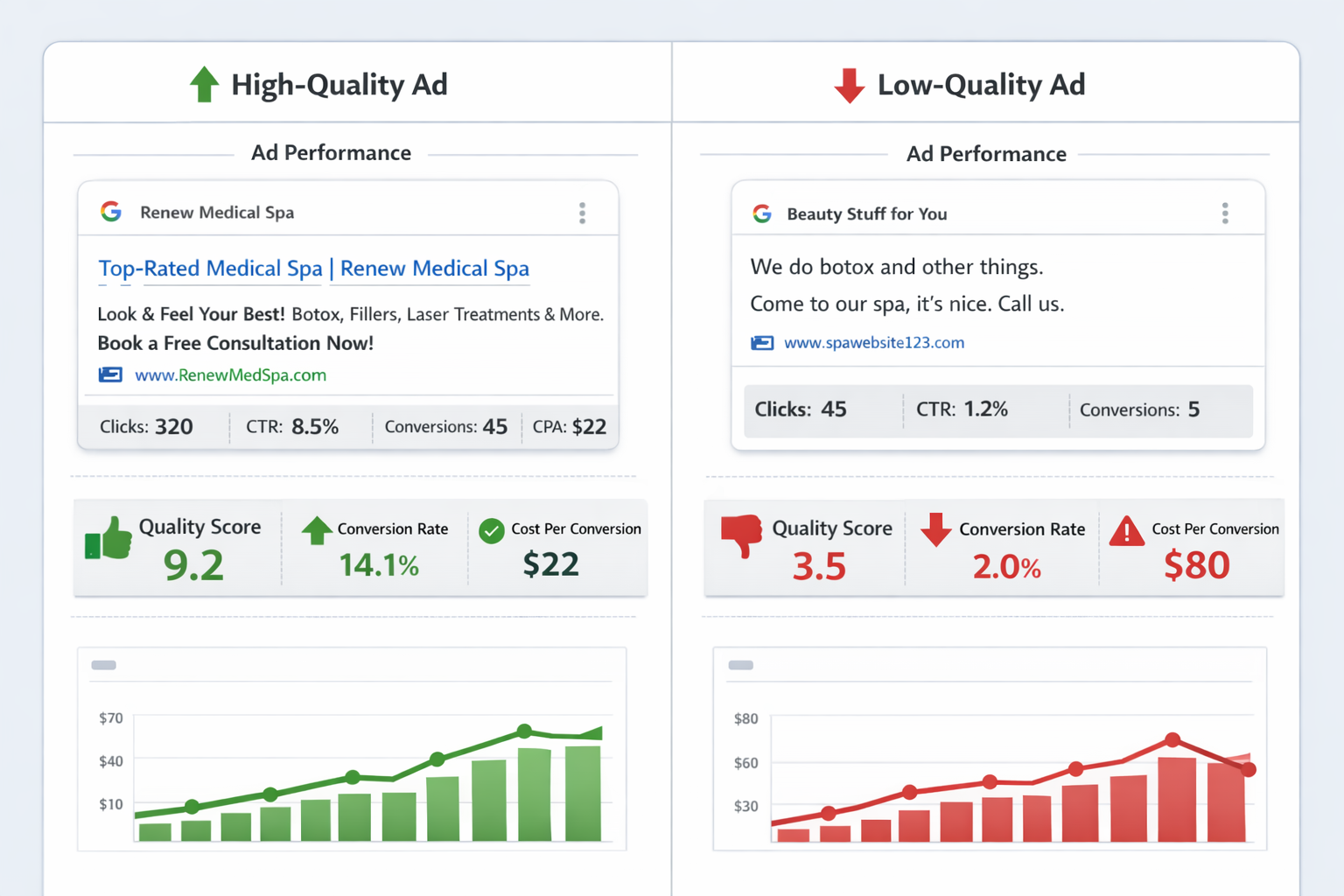
Medical spa patients aren’t just buying a service. They’re buying confidence, results, and trust in the provider. Your ad copy needs to communicate all three in under 30 characters per headline.
The Anatomy of a High-Converting Med Spa Ad
Google’s Responsive Search Ads (RSAs) let you provide up to 15 headlines and 4 descriptions. Google automatically tests combinations to find what performs best.
Strong headline frameworks:
- Urgency + Location: “Book Botox in Naples Today”
- Result + Timeframe: “Smoother Skin in 30 Minutes”
- Trust Signal: “Board-Certified Injectors · Since 2015”
- Offer: “Free Consultation · Limited Spots”
- Social Proof: “500+ Five-Star Reviews”
Description best practices:
- Lead with the patient’s benefit, not your features
- Include a clear CTA: “Book Your Free Consultation Now”
- Mention financing if you offer it: “Flexible Payment Plans Available”
- Address the objection: “No Downtime · Same-Day Appointments”
What doesn’t work:
- Vague copy (“We’re the best med spa in the area”)
- Listing treatments without benefits (“We offer Botox, fillers, laser”)
- Missing CTA or weak CTAs (“Learn more” vs. “Book Now”)
Use ad extensions (now called “assets”) to maximize real estate: sitelinks to specific service pages, callouts for unique selling points, call extensions with your phone number, and location extensions tied to your Google Business Profile.
Landing Pages: Where Clicks Become Patients
This is where most medical spas lose money. They run decent ads, get decent clicks, then send everyone to their homepage — and wonder why no one books.
A dedicated landing page for each campaign (or at minimum each service) will dramatically improve your conversion rate. Here’s what that page needs:
Above the fold:
- A clear headline matching the search intent (“Schedule Your Botox Consultation in Naples”)
- A high-quality image of your actual practice or a real patient result (with consent)
- A visible booking form or prominent CTA button — no scrolling required
Trust signals:
- Provider credentials (MD, RN, PA designations)
- Years in business / number of treatments performed
- Before/after gallery (HIPAA-compliant, patient-consented)
- Real reviews with star ratings
Content:
- What the treatment includes
- What to expect during and after
- Pricing or “starting at” range (patients will Google this anyway — transparency wins)
- FAQs that address the most common objections
The CTA:
- Make it specific: “Book Your Free Botox Consultation” not just “Contact Us”
- Repeat it 2-3 times down the page
- Offer phone call as an alternative — some patients prefer to talk first
For a detailed breakdown of landing page optimization, see our landing page guide.
Bidding Strategies and Budget Management
Start Simple, Then Scale
When launching your first campaigns, use Maximize Conversions or Target CPA (Cost Per Acquisition) bidding — but only once you have at least 30-50 conversions tracked. Before that, use Manual CPC so you maintain control and learn what keywords actually convert.
A typical starting budget for a medical spa in a mid-size market: $1,500–$3,000/month. In highly competitive markets (Miami, NYC, LA), you’ll need more to be competitive.
What’s a Good CPA for a Med Spa?
Think about your average transaction value:
- Botox touch-up: $300–$600
- Full face filler: $1,500–$3,000
- Laser package: $2,000–$6,000
- Membership signup: $150–$300/month with high LTV
If your average new patient generates $800 in their first visit and stays for an average of 3 years, even a $200–$300 CPA is an excellent return. Work backwards from your patient lifetime value (LTV) to determine the maximum CPA that keeps campaigns profitable.
Campaign Structure Best Practices
Organize campaigns by service category, not by keyword. This keeps budgets isolated and performance data clean:
- Campaign 1: Injectables (Botox, fillers)
- Campaign 2: Laser Treatments (hair removal, resurfacing, IPL)
- Campaign 3: Body Contouring (CoolSculpting, Emsculpt, etc.)
- Campaign 4: Skin Treatments (Hydrafacial, microneedling, peels)
- Campaign 5: Branded (your practice name)
Within each campaign, create tightly themed ad groups. “Botox” and “lip filler” should be separate ad groups — they have different searcher intent and deserve different ad copy and landing pages.
Remarketing: Convert the Browsers Into Bookers
Most first-time visitors to your website don’t book on the first visit. They’re researching. Remarketing lets you stay in front of them as they continue browsing the web.
How it works: A tracking pixel on your website creates audiences based on page visits. Visitors to your Botox page see ads for your Botox consultation. Visitors who started booking but didn’t complete see ads reminding them to come back.
Remarketing audiences to build:
- All site visitors (general awareness retargeting)
- Visitors to specific service pages (service-specific offers)
- Booking page visitors who didn’t convert (highest priority — they almost booked)
- Past patient lookalikes (if you have an email list to upload)
Keep remarketing ad frequency capped at 3-5 impressions per user per day — enough to stay top-of-mind without being annoying.
Tracking What Matters
You can’t improve what you don’t measure. Set up these conversions in Google Ads before launching any campaign:
- Phone call conversions — calls lasting 60+ seconds from ads
- Form submissions — consultation request, contact form
- Booking completions — if you have an online scheduling system
- Chat initiations — if you use a chat widget
Connect Google Ads to Google Analytics 4 for deeper audience insights and attribution data. Our Google Analytics 4 guide covers the setup in detail.
Review your campaign performance weekly during the first month:
- Click-through rate (CTR): Below 3% means your ads need work
- Quality Score: Below 6 means relevance issues between keyword → ad → landing page
- Conversion rate: Industry average is 3-5%; above 8% is excellent
- Cost per conversion: Compare against your patient LTV
Common Mistakes Medical Spas Make With Google Ads
Sending all traffic to the homepage. Your homepage is a welcome mat. Paid traffic needs a conversion-optimized landing page for each service or offer.
Not adding negative keywords from the start. Without negatives, you’ll pay for clicks from people looking for jobs at a med spa, DIY at-home “botox” alternatives, or medical school training programs.
Setting and forgetting. Google Ads requires active management. Search trends shift, competitors change bids, and Google’s algorithm makes automatic adjustments. Campaigns that aren’t reviewed weekly slowly degrade.
Ignoring the Quality Score. A low Quality Score means Google charges you more per click than competitors with better scores. Improving your ad relevance and landing page experience can cut your costs by 30-50%.
Stopping campaigns when they get busy. Many practices pause ads when they’re fully booked, then struggle to fill their calendar the following month. Maintain consistent advertising and use budget controls to manage volume.
Not testing. Run A/B tests on headlines, CTAs, landing page layouts, and offers. Small improvements compound into significant revenue gains over time.
Your Google Ads Launch Checklist
Before going live, make sure you’ve covered:
- Google Ads account linked to Google Analytics 4
- Conversion tracking for calls, forms, and bookings
- Negative keyword list built (minimum 20-30 terms)
- Dedicated landing pages for each campaign — not the homepage
- Ad copy reviewed for Google healthcare policy compliance
- At minimum 3 headlines and 2 descriptions per ad group
- Location targeting set to your service area (radius + city)
- Ad scheduling enabled (consider pausing ads when your office is closed)
- Call extension added with your practice phone number
- Starting budget set conservatively until you have conversion data
Putting It All Together
Google Ads works for medical spas because it captures patients at their highest intent moment — when they’re already searching for what you offer. A well-structured campaign with the right keywords, compelling ad copy, a conversion-optimized landing page, and consistent optimization can deliver a consistent flow of new patient bookings at a predictable cost.
The investment pays for itself when you look at patient lifetime value. One new membership client, one full-face filler patient, or one person who starts coming for regular Botox touch-ups can be worth $3,000–$10,000+ over the years they’re with your practice.
To make the most of those new patients once they arrive, pair your Google Ads efforts with a strong patient onboarding automation system and an online reputation strategy that captures reviews automatically.
Ready to build your first campaign? Let’s talk →
Monsoft Solutions helps medical spas and aesthetic practices build marketing systems that generate high-quality patient leads and grow predictably. Contact us to learn how we can build and manage your Google Ads campaigns.