
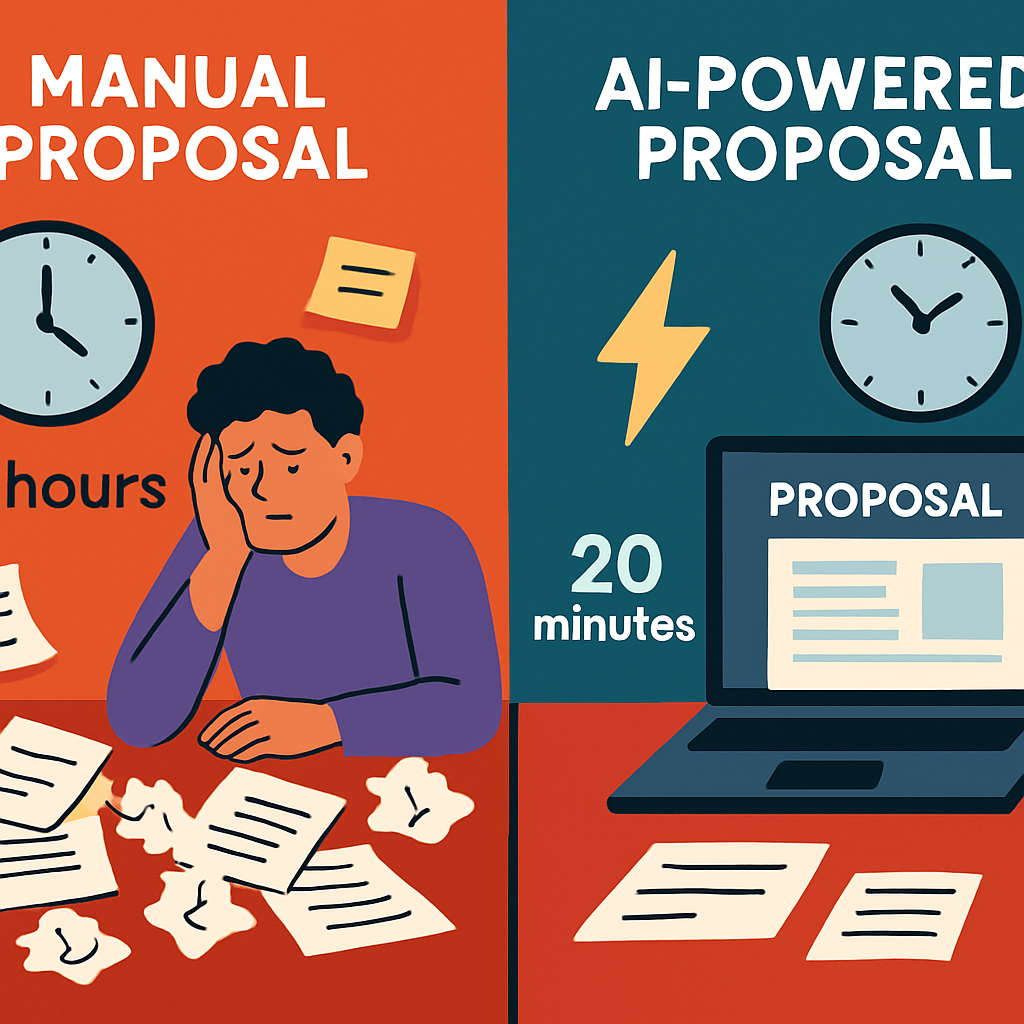
You lose jobs you should win. Not because your pricing is wrong or your work is bad — but because your competitor sent a polished, professional proposal within two hours and yours went out the next day in a Word document with inconsistent fonts.
Proposals are sales tools. And most small businesses treat them like a necessary evil: time-consuming, repetitive, and low on the priority list. AI changes that math entirely.
This guide shows you exactly how to use AI to write winning proposals faster, personalize them for every client, and build a repeatable system that turns your proposal process into a competitive advantage.
Why Proposals Lose (Before They’re Even Read)
Before diving into AI tools, it’s worth understanding where proposals typically fail. Most don’t lose on price — they lose on:
- Speed: The first credible proposal often wins. Delays signal disorganization.
- Relevance: Generic proposals feel like templates. Clients want to feel like you understand their specific situation.
- Clarity: Proposals that bury the value in paragraphs of jargon lose to ones that make the ROI obvious in 30 seconds.
- Professionalism: A beautifully formatted proposal raises perceived value before you even state a price.
AI directly addresses all four. It helps you respond faster, personalize at scale, write clearly, and produce polished output every time.
What AI Actually Does in Proposal Writing
“AI proposal writing” means different things depending on the tool. Here’s what’s actually available:
AI-Assisted Drafting
You provide context — project scope, client name, budget range, key deliverables — and the AI generates a structured first draft. This isn’t just filling in a template; modern tools can write complete sections, suggest pricing language, and tailor tone to the industry (very different proposals for a dentist vs. a tech startup).
Smart Templates and Personalization
AI-powered proposal tools store your past wins and losses, then suggest which approach is most likely to work for a given client type. They pull in company data (from CRM records or public sources like LinkedIn) to personalize the intro and problem statement automatically.
Pricing Optimization
Some tools analyze your historical win rate by price tier and recommend pricing strategies based on deal size and client type. This is especially useful when you’re unsure whether to anchor high and negotiate or come in with your best number upfront.
Follow-Up Automation
AI tracks when a prospect opens your proposal, how long they spent on each section, and whether they forwarded it to a decision-maker. You get actionable signals: if someone spent 8 minutes on the pricing page and then closed it, that’s a buying signal worth acting on immediately.
Top AI Proposal Tools for Small Businesses
| Tool | Best For | Starting Price |
|---|---|---|
| PandaDoc | Full proposal workflow + e-signature | $19/month |
| Proposify | Design-forward proposals + analytics | $49/month |
| Qwilr | Interactive web-based proposals | $35/month |
| Better Proposals | Simple + fast for solo operators | $19/month |
| HoneyBook | Service businesses + contract/invoice in one | $19/month |
| Dubsado | Creative services + full client workflow | $20/month |
| ChatGPT / Claude | Custom AI drafting for any template | $20/month |
For most small businesses, the practical stack is: a dedicated proposal tool (PandaDoc, Proposify, or HoneyBook depending on your industry) combined with an AI writing assistant (ChatGPT or Claude) for first drafts and personalization.
Building Your AI Proposal System: Step by Step
Step 1: Create Your Master Proposal Template
Before AI can help you, you need a solid base template. Every great proposal includes:
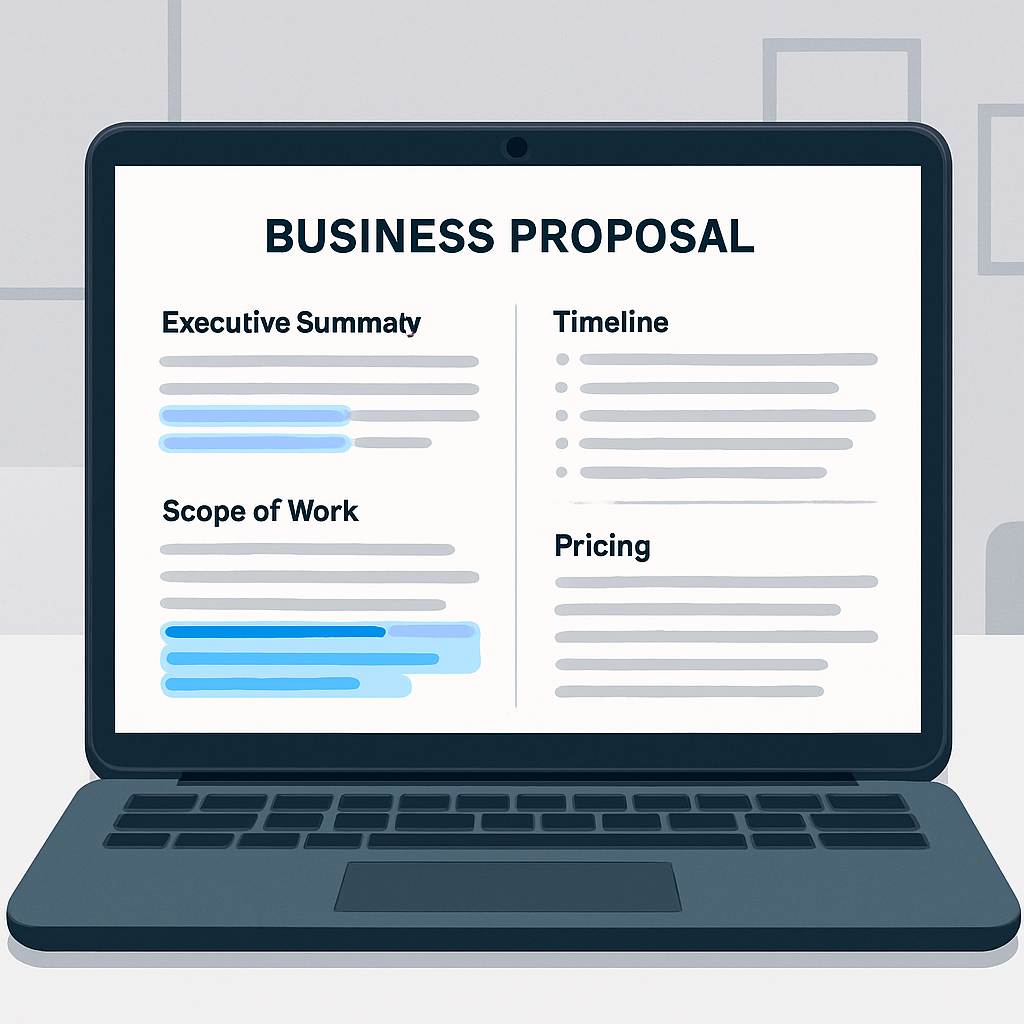
- Executive Summary — 2–3 sentences restating the client’s problem in their words
- Your Solution — What you’re going to do and why it works for their situation
- Scope of Work — Specific deliverables with clear boundaries (what’s included and what isn’t)
- Timeline — Phases with milestone dates
- Investment — Pricing with options when possible (more on this below)
- About Us / Social Proof — 2–3 relevant case studies or client results
- Next Steps — One clear action (sign here, schedule a call, choose a package)
Build this once, clean. Every AI-assisted proposal starts from here.
Step 2: Train Your AI on Your Voice and Wins
Paste your three best past proposals into your AI tool of choice and ask it to identify what made them effective. Ask it to extract your writing voice and tone. Save this as a “style reference” you use every time you prompt the AI to draft.
This step transforms generic AI output into something that actually sounds like you — which matters enormously for proposals that need to convey trust.
Step 3: Build a Personalization Prompt
For each new proposal, give the AI a brief with:
- Client company name and what they do
- The specific problem they described in your discovery call
- Their key decision criteria (price sensitivity, timeline pressure, quality expectations)
- Any specific concerns they raised
- Your proposed solution and scope
A good personalization prompt gets the AI to write the Executive Summary and Problem sections in a way that feels bespoke — like you really listened. This takes 5 minutes per proposal instead of 45.
Step 4: Use Tiered Pricing
One of the highest-ROI changes you can make to your proposals: always present three price options. Research by behavioral economist Dan Ariely consistently shows that offering three tiers increases average deal size by 20–30% compared to a single price.
Name your tiers around outcomes, not features:
- Essential — Core deliverables, fastest path to the primary goal
- Accelerated — Core + supporting systems, better results, higher certainty
- Transform — Complete solution, ongoing support, maximum ROI
AI tools can help you draft each tier description so they feel natural and not like an upsell pitch.
Step 5: Automate the Send and Follow-Up
A proposal sent manually from your email is a black hole. You have no idea if it was opened, forwarded, or ignored. A proposal tool changes this completely:
- Send-time tracking — See exactly when they opened it
- Section engagement — Know which parts they read carefully
- Automated reminders — If not opened in 48 hours, trigger a follow-up: “Hey — just wanted to make sure my proposal got through. Happy to jump on a quick call if you have questions.”
- Win/loss tracking — Build data over time on what’s working
Connect your proposal tool to your CRM (see our CRM automation guide) so won deals automatically move to the onboarding sequence and lost deals enter a nurture track.
AI Proposal Writing for Specific Industries
Service Businesses (Landscaping, Cleaning, Home Services)
Focus on speed over elegance. For service businesses, a proposal sent in 30 minutes beats a beautiful one sent tomorrow. Use AI to draft a concise 1-page proposal with clear scope, timeline, and pricing — then automate e-signature. Tools like Jobber and ServiceTitan have built-in proposal features with light AI capabilities.
Creative Agencies (Marketing, Design, Video)
Proposals are part of the product. They need to look good and communicate vision. Use Qwilr or Proposify for interactive proposals, and use AI to help write compelling case study summaries that show results, not just work.
Consultants and Coaches
The problem statement section is everything. Prospects need to feel understood before they feel ready to invest. Use AI to turn your discovery call notes into a 3-paragraph problem statement that mirrors their exact language. Nothing closes faster than a prospect reading their own words back to them.
Medical and Aesthetic Practices
Proposals for treatment plans or practice technology need to balance professionalism with HIPAA sensitivity. For internal use, AI can help draft patient communication templates (not medical advice). For vendor proposals or partnership proposals, standard AI drafting applies. See our HIPAA compliance guide for related automation considerations.
Common Proposal Mistakes AI Helps You Avoid
Writing about yourself instead of the client. Most proposals are essentially company brochures that happen to include a price. AI forces you to frame around the client’s outcomes when you prompt it correctly. Try: “Write this as if the client’s goal is the hero of the story, not my services.”
Burying the price. Prospects scan proposals. If your pricing is on page 8, you’ve already lost their attention. AI tools and modern templates move pricing earlier and make it scannable.
Forgetting social proof. AI can pull relevant client testimonials or case study snippets into your proposals automatically if you’ve built a testimonial library. Even one sentence — “We helped [similar business] achieve X” — increases close rate meaningfully.
No clear next step. A proposal without a specific CTA (“Sign by Friday to lock in this pricing / Click here to schedule your kickoff call”) creates friction. AI won’t forget to include it if your template always has a next-steps section.
Measuring Your Proposal Performance
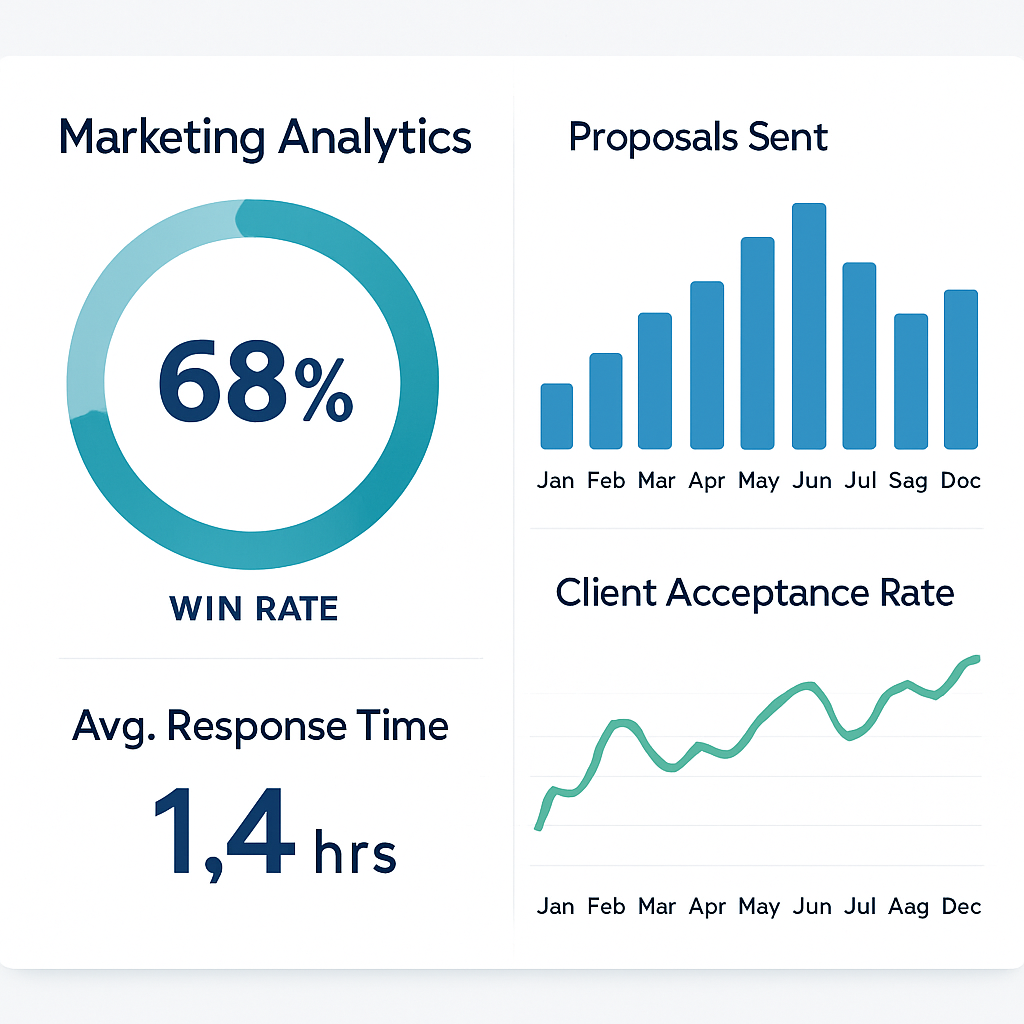
Once you have a tool with analytics, track these monthly:
| Metric | Benchmark | What to Do If Low |
|---|---|---|
| Proposal win rate | 35–55% for inbound leads | Audit tone, pricing, and social proof sections |
| Time-to-send | Under 24 hours | Invest in AI drafting + template optimization |
| Open rate | 80%+ | If low, check subject lines and email deliverability |
| Proposal-to-call rate | 15–25% | Add a clear “schedule a quick call” CTA |
| Average proposal value | Track trend | Test tiered pricing if not already using it |
Review these quarterly. A 10% improvement in win rate on a $5,000 average proposal value means significantly more revenue from the same number of conversations — without hiring anyone.
Connecting Proposals to Your Broader Sales Automation
The proposal step doesn’t exist in isolation. It fits into a sales system that should be as automated as possible:
- Lead capture → AI chatbot or contact form
- Lead qualification → CRM scoring (AI lead scoring guide)
- Discovery call → Scheduled automatically (consultation booking guide)
- Proposal → AI-drafted, sent same day ← you are here
- Follow-up → Automated based on open/engagement signals
- Close → E-signature triggers onboarding sequence
- Delivery → Automated reminders and check-ins
When proposal writing is the slowest step in this chain — the bottleneck where deals go cold — fixing it with AI has an outsized impact on revenue. For a complete view of end-to-end funnel automation, see our AI sales funnel automation guide.
30-Day Implementation Plan
Week 1: Foundation
- Audit your last 10 proposals — identify what won vs. lost
- Build your master template with all 7 sections
- Choose a proposal tool and set up your account
Week 2: AI Integration
- Write your style reference document using past winning proposals
- Build a personalization prompt template
- Draft three tiered pricing structures for your core offer
Week 3: Automation
- Connect your proposal tool to your CRM
- Set up automated follow-up sequences (48-hour nudge, 7-day check-in)
- Set up e-signature workflow that triggers onboarding
Week 4: Measure and Optimize
- Review open rates, win rates, and time-to-send from first month
- A/B test two different executive summary approaches
- Identify your highest-converting proposal section and put it earlier
Frequently Asked Questions
Does using AI for proposals feel inauthentic to clients?
No — and the distinction matters. AI drafts the structure and language; you review and send. Your judgment, experience, and client relationship are still fully yours. The proposal reflects your thinking, just written faster. Clients care about relevance and professionalism, not whether you typed every word.
What’s the fastest way to get started with AI proposals?
Start with ChatGPT or Claude and your existing best proposal as a template. Paste the template and a discovery call summary, then ask: “Rewrite the Executive Summary and Problem sections for this specific client using this context.” Test it on your next 5 proposals and compare win rate.
How do I handle pricing in proposals when my services are custom?
Use tiered ranges rather than a single number. Present three options: one that fits their stated budget, one that’s 20–30% above it with better outcomes, and one premium option that represents the full solution. Most clients buy the middle tier — and the high anchor makes it feel like a value.
Can AI handle technical proposals with complex scopes?
Yes, with the right prompts. Give the AI a detailed scope breakdown in bullet points and ask it to convert that into clear client-facing language. Use it for the communication layer — what you’re doing and why it matters — and keep your technical documentation separate.
What if I don’t have case studies yet?
Use results descriptions without naming clients. “We helped a local service business in Southwest Florida reduce their no-show rate by 60% using automated appointment reminders” is specific enough to be compelling without naming names. As you accumulate testimonials, plug them in — but you can close deals without them using strong problem framing alone.
A slow, generic proposal process is a silent revenue drain. Every deal that goes cold waiting for you to find time to write something up is money you left on the table. AI doesn’t replace your expertise — it removes the time tax on communicating it.
Start with one: take your best past proposal, feed it to ChatGPT with the context from your next prospect conversation, and see what it generates in 10 minutes. Then decide whether you want to keep spending two hours on the next one.
Ready to automate more of your sales and client experience? Talk to the team at Monsoft Solutions — we build AI-powered systems that help small businesses grow without adding headcount.