
You’re competing for the same customers as the big-box stores, national chains, and anyone willing to outspend you on Google Ads. That’s a tough fight when your budget has limits theirs don’t.
But there’s a competitive advantage those giants can’t buy: genuine community roots. And local partnership marketing is how you turn that advantage into real revenue.
This isn’t about vague “collaboration” or swapping business cards at a Chamber of Commerce mixer. It’s about building structured, mutually beneficial alliances with other local businesses that send you customers consistently — and vice versa.
Here’s how to do it right.
Why Local Partnerships Work (When Most Marketing Doesn’t)
Referrals from trusted sources convert at dramatically higher rates than cold advertising. When a business a customer already trusts recommends you, that recommendation carries weight that a Google ad never could.
The math is compelling:
- Referred customers convert 3–5x higher than cold traffic
- Referred customers spend 13–18% more on average than non-referred customers
- Lifetime value of referred customers is 16–25% higher — they stay longer and churn less
- Zero media cost — your “ad spend” is the value you deliver to the partner
That last point matters. Every customer a partner sends you costs you nothing upfront. You’re essentially paying per result, and the result is a pre-warmed, pre-qualified lead who already has some trust in you by association.
The 3 Types of Local Business Partnerships
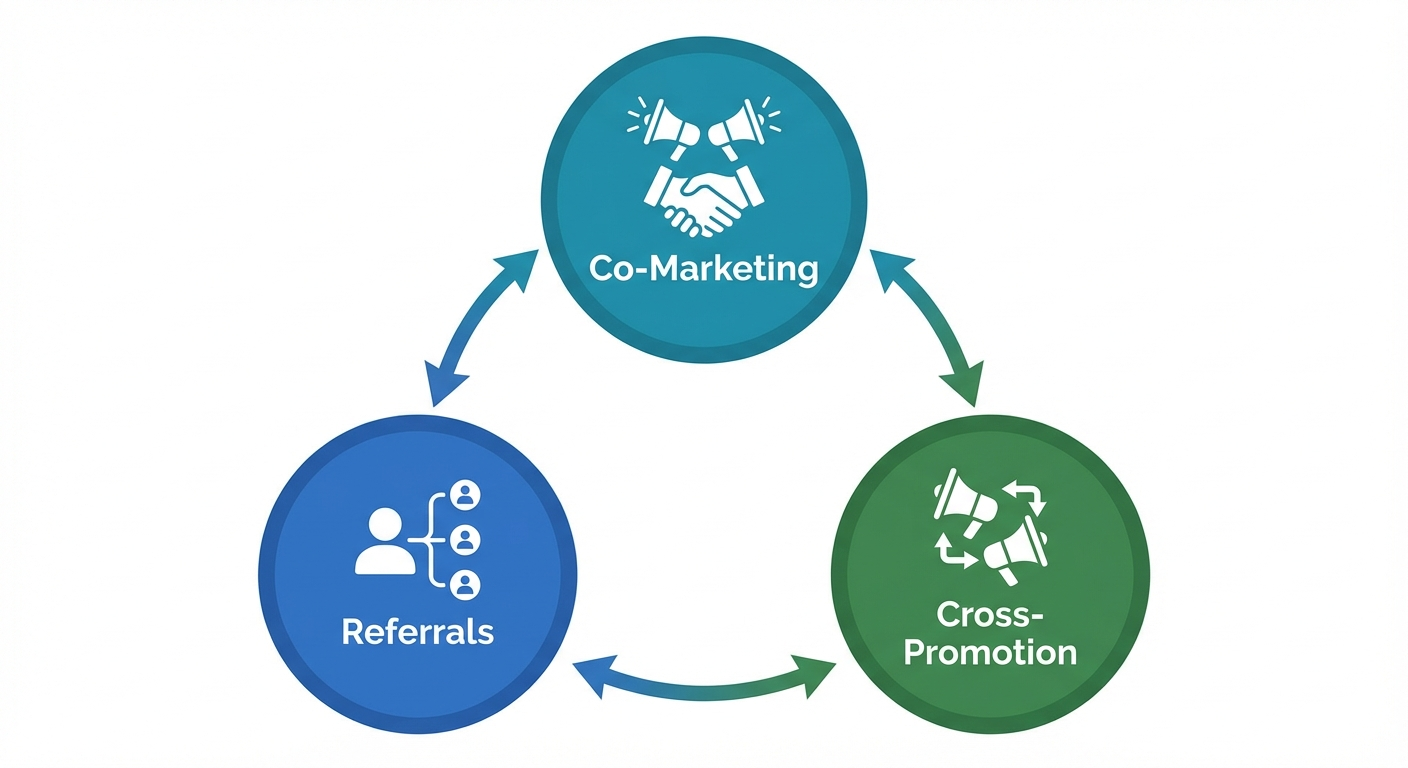
Not all partnerships are created equal. There are three distinct structures, each with different levels of commitment and reward.
1. Referral Partnerships
The simplest and most common. You and another business agree to recommend each other to customers who need what the other provides.
How it works: A wedding photographer recommends your floral design studio to every couple who books them. You recommend the photographer to every client planning a wedding. Both parties benefit — and the customer gets a trusted recommendation from someone they already hired.
What makes it work:
- Natural fit between services (you serve the same customer, at different moments)
- Clear mutual benefit (both sides win)
- Explicit agreement — not just a vague “we’ll send each other clients” verbal understanding
- A tracking mechanism so you know what’s working
Good referral partnerships are built on natural adjacency. A chiropractor and a personal trainer serve the same body-conscious customer. A tax accountant and a business attorney serve the same small business owner. A med spa and a bridal boutique serve the same image-conscious woman.
2. Co-Marketing Campaigns
This is where partnerships get interesting. Instead of just quietly referring customers back and forth, you actively market together — sharing audiences, costs, and results.
Examples:
- A coffee shop and a bookstore co-host a “Books & Brunch” Saturday event
- A fitness studio and a nutrition coach run a joint 30-day transformation challenge
- A real estate agent and an interior designer produce a monthly “Home of the Month” email newsletter
Co-marketing means you’re combining your audiences. If you each have 500 email subscribers and you run a campaign together, you’re suddenly reaching 1,000 warm contacts — without paying for a single ad.
3. Cross-Promotion
Lower commitment than co-marketing, but still highly effective. You promote each other’s businesses through your existing channels and physical spaces.
Tactics:
- Display each other’s business cards or brochures at the point of sale
- Feature partner businesses in your email newsletters (“We recommend…”)
- Tag each other in social media posts when relevant
- Offer partner discounts to each other’s customers (“Show this email for 15% off at [Partner]”)
Cross-promotion works well as a starting point when you’re testing a new partnership before committing to more involved co-marketing.
Finding the Right Partners
The partnership has to make sense for your customer first, and your business second. The best partners:
Serve the same customer without competing. A landscaping company and a pool maintenance service both serve homeowners with property to maintain — and neither competes with the other. Perfect.
Have a similar quality reputation. You’re lending your credibility when you refer someone. If the partner does shoddy work, that reflects on you. Vet partners the same way you’d vet a hire.
Have roughly comparable customer bases. A partnership between a single-location boutique and a regional franchise isn’t equal — the boutique gives more than it gets. Look for businesses where the exchange is genuinely mutual.
Have owners who are engaged and responsive. The best partnership structures fail when one side stops executing. If the owner isn’t personally invested, the referrals dry up fast.
Where to Find Partners
- Your current customer base — ask who else they use. If your customers consistently mention the same landscaper, that landscaper is a natural partner.
- Local business associations — Chamber of Commerce, BNI, industry groups
- Neighboring businesses — literally your neighbors. Geography creates natural complementarity.
- Social media — engage genuinely with local business accounts before pitching anything
How to Approach a Potential Partner
This is where most people stumble. They either never make the ask, or they make it awkwardly.
The key is to lead with value, not ask.
Don’t say: “Hey, would you like to refer customers to each other?”
Do say: “I’ve been sending a few of my clients your way when they mention [your service]. I’ve had great feedback. Would it make sense to formalize that a bit — maybe meet for coffee and see if there’s a structure that works for both of us?”
Starting with “I’ve been sending clients your way” accomplishes several things:
- It makes you immediately valuable before they’ve done anything
- It shows you’ve already vetted them (implied)
- It frames the conversation as formalizing something already happening, not starting from zero
Lead with the give. The ask follows naturally.

Structuring the Partnership Agreement
You don’t need a lawyer for most local business partnerships. But you do need a clear agreement — in writing, even if it’s just an email — that covers:
What each party commits to doing:
- “We will include each other in our monthly email newsletter”
- “We will display each other’s cards at the front desk”
- “We will refer customers who mention [need] to each other before recommending anyone else”
How referrals will be tracked:
- A simple tracking method: customers mention who referred them at time of booking
- Digital: a unique discount code per partner (“Use code PARTNER15 for 15% off — mention [Partner Name]”)
- A shared Google Sheet where both parties log referrals sent and received
Review cadence:
- Monthly or quarterly check-in to review what’s working and what isn’t
- A clear exit clause — both parties can wind down the partnership with 30 days notice, no hard feelings
The goal is clarity, not formality. The more specific the commitments, the more likely both sides actually execute.
Co-Marketing Campaign Ideas That Work
If you’re ready to go beyond simple referrals, here are co-marketing structures proven to work for local businesses:
The Joint Event Two complementary businesses co-host an event and split costs. A wine bar and a cheese shop co-host a tasting evening. A yoga studio and a holistic health practitioner host a wellness Saturday. Each business promotes to their audience; both capture leads and new customers.
The Bundle Offer Create a combined offer that’s only available through both businesses. A salon and a photography studio offer a “Headshot Day” package — hair and makeup at the salon, professional headshots at the studio, one price, pre-booked together. Neither could offer this alone; together it’s a compelling premium experience.
The Co-Branded Content Piece Produce something useful together — a local guide, a checklist, a video series — and distribute it through both audiences. A pediatric dentist and a family photographer co-produce “The First Year Smile Guide.” Both promote it. Both collect emails. Both look authoritative.
The Newsletter Swap Feature each other’s businesses in your respective email newsletters once a quarter. No cost, no complexity, high trust. Your 800 subscribers see a warm recommendation for the partner; their 600 subscribers see one for you. 1,400 warm touches for free.
The Loyalty Add-On Add partner businesses to your loyalty or rewards program. “Earn points at [Your Business] — redeem perks at [Partner].” This keeps customers in your ecosystem longer and makes both businesses stickier.
Tracking Results (So You Know What’s Working)
The fatal mistake with partnerships is treating them as “set and forget.” Build in measurement from day one.
Minimum tracking:
- Monthly: How many referrals did each party send? How many converted?
- Quarterly: What’s the revenue impact? Is this partnership worth continuing?
Simple systems work best. A shared note in Google Docs. A column in your CRM tagged “referral source: [Partner Name].” A discount code unique to each partner.
The data tells you which partnerships to invest in and which to gracefully wind down. Not every partnership will perform equally — and that’s fine. Double down on what works; don’t force what doesn’t.
Common Pitfalls to Avoid
Partnering with too many businesses at once. A handful of deep, active partnerships beats a dozen superficial ones. Start with two or three. Do them well before expanding.
Skipping the follow-through. You agreed to mention them in your newsletter. Did you actually do it last month? Partners notice when promises go unfulfilled. Consistency is what builds trust — and referrals.
Assuming it’ll work automatically. Partnerships require maintenance. Check in with your partners. Ask if there’s anything you could be doing better. Have the quarterly review conversation even when it’s tempting to skip it.
Partnering with competitors for “exposure.” If you and a direct competitor partner on something, you’re training your customers to consider them. Don’t do it.
Expecting immediate results. Partnership marketing is a compound strategy. The first month may bring a handful of referrals. By month six, if you’ve maintained it consistently, the referral flow becomes meaningful. Give it time.

Your 30-Day Partnership Marketing Launch Plan
You don’t need months of planning. You need to start small and build.
Week 1: Identify your top 5 candidates List businesses that serve your same customer without competing. Check their Google reviews and social presence — you want quality partners. Reach out to two this week with a low-pressure coffee meeting ask.
Week 2: Have the conversations Meet with anyone who responds. Lead with what you’ve already been doing or what you’d like to start doing for them. Listen more than you pitch.
Week 3: Set up one partnership Formalize the first partnership that feels natural. Write down the commitments. Set up tracking. Execute your first action (display their cards, send the referral, write the newsletter mention).
Week 4: Deliver on your commitments — and measure Do exactly what you said you’d do. Then track whether it generated any activity. Report back to your partner. Build the habit of follow-through from day one.
By the end of 30 days, you’ll have at least one active partnership delivering results. Build from there.
The Long Game
The businesses that win in local markets almost always have strong community networks behind them. They’re not just transactional — they’re woven into the local business fabric in ways that are hard for newcomers to replicate.
Partnership marketing is how you build that fabric. One well-chosen relationship at a time.
You don’t need a big ad budget to compete. You need better relationships — and the discipline to nurture them consistently.
Start with one. Do it well. Then build.
Need help building systems that support your local marketing — from automated follow-ups to CRM pipelines? Get in touch with Monsoft Solutions and let’s talk about what’s possible.
Related reading: