
Big companies spend millions trying to feel like a small business. They hire “customer experience” consultants, train call center reps on “personalization scripts,” and build apps that simulate warmth. And yet, customers still leave reviews saying things like “felt like just a number.”
You don’t have that problem — if you play your cards right.
Customer service excellence is the single most powerful competitive advantage a small business has over a chain. You can respond faster, remember names, fix problems on the spot, and make someone feel genuinely seen. That’s not a feature — it’s a moat. This guide shows you exactly how to build it.
Why Customer Service Is Your Biggest Growth Lever
Before we get into tactics, let’s look at the numbers:
- 70% of buying experiences are based on how customers feel they’re being treated (McKinsey)
- Acquiring a new customer costs 5–7x more than retaining an existing one
- A customer who receives excellent service tells an average of 9 people
- A customer who has a bad experience tells 16
For a small business with a limited marketing budget, the math is simple: every dollar you invest in customer service delivers a higher return than almost any advertising channel.
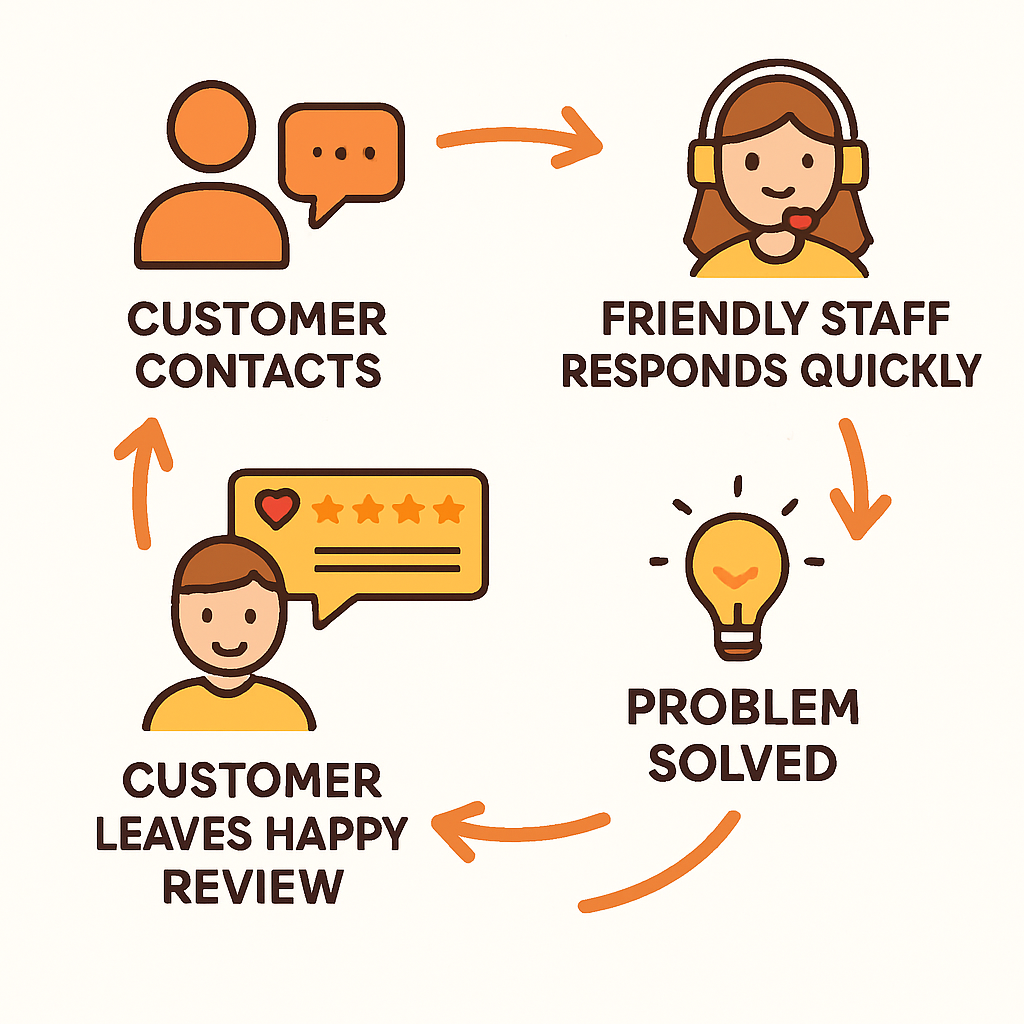
The other thing customer service does — and this one gets underestimated — is generate reviews. Every positive Google review is a 24/7 sales rep. Our review generation automation guide shows how to systematically turn good experiences into public proof, but it all starts with having experiences worth reviewing.
The Four Pillars of Small Business Customer Service
1. Speed: First Response Wins
Customers have options. When someone sends a message or calls, they’re often contacting multiple businesses at once. The first one to respond meaningfully — not with an auto-reply, but with a real answer — wins the job.
Target response times by channel:
| Channel | Target Response Time |
|---|---|
| Phone (during hours) | Answer live or call back within 5 minutes |
| Text/SMS | Within 15–30 minutes |
| Within 2–4 hours same business day | |
| Social media DM | Within 1 hour |
| After-hours inquiry | First thing next morning + automated acknowledgment |
After-hours is where most small businesses leak revenue. A simple automated acknowledgment — “Thanks for reaching out! We’ll get back to you first thing in the morning. In the meantime, here’s our FAQ: [link]” — keeps the lead warm and signals professionalism.
For more on capturing leads after hours, see our after-hours lead capture guide.
2. Personalization: They’re a Person, Not a Ticket
Every customer interaction is a chance to make someone feel like you remember them. This doesn’t require a perfect memory — it requires a system.
A simple CRM (even a Google Sheet to start) lets you record:
- Customer name and contact info
- What they hired you for and when
- Any preferences or notes (“prefers morning calls,” “allergic to lavender”)
- Last interaction date
When someone calls back six months later, you can say “Hi Sarah, last time you came in we did the full bathroom remodel — are you thinking about the kitchen now?” That moment of recognition is worth more than any discount.
Our CRM automation guide covers how to set this up efficiently without spending hours on data entry.
3. Resolution: Fix It Fast, Fix It Right
Every problem is a gift wrapped in bad packaging. A customer who brings you a complaint is giving you a chance to convert them into your most loyal advocate. Research by the Harvard Business Review found that customers whose problems were quickly resolved were actually more loyal than customers who never had a problem at all.
The small business resolution framework:
- Listen first — Let them finish without interrupting. Most complaints just need to be heard.
- Acknowledge without deflecting — “I completely understand why that’s frustrating” is not an admission of guilt. It’s empathy.
- Own the solution — Don’t point to policy. Say what you’re going to do.
- Do it faster than promised — If you say you’ll call back by Friday, call Thursday.
- Follow up — A quick check-in 3–5 days later shows you actually care about the outcome, not just closing the ticket.
What you should never do: argue, escalate defensively, or offer a token fix that doesn’t match the size of the inconvenience.
4. Proactive Communication: Don’t Make Them Chase You
Customers get anxious when they don’t know what’s happening. A plumber who fixes a pipe is doing their job. A plumber who texts “we’re on our way” and follows up with “all done — here’s what we found and what we fixed” is building a relationship.
Proactive communication touchpoints:
- Appointment confirmation (day before + morning of)
- “On the way” notification
- Job completion summary with clear explanation
- Follow-up check-in 3–7 days later
- Seasonal check-in or maintenance reminder (monthly or quarterly)
Most of these can be automated without feeling robotic. See our automating appointment reminders guide for implementation details.
Building a Customer Service Culture on Your Team
If you have employees — even one — customer service is a culture question, not just a training checklist.
Hire for Attitude, Train for Skills
You can teach someone how to use your scheduling software. You can’t teach them to genuinely care about people. When hiring, prioritize:
- Warmth and patience (ask for a story about a difficult person they helped)
- Ownership mentality (ask how they handled a mistake they made)
- Curiosity (do they ask good questions?)
Define What “Good” Looks Like
Vague expectations produce vague results. Write down what excellent service looks like at your business specifically. Not “be polite” but:
- “Greet every customer by name on their second visit”
- “If a customer waits more than 3 minutes, acknowledge them and give a time estimate”
- “Every complaint gets escalated to me within the same business day”
Make these visible. Review them in team meetings.
Empower Your Staff to Solve Problems
Nothing frustrates customers more than hearing “let me check with my manager.” Give your team a clear authority threshold — say, up to $50 in comps or free services — that they can offer without approval. This speeds resolution and makes your staff feel trusted, which makes them perform better.
Recognize and Celebrate Good Service
What gets recognized gets repeated. When a team member gets a 5-star review mentioning their name, make it a big deal. Read it aloud in the team chat. Post it on the break room wall. Small recognition rituals reinforce the behaviors you want.
Turning Good Service Into Visible Social Proof
Great service that no one knows about is a missed opportunity. The goal is to create a visible feedback loop where good experiences systematically generate reviews, referrals, and repeat business.
The Ask: Train your team to ask every satisfied customer: “If you had a good experience today, we’d really appreciate a quick Google review — it makes a huge difference for a small business like ours.” Simple, honest, effective.
The Automation: Use tools like your CRM or a service like Birdeye to send a follow-up text or email 24 hours after a completed job: “Thanks for choosing us! If we earned it, here’s a direct link to leave a Google review: [link].” The timing matters — ask while the experience is still fresh.
The Referral Nudge: Satisfied customers are your best salespeople. A simple referral program — “refer a friend and you both get $25 off your next service” — gives happy customers a reason to tell their neighbors. Local businesses in Southwest Florida do particularly well with referral programs during snowbird season (November through April), when new residents are actively looking for trusted local providers.
For a complete system, see our referral program guide and customer retention strategies.
Measuring What Matters
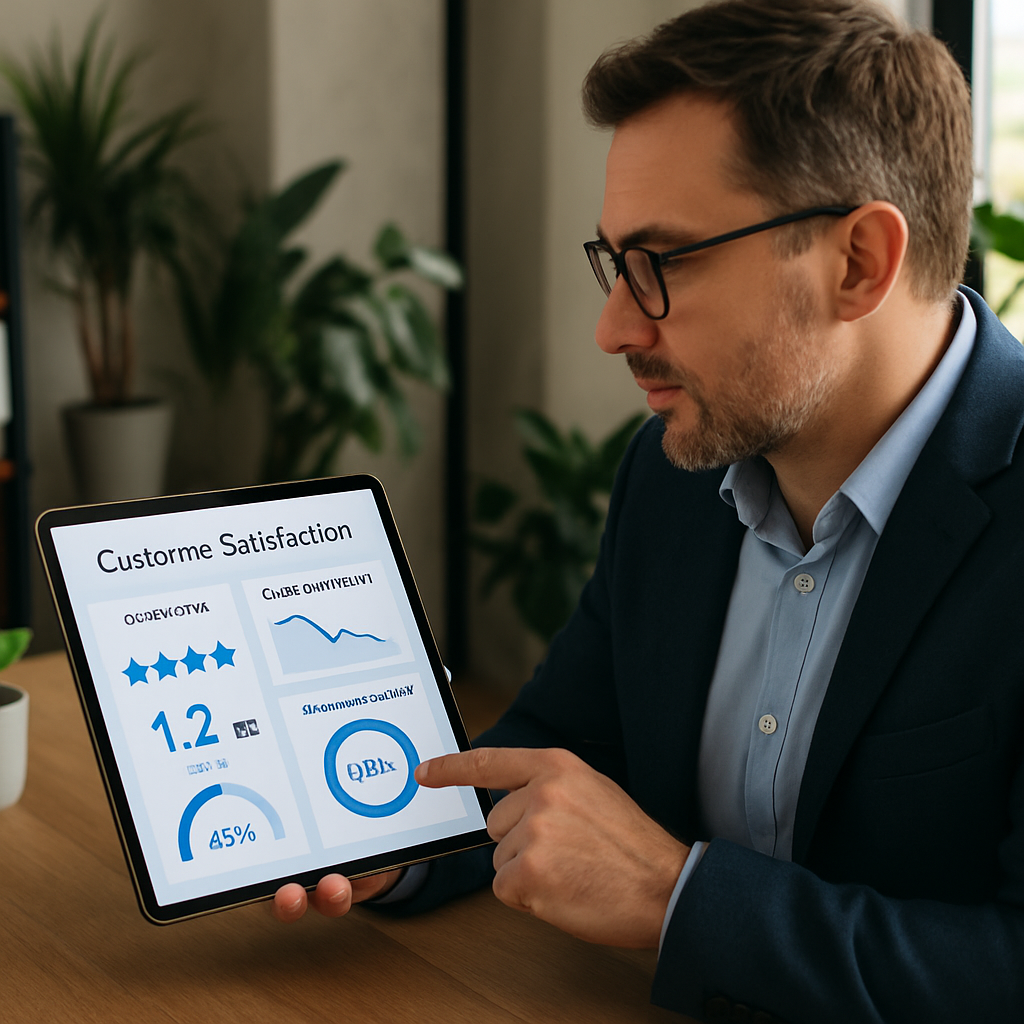
You can’t improve what you don’t measure. These are the customer service metrics that actually matter for small businesses:

| Metric | How to Track | Target |
|---|---|---|
| First response time | CRM or call log timestamps | < 30 min average |
| Resolution time | Ticket close date vs. open date | < 24 hours for most issues |
| Google rating | Google Business Profile | 4.7+ |
| Review velocity | Reviews per month | Increasing trend |
| Repeat customer rate | CRM purchase history | 40–60% for service businesses |
| Referral rate | Ask new customers “how did you hear about us?“ | 20–30%+ is healthy |
Track these monthly. Set a benchmark, then improve it by 10% over 90 days. That’s how systems improve.
Customer Service Quick Wins You Can Implement This Week
Don’t let the scope of this guide overwhelm you. Here are five things you can do right now that will make a visible difference:
- Set up an after-hours auto-reply on your business phone and email acknowledging receipt and promising a next-morning response.
- Create a simple Google Sheet with customer names, contact info, and notes — and actually use it before every call.
- Ask your last 10 satisfied customers for a Google review — personally, by text, with a direct link.
- Write one customer service standard for your team: one specific behavior you want to see every time.
- Call one unhappy customer from the past 90 days and check in. No agenda. Just ask how things are going.
None of these cost money. All of them compound.
Frequently Asked Questions
How do I handle a customer who is upset or unreasonable?
Stay calm, listen fully, and acknowledge their frustration without arguing. Even if they’re being unreasonable, responding with patience demonstrates professionalism. Give them a concrete resolution with a specific timeline. If they remain hostile after genuine attempts to help, it’s appropriate to calmly end the interaction and document it.
Should I respond to negative online reviews?
Yes — always, professionally, and promptly. A thoughtful public response to a negative review shows prospective customers that you take service seriously. Keep it brief: acknowledge the concern, apologize for the experience, and invite them to contact you directly to resolve it. Never argue online.
How many reviews do I need before it makes a real difference?
Research suggests that 10–15 reviews is the minimum threshold for credibility, and 50+ is where you start seeing significant SEO and conversion impact. More important than the number is recency — a steady stream of recent reviews outperforms a large volume of old ones.
Can I automate customer service without losing the personal touch?
Absolutely. Automation handles the logistics (confirmations, reminders, follow-ups) so your team can focus on the human moments that matter. The key is making automated messages sound natural and personal — using the customer’s name, referencing their specific service, and including a real contact option.
What’s the fastest way to improve my Google rating?
Systematically ask every satisfied customer to leave a review immediately after service. A direct link sent by text (not email) within 24 hours of job completion converts at 20–30% for most service businesses. Even getting 2–3 new reviews per month will move your rating meaningfully within 6 months.
Customer service isn’t a department — it’s a competitive strategy. For small businesses, it’s the clearest path to outperforming competitors who have bigger budgets but can’t match your speed, knowledge, and genuine care.
The businesses that win long-term in any local market are the ones people recommend to their friends. That starts with how you treat people today.
Ready to build systems that support exceptional service? Talk to our team at Monsoft Solutions — we help small businesses automate the logistics so you can focus on the relationships.