
That one-star review just landed. Your stomach drops. A customer went public with their frustration, and now everyone searching for your business will see it. What you do next can either damage your reputation further—or transform this crisis into an opportunity.
Responding to negative reviews effectively requires more than a quick apology. It demands a strategic approach that acknowledges the customer’s frustration, demonstrates your commitment to improvement, and shows prospective customers that you care about getting things right. The businesses winning in 2026 treat every negative review as a chance to showcase their values.
Why Negative Reviews Matter More Than You Think
Before diving into response strategies, let’s understand what’s at stake. According to research, 97% of consumers read online reviews before making a purchase decision. More importantly, 45% of consumers specifically look for how businesses respond to negative reviews—viewing these interactions as a preview of the customer experience they’ll receive.
A single negative review, handled well, can be more valuable than dozens of generic five-star ratings. Potential customers know no business is perfect. What they want to see is how you handle problems when they arise.
Three key statistics every business owner should know:
- 70% of consumers change their opinion about a business based on how it responds to reviews
- Responding to reviews increases overall review ratings by an average of 0.12 stars
- 45% of consumers are more likely to visit a business that responds to negative reviews
For local businesses in Southwest Florida—from Naples restaurants to Fort Myers home service companies—your review responses are often the first real interaction potential customers have with your brand.
The HEAR Framework for Negative Review Responses
Effective review responses follow a consistent structure. We recommend the HEAR framework: Humanize, Empathize, Acknowledge, Resolve.
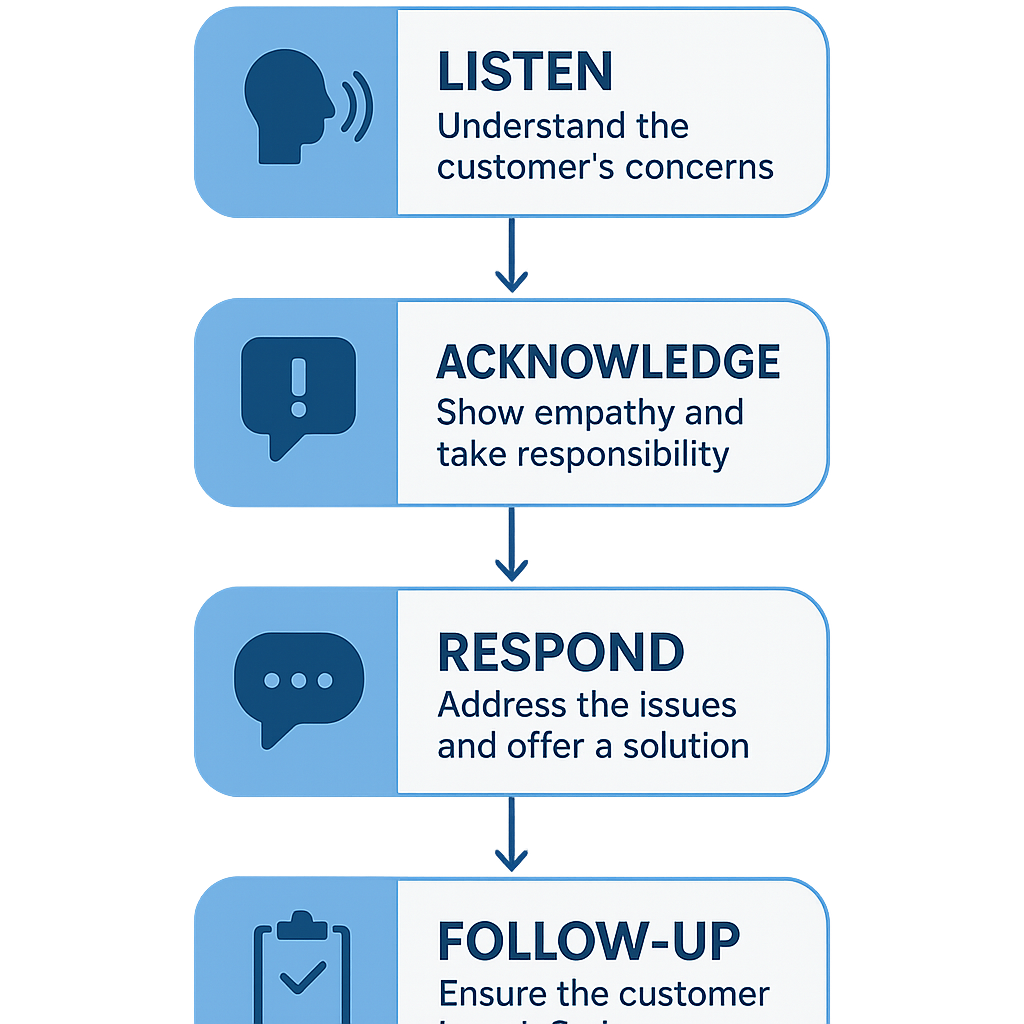
H — Humanize the Response
Start by using the customer’s name if available and signing off with yours. This transforms a corporate-sounding reply into a genuine human interaction.
Instead of: “Dear Valued Customer, We apologize for your experience…”
Try: “Hi Sarah, I’m Mike, the owner of ABC Services. Thank you for taking the time to share your feedback…”
E — Empathize Genuinely
Show that you understand why they’re frustrated—not just that you’re sorry they’re frustrated. There’s a crucial difference.
Generic empathy: “We’re sorry to hear you had a negative experience.”
Genuine empathy: “I can understand how frustrating it must have been to wait three hours for a technician who was scheduled for noon. That’s not the experience we want for anyone.”
A — Acknowledge the Issue
Take ownership without making excuses. Even if the situation was complicated, focus on what you could have done better.
Avoid: “Unfortunately, due to circumstances beyond our control…”
Better: “You’re right—we should have communicated the delay. That’s on us, and we’re addressing how we handle scheduling communication going forward.”
R — Resolve with Action
Offer a concrete next step. Whether that’s a refund, a redo, or simply a direct line to discuss further, give the customer a path forward.
Weak resolution: “Please contact us if you’d like to discuss this further.”
Strong resolution: “I’d like to make this right. Please call me directly at [phone] or email mike@abcservices.com, and I’ll personally ensure we resolve this to your satisfaction.”
What Good vs. Bad Responses Look Like
The difference between a reputation-saving response and a reputation-damaging one often comes down to tone and approach.
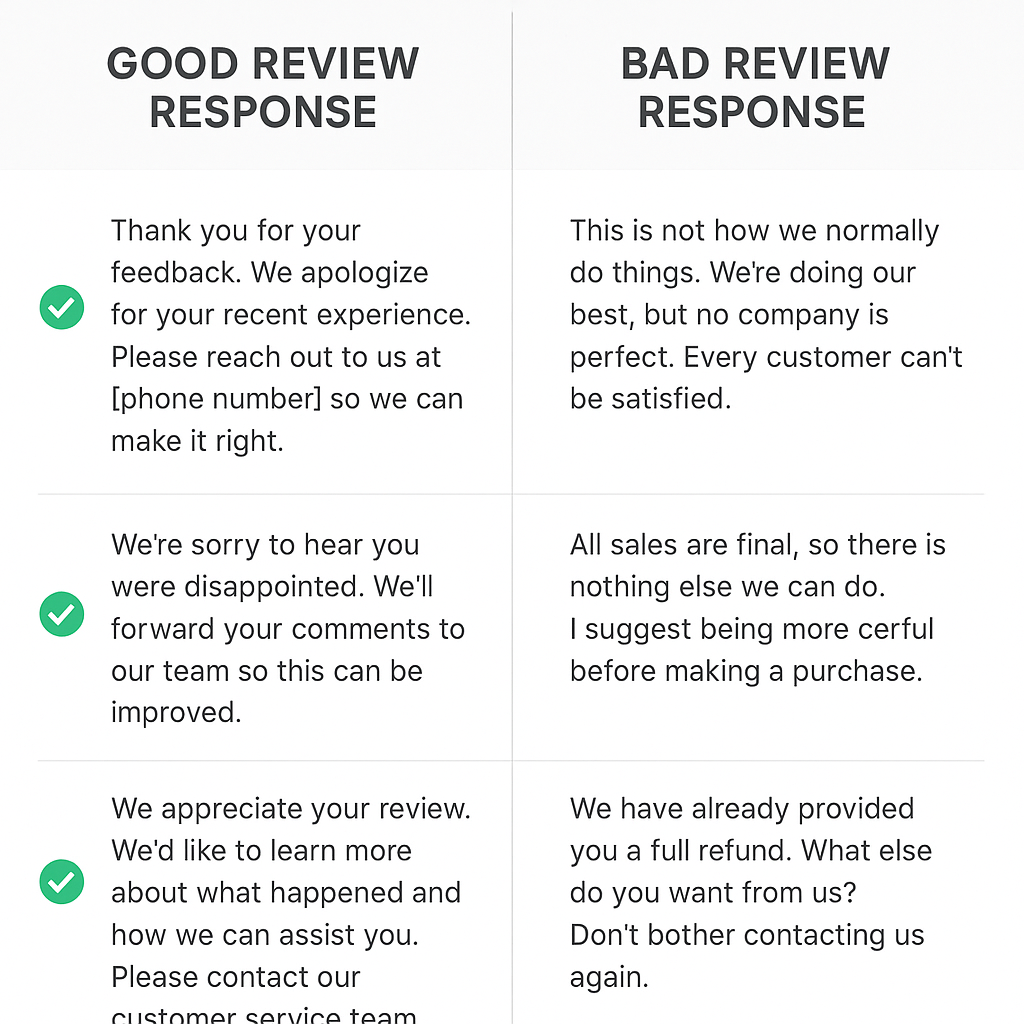
Example: A Restaurant Review
The Negative Review: “Waited 45 minutes for our food, and when it came, my steak was overcooked. Server seemed annoyed when I mentioned it. Won’t be back. ★☆☆☆☆”
Bad Response: “We’re sorry to hear this. Our restaurant gets very busy on weekends and we always do our best. Hope you’ll give us another chance.”
Problems: Defensive undertones, no specific acknowledgment, passive hope instead of active invitation.
Good Response: “Hi James, I’m Maria, the manager here at Riverside Grill. Thank you for your honest feedback—and I’m truly sorry we let you down.
A 45-minute wait is too long, and an overcooked steak after all that waiting makes it even more frustrating. You deserved better, and so did your evening out.
I’ve shared this with our kitchen team and spoken with our serving staff about how we handle these situations. I’d love the chance to show you what we’re actually capable of. If you’re willing, please email me at maria@riversidegrill.com, and I’ll arrange a complimentary dinner for you and your guest.
— Maria, General Manager”
Why it works: Names used, specific acknowledgment of issues, action taken internally, concrete resolution offered.
Example: A Home Services Review
The Negative Review: “Technician tracked mud through my house and didn’t even offer to clean it up. Charged full price for what felt like a rushed job. ★★☆☆☆”
Bad Response: “Our technicians work in various conditions and unfortunately some mess is unavoidable. We always recommend customers prepare their homes for service visits.”
Problems: Blame-shifting, defensive, no empathy.
Good Response: “Hi Patricia, I’m Tom, owner of Cape Coral HVAC. Reading your review was genuinely upsetting—this is not how we operate, and I apologize that it happened in your home.
Our technicians carry boot covers and clean-up supplies for exactly this reason. There’s no excuse for leaving your home worse than we found it, and I’ve addressed this directly with the team member involved.
I’d like to send someone back to properly clean any remaining mess and re-inspect the work at no charge. More importantly, I’d like to credit you 25% off your next service as an apology. Please reach out to me directly at tom@coralcoalhvac.com.
— Tom”
Common Mistakes to Avoid
Even well-intentioned responses can backfire. Watch out for these pitfalls:
1. Responding Too Quickly (or Too Slowly)
Too quick: Responding within minutes of a review can seem like you’re monitoring obsessively or responding emotionally. Give yourself at least 1-2 hours to craft a thoughtful reply.
Too slow: Waiting more than 24-48 hours signals you don’t prioritize customer feedback. The ideal window is 4-24 hours.
2. Getting Defensive
The urge to explain your side is natural, but public review responses aren’t the place for it. Even if the customer is wrong about certain facts, arguing publicly never looks good.
Red flag phrases to avoid:
- “Actually, what happened was…”
- “Our records show…”
- “You failed to mention that…”
- “In fairness…“
3. Using Templates Without Personalization
Customers can spot a copy-paste response instantly. If every negative review gets the same “We’re sorry to hear this” reply, you’re actually making your reputation worse.
4. Asking for Review Updates
While it’s okay to invite the customer to return, asking them to update or remove their review in your public response looks manipulative. Handle resolution privately, and if the customer chooses to update their review, that’s their decision.
5. Ignoring Negative Reviews Entirely
No response at all is often worse than a mediocre response. It signals you either don’t notice or don’t care about customer feedback.
Automating Review Monitoring Without Losing the Human Touch
For businesses receiving more than a few reviews per week, manual monitoring becomes unsustainable. This is where reputation management automation becomes valuable.
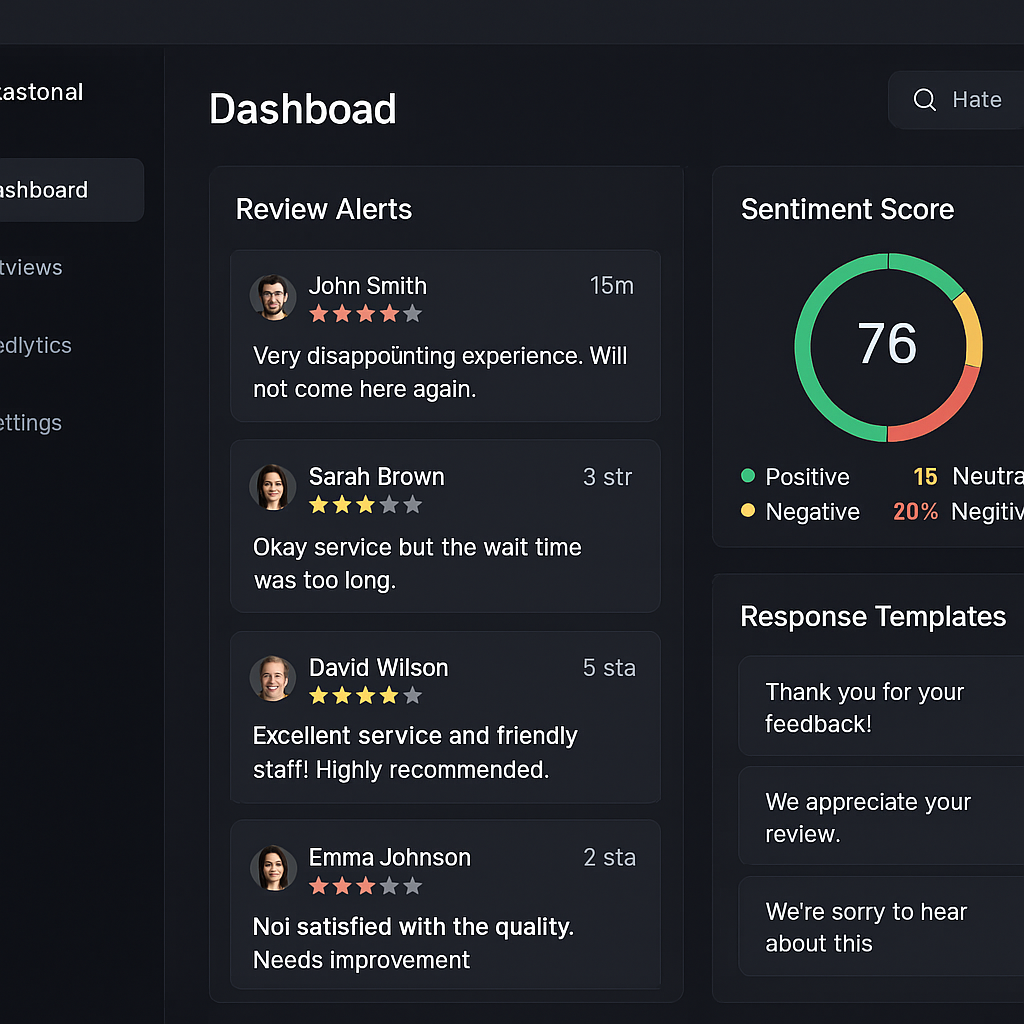
What to Automate
- Monitoring: Set up alerts for new reviews across Google, Yelp, Facebook, and industry-specific platforms
- Initial notification: Get instant alerts when negative reviews appear
- Response templates: Use frameworks (not scripts) to speed up drafting
- Follow-up tracking: Ensure every negative review gets proper resolution
What to Keep Human
- The actual response: Even with templates as starting points, personalize every reply
- Resolution decisions: Discounts, refunds, and make-good offers need human judgment
- Escalation: Know when a review requires owner/manager involvement vs. standard staff response
For businesses handling multiple locations or high review volumes, our automation services can help you set up systems that alert the right people instantly while keeping responses authentic and personalized.
Special Considerations for Different Industries
Medical and Aesthetic Practices
HIPAA regulations add complexity to review responses. You cannot confirm or deny that someone is a patient, discuss their treatment, or reveal any protected health information—even if the reviewer disclosed it themselves.
Safe response approach for practices:
- Thank them for their feedback
- Express genuine concern about their experience
- Invite them to contact your office directly
- Never confirm patient status or discuss specifics
For more on HIPAA-compliant communication, see our guide to patient communication automation.
Home Services and Contractors
Photos and specific claims require careful handling. If a customer posts misleading photos or inaccurate claims, document everything but respond without accusations.
Focus on: Offering to inspect the work, bringing in third-party verification if needed, and emphasizing your warranty/guarantee policies.
Restaurants and Hospitality
Immediacy matters more in hospitality. Diners often review while still on-premises or shortly after. Having a manager empowered to respond quickly—including offering immediate resolution—can prevent negative reviews from being posted at all.
Turning Resolution Into Retention
The work doesn’t end when you post your response. The real opportunity comes in the follow-through.
The 48-Hour Rule
If a customer takes you up on your resolution offer, complete the follow-up within 48 hours. A quick resolution demonstrates the same urgency you showed in your response.
Document and Learn
Every negative review is data. Track:
- What went wrong?
- Was this a one-time issue or a pattern?
- What systems need adjustment?
- Did this customer return after resolution?
Request Permission to Follow Up
After resolving an issue, ask if you can check in with them in a few weeks. This continued attention often converts unhappy customers into your most loyal advocates—they’ve experienced how you handle problems firsthand.
Building a Proactive Review Strategy
The best defense against negative reviews is a proactive approach to generating positive reviews. When you consistently collect reviews from satisfied customers, the occasional negative review has less impact on your overall rating.
Ask at the Right Time
Request reviews when customer satisfaction is highest:
- Immediately after a successful service completion
- Following positive feedback in person or via email
- After a customer refers someone new to your business
Make It Easy
Provide direct links to your review profiles. The fewer clicks required, the more reviews you’ll receive.
Respond to Positive Reviews Too
This encourages more feedback overall and shows that you engage with all customers—not just unhappy ones.
Frequently Asked Questions
Should I respond to fake or competitor reviews?
Yes, but carefully. Flag the review as fake through the platform’s official process, then post a brief, professional response stating that you have no record of this customer or transaction and inviting them to contact you directly with order details. Don’t accuse directly—let readers draw their own conclusions.
How long should my response be?
Aim for 75-150 words for most reviews. Long enough to address the specific issues and offer resolution, short enough to be read completely. Longer responses (200+ words) are appropriate for complex situations or when multiple issues need addressing.
What if the customer keeps responding negatively?
After your initial response and one follow-up offer, take the conversation private. Post a final public reply stating you’ve reached out directly and hope to resolve the matter offline. Continued public back-and-forth never looks good for either party.
Should I offer compensation in my public response?
Mention that you’d like to “make this right” without specifying exactly what. Details of refunds, credits, or free services should be discussed privately. This prevents setting public expectations and avoids attracting opportunistic complaints.
How do I handle reviews that include threats or inappropriate content?
Report the review to the platform for content policy violations. You can respond briefly noting that you take customer feedback seriously and have attempted to reach out directly, without engaging with the inappropriate content itself.
Start Responding Strategically Today
Every negative review is a public test of your business values. Pass that test, and you don’t just neutralize the damage—you actively build trust with every potential customer who reads your response.
Start by auditing your existing reviews. Are there unanswered negative reviews? Respond to those first, even if they’re months old. Then establish a consistent process for monitoring and responding going forward.
Need help building a review management system that keeps you responsive without overwhelming your schedule? Contact us to discuss how automation can help you maintain your reputation while focusing on what you do best—running your business.