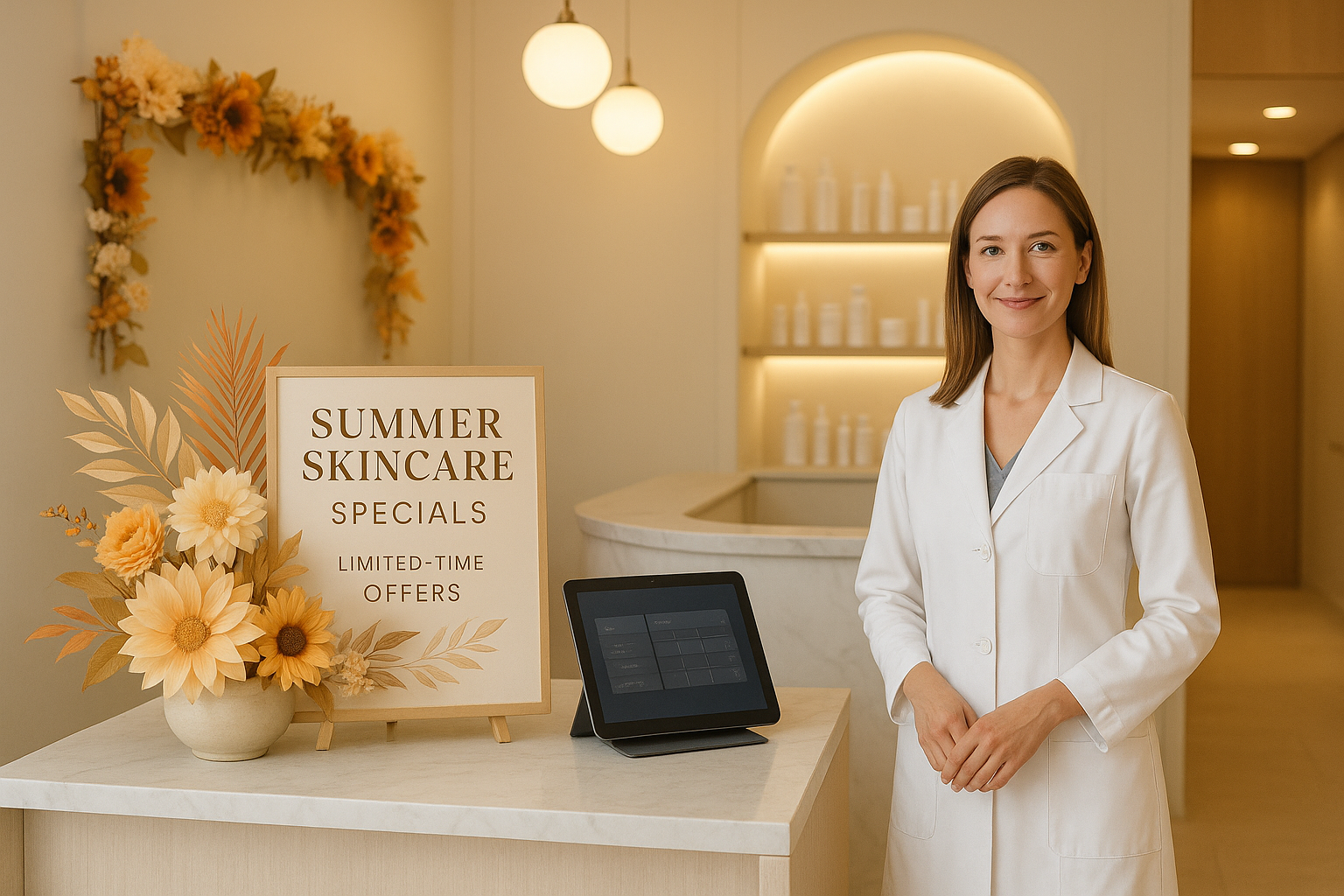
Every med spa has slow months. The question is whether you’re caught off guard by them or ready with a promotion that fills your schedule before the slowdown hits.
Most aesthetic practices approach promotions reactively: revenue dips, someone suggests a discount, a last-minute email goes out, and the results are mixed at best. The practices that consistently run full schedules do something different — they build a seasonal promotions calendar that plans 12 months of offers in advance, ties each offer to a real patient motivation, and uses automation to deliver the right message at exactly the right moment.
This guide walks through exactly how to build that system for your med spa or aesthetic practice.
Why Seasonal Promotions Work (When Done Right)
There’s a difference between a discount and a promotion. Discounts are defensive — you drop your price because you need to move volume. Promotions are strategic — you create a compelling offer tied to a reason to act now.
Seasonal promotions work because they tap into patient psychology that already exists. People are already thinking about how they look before summer. They’re already motivated to treat themselves around the holidays. They’re already thinking about skincare as the weather changes. Your promotion doesn’t have to create desire from scratch — it just has to give that existing desire a specific destination.
The seasonal calendar gives you three structural advantages:
1. You’re never surprised. Slow January? You planned for it in October. Summer skincare rush? Your campaign went out in late April. You’re not reacting; you’re executing.
2. Your messaging has a built-in reason. “Spring is here and so is your complimentary skin consultation” is more compelling than “we have availability this week.” Seasonality creates natural urgency without manufactured pressure.
3. You can build better offers. When you plan 60 to 90 days ahead, you have time to negotiate package pricing with vendors, coordinate inventory, train your team on the promotion, and design creative assets — instead of slapping together a last-minute email.
The 12-Month Seasonal Framework for Aesthetic Practices
Here’s how the aesthetic calendar typically breaks down, along with the patient motivations that drive each season:
January — New Year, New You Motivation: Resolution energy, renewal after the holidays. Strong for body contouring, skin resurfacing, and treatment packages for patients who received gift cards over the holidays.
February — Valentine’s Day and Self-Care Motivation: Romance, gifting, and self-love messaging resonates across demographics. Lip filler, injectables, facials, and couples treatment packages perform well.
March — Spring Preview Motivation: Warmer weather is coming. Patients start thinking about how they look in lighter clothing and outdoors. Laser hair removal, body treatments, and skin brightening are natural fits.
April — Spring Treatment Season Motivation: Peak season is beginning. Capture new patient consultations before summer demand surges. Introduce your summer treatment bundles.
May — Pre-Summer Push Motivation: The urgency is real — beach season, vacations, outdoor events. Neuromodulators, fillers, and body contouring bookings spike. This is one of your highest-leverage promotional windows.
June/July — Summer Skin Motivation: Maintenance and correction. Sunscreen, post-sun facials, hydration treatments. Many patients are actively in treatment and referring friends. Referral programs perform exceptionally in summer.
August — Back to Routine Motivation: Summer winding down, patients refocusing on self-care after a hectic season. Strong for skin health treatments and prepping for fall social season.
September — Fall Glow Season Motivation: Cooler weather means the best time for more intensive treatments — peels, resurfacing, laser. Patients want to look their best for fall social events and holidays.
October — Holiday Prep Begins Motivation: Thanksgiving, holiday parties, family photos. Smart patients start now — neurotoxin and filler patients know it takes 10 to 14 days to see results. “Start early for the holidays” messaging converts well.
November — Black Friday and Holiday Gifting Motivation: Gift cards, package deals, pre-payment for treatments. The biggest promotional window of the year for many aesthetic practices. Bundle pricing and gift card campaigns perform at peak here.
December — Last-Chance Holiday Offers Motivation: Urgency — holiday events are this week. Quick-result treatments (Botox, lip filler) still convert. Gift cards for last-minute shoppers. Introduce January new year offers for patients in the chair.

Building Your Seasonal Promotions Calendar
Now that you have the framework, here’s how to build your actual calendar.
Step 1: Audit Your Last 12 Months
Pull your booking data by month. Where were your slow periods? Which months drove the most new patient consultations? Which treatments spiked and when? This tells you where you have the most room to grow and which seasons your patients are most responsive.
Most practice management software (Aesthetix, Nextech, PatientNow, or even a well-structured CRM) can pull this data quickly. If you don’t have easy reporting, a simple revenue-by-month spreadsheet gives you enough to work with.
Step 2: Identify Your 4 to 6 Major Promotional Windows
You don’t need a promotion running every single week — that’s exhausting to manage and dilutes each offer’s impact. Most practices do well with 4 to 6 meaningful promotions per year, supplemented by lighter “evergreen” offers between them.
Choose your windows based on:
- Your historical slow periods (where you need the most lift)
- The highest-leverage seasonal moments for your specific patient mix
- Treatment lead times (neurotoxin results take two weeks — launch pre-holiday campaigns accordingly)
Step 3: Design the Offer Before the Creative
The most common mistake in promotional planning is starting with the creative (email template, social post) before getting clear on the actual offer. Start with the substance:
- What are you promoting? Be specific — not “our injectable menu” but “Botox for forehead lines and crow’s feet.”
- What’s the incentive? A discount, a package bundle, a complimentary add-on, a gift with purchase, a referral bonus?
- Why now? The seasonal reason — and make sure it’s genuine, not manufactured.
- What’s the deadline? Open-ended offers don’t convert. Even a two-to-three week window creates urgency.
- Who is this for? Existing patients? New patient consultations? A specific demographic?
Clarity on these five questions before you write a single email subject line will double your conversion rate.
Step 4: Plan Your Delivery Channels
For each promotion, you’ll typically use a combination of:
Email — Your list is your highest-converting channel for existing patients. Sequence your emails: announcement, reminder, last-chance. Three emails minimum per promotion window.
SMS — Short, high-open-rate notifications work best for deadline reminders and day-of appointment prompts. HIPAA compliance applies — use platforms built for healthcare messaging.
Social media — Organic and paid. Organic posts for awareness; targeted ads (Instagram, Facebook) to reach new patients in your area.
In-clinic — Every patient in your chair this month should hear about next month’s promotion. Arm your team with simple talking points.
Your website — A dedicated landing page or homepage banner for each major promotion. Don’t make patients hunt for the offer.
Step 5: Build the Automation Before the Campaign Starts
Here’s where most practices leave money on the table: they send one email, get some bookings, and call it a campaign. The practices that consistently outperform their benchmarks build automated sequences that run through the entire promotion window without manual effort.
For each promotion, set up:
- Day 1: Announcement email — full offer details, deadline, booking link
- Day 5: Follow-up to non-openers with a different subject line
- Day 10: Reminder email — “One week left” — with patient testimonials or before/after imagery
- Day 14: Last-chance email — “48 hours remaining” — simple, urgent
- Day 1 (SMS): Short reminder once the email campaign is live
- Day 14 (SMS): Final deadline reminder
Your CRM and email platform can schedule all of this in advance. Once you build the first seasonal promotion sequence, each subsequent one takes a fraction of the time.
The Anatomy of a High-Converting Seasonal Promotion
Let’s look at what separates promotions that fill your schedule from ones that get opened and forgotten.
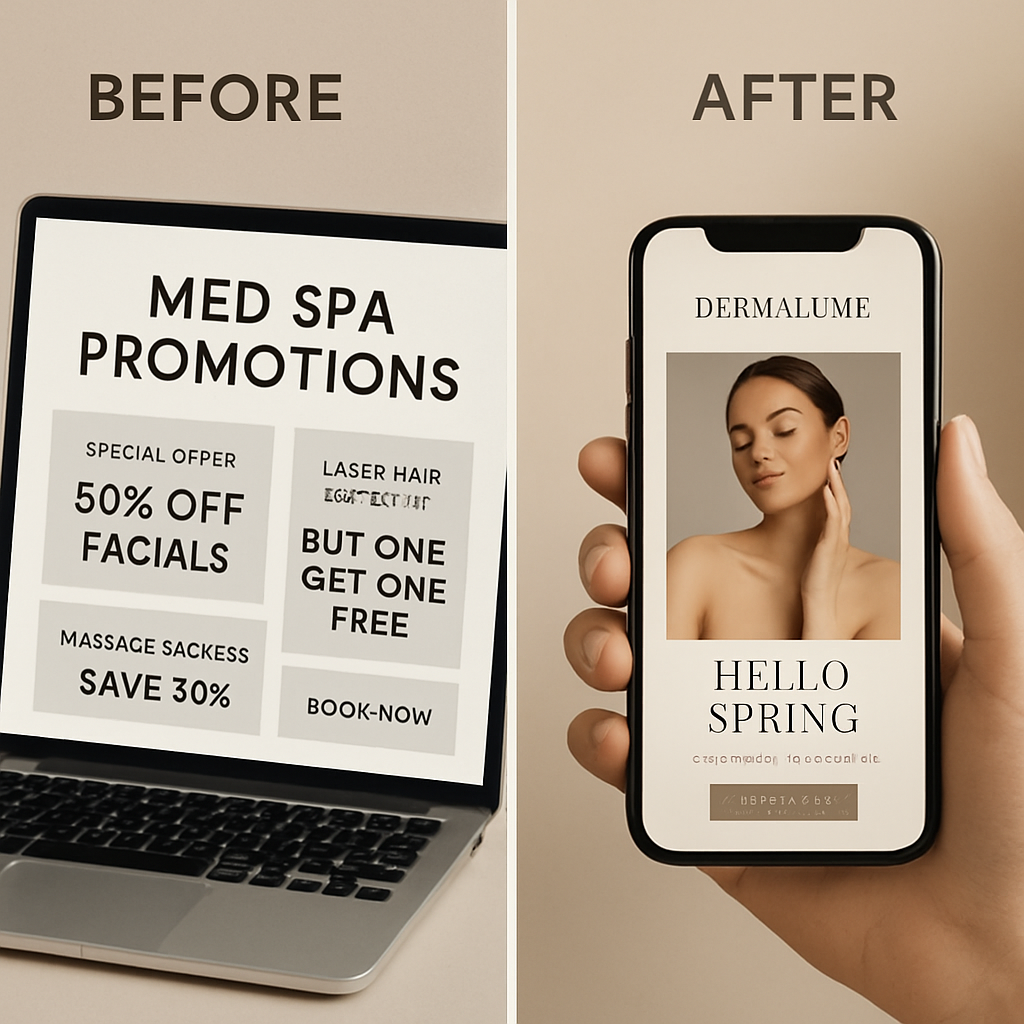
Lead With the Patient Benefit, Not the Discount
Weak offer: “20% off Botox this month”
Strong offer: “Walk into summer looking refreshed — Botox treatment packages starting at [price], available through May 30.”
The weak version leads with the discount — which signals that maybe your regular price is inflated. The strong version leads with the outcome (looking refreshed for summer) and presents the offer as part of a complete experience.
Give Them One Clear Action to Take
The fastest way to kill a promotion is to include too many options. Every additional choice reduces conversion. For each campaign, there should be exactly one primary call to action: Book your appointment. Not “learn more,” not “see our full menu,” not “call or text or email or DM.” One link, one action.
Use Real Urgency, Not Fake Urgency
Countdown timers that reset every time the patient visits the page. “Limited time offer” on an offer that’s been running for six months. Patients see through this — and it erodes trust in your brand.
Real urgency is real: “We have 12 appointment slots available for our spring skin consultation event on May 15-16. Reserve yours before they fill.” That’s a legitimate scarcity claim that motivates action without manipulation.
Personalize Where You Can
Segmented campaigns consistently outperform broadcast campaigns. Some easy segmentation strategies:
- By last visit date — Patients who haven’t been in for 6+ months get a “we miss you” version; recent patients get a “you’re going to love this” version.
- By treatment history — Botox patients get an injectable-focused offer; skincare patients get a facial or peel campaign.
- By birthday month — A birthday promotion feels personal and lands reliably.
Most CRM and email platforms make this segmentation straightforward once your data is organized.
HIPAA Considerations for Aesthetic Promotions
If your practice handles any protected health information — and for aesthetic practices doing medical treatments, that includes treatment records — your marketing communications need to comply with HIPAA.
Key rules for promotional campaigns:
Obtain proper authorization. Patients must opt in to receive marketing communications. This is typically captured during intake paperwork or consent forms.
Don’t include treatment-specific details in SMS or email. “We noticed you’re due for a Botox touch-up” in a marketing email can cross a line. Keep promotional messaging general — tied to the season or offer, not the patient’s specific treatment history — unless the patient has explicitly consented to personalized health communications.
Use HIPAA-compliant platforms. Standard email marketing tools (Mailchimp, Constant Contact) are generally not HIPAA-compliant. Look for platforms built for healthcare: Klara, Weave, PatientNow, or similar tools that offer BAAs (Business Associate Agreements).
For a deeper dive on compliant patient marketing, see our guide on HIPAA-compliant social media marketing for aesthetic practices.
Tying Promotions to Your Membership and Loyalty Programs
If your practice has a membership program, seasonal promotions are a natural complement. Here’s how to layer them:
Members-first access. Announce your next seasonal promotion exclusively to members 48 to 72 hours before it opens to the public. This is a high-value membership benefit that costs you nothing and builds loyalty.
Exclusive member enhancements. Your spring promotion might be a complimentary consultation for all patients. For members, the promotion includes a complimentary add-on (hydrating serum, lip treatment, extra units). This reinforces membership value without discounting your core offer.
Loyalty point events. For promotions tied to major purchase seasons (November/December), offer bonus loyalty points on purchases made during the window. This is especially effective for gift card purchases.
For practices that don’t yet have a membership program, seasonal promotions can be the entry point: offer patients who book during the promotion window a special rate on your membership. The promotion drives initial commitment; the membership drives long-term retention.
See our full guide to building a med spa membership program that drives recurring revenue.
Making Seasonal Promotions Stick: The Execution Checklist
The strategy is only half of it. Most seasonal promotions fail in execution — the campaign goes out late, the team isn’t briefed, the booking link doesn’t work. Use this checklist:
6 weeks before the promotion launches:
- Finalize the offer (treatment, incentive, deadline, target patient segment)
- Brief your clinical team — they need to be ready to deliver at volume
- Check inventory and supply levels for the promoted treatment
- Design assets (email templates, social graphics, in-clinic materials)
- Build email sequences in your CRM/email platform
- Set up the landing page or booking link
2 weeks before launch:
- Test all email automations — send to a test list and confirm links work
- Train front desk on promotion details and rebooking language
- Schedule social media posts
- Confirm any paid ad campaigns are approved and scheduled
At launch:
- Monitor booking volume daily
- Check for automated email delivery issues
- Track your SMS open and response rates
After the promotion closes:
- Pull results: bookings generated, revenue attributed, new vs. returning patients
- Note what worked and what didn’t (subject lines, offer structure, timing)
- Document for next year’s calendar
Measuring Seasonal Promotion ROI
Don’t run a promotion without knowing how to measure it. Track these metrics for every campaign:
Bookings generated: How many appointments were directly tied to the promotion? (UTM parameters on email links and a dedicated booking landing page make this trackable.)
Revenue attributed: Total revenue from those bookings during the promotion window.
Cost of promotion: If you’re offering a discount or complimentary add-on, what’s the margin impact? Is the cost justified by the volume?
Patient type split: New patients vs. returning patients. A good seasonal promotion should drive both — new patient consultations and reactivation of lapsed patients.
Email metrics: Open rate, click-through rate, and conversion rate for each email in the sequence. Use this to refine subject lines and CTAs for future campaigns.
Over time, you’ll develop benchmarks specific to your practice — which promotions consistently outperform, which seasons are reliably slow, and which patient segments respond best to which offers.

Putting It All Together: Your First Seasonal Calendar
If you’re starting from scratch, here’s how to build your first seasonal calendar this week:
Day 1 — Audit and anchor. Pull your last 12 months of booking data. Identify your two or three slowest months and your two or three biggest natural demand peaks. These are your highest-priority promotional windows.
Day 2 — Map the 12-month calendar. Using the seasonal framework above as a guide, write down one promotion idea for each major window — even rough ones. You don’t need final offer details yet; just anchor the calendar so nothing slips.
Day 3 — Design your next promotion in full. Whatever promotion is coming up in the next 6 to 8 weeks: finalize the offer, write the email sequence, build the landing page, brief the team.
Day 5 — Set up your automation. Load the email sequence into your platform, schedule the send dates, and test every link. This is the work that makes a promotion run without constant manual effort.
From there, work through the calendar one promotion at a time, always staying 6 to 8 weeks ahead of launch.
Seasonal promotions aren’t magic. They’re systems — and like any system, they get better every time you run them. The first campaign teaches you what your patients respond to. The second one does it faster. By the third year, your seasonal calendar is a predictable revenue engine that fills your schedule regardless of what the month looks like outside.
If you want help building your seasonal promotion strategy — from the offer design to the CRM automation to the patient segmentation — Monsoft Solutions works with med spas and aesthetic practices across Southwest Florida and beyond to build the marketing systems that turn patient relationships into consistent, predictable revenue.