
In aesthetic medicine, patients aren’t buying a service. They’re buying a promised outcome — tighter skin, a slimmer silhouette, a face that finally matches how they feel inside. That promise is hard to make credibly in an ad. But it’s easy to make when a real patient does it for you.
That’s the power of social proof for aesthetic practices. When a prospective patient sees a photo of someone who looks like them, reads a story about a concern they share, or watches a video testimonial from someone whose results are undeniable — the decision accelerates. Doubt melts. The consultation gets booked.
Yet most aesthetic practices treat social proof as an afterthought: a few Google reviews collected haphazardly, before/after photos buried in a gallery no one visits, and a handful of testimonials gathered years ago collecting digital dust.
This guide will show you how to build a systematic, HIPAA-compliant social proof strategy that turns every satisfied patient into a marketing asset — and fills your schedule with high-value consultations.
Why Social Proof Converts Better Than Advertising in Aesthetics
Aesthetic procedures are high-stakes decisions. Patients are investing anywhere from $500 to $50,000 in treatments that will change their appearance. They need certainty before they commit. Traditional advertising can generate awareness, but it rarely generates trust — and trust is what drives consultation bookings.
Social proof works differently. It’s not you telling prospective patients you’re good. It’s other people — people just like them — saying it instead. Research consistently shows that peer endorsements are trusted far more than any marketing message, and in aesthetics the gap is even wider. Patients are looking for proof, not promises.
There are several types of social proof that matter most for aesthetic practices:
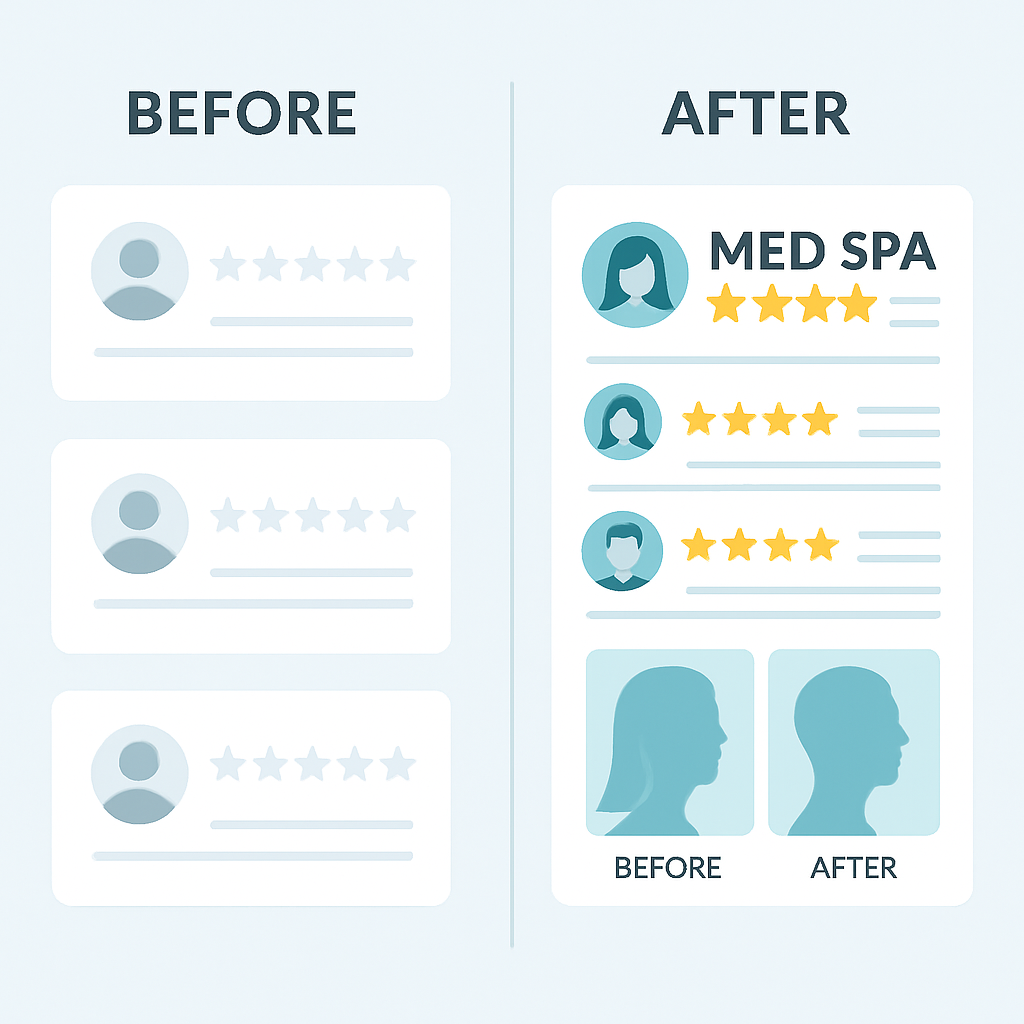
- Before/after photo galleries — the closest thing to a guarantee in aesthetics
- Written patient testimonials — specific, story-driven accounts of transformation
- Video testimonials — the highest-trust format; seeing and hearing a real person is powerful
- Star ratings and reviews (Google, RealSelf, Yelp, Healthgrades)
- Case studies — detailed breakdowns of a patient’s journey and outcome
- User-generated content — patients sharing their own results on social media
- Media mentions and industry recognition — authority signals that build credibility
- Certifications and board credentials — trust foundations specific to medical practices
Each type does different work at different points in the patient journey. A star rating might get someone to click. A testimonial might get them to read more. A before/after photo might get them to call. A video testimonial might be what finally gets them to book.
The most effective practices don’t rely on one type — they build a full social proof ecosystem that guides patients from first impression to signed consent.
HIPAA Compliance: The Non-Negotiable Foundation
Before building any social proof system, you need to get the legal foundation right. Patient privacy in healthcare isn’t optional — and in aesthetics, where treatments are highly personal, the stakes are especially high.
What Requires Patient Authorization
Under HIPAA, any use of patient information for marketing purposes requires explicit written authorization. This includes:
- Before/after photos — even if the patient’s face isn’t visible
- Video testimonials that reference specific treatments or conditions
- Case studies that could identify the patient
- Social media posts that tag or reference a patient
- Testimonials that include specific clinical details
Building a Compliant Authorization Process
The key is making authorization a seamless part of your patient workflow — not an awkward afterthought. Best practices include:
- Digital consent forms at intake — Include a separate “Marketing Authorization” section in your initial patient intake forms, clearly explaining how content may be used
- Specific language — Authorization should cover photos, video, written testimonials, and social media separately so patients can consent selectively
- Revocation rights — Patients must be informed they can revoke consent at any time
- Secure storage — Keep signed authorizations in your practice management system and link them to patient records
- Staff training — Anyone collecting testimonials or photographing patients should understand what’s authorized for each individual
For a deeper dive on HIPAA-compliant marketing systems, our guide on HIPAA-compliant social media marketing for aesthetic practices covers the full regulatory landscape.
The upside of building proper authorization into your workflow: once it’s there, collecting social proof becomes automatic. Every new patient who consents is a potential future advocate.
Before/After Photos: Your Most Powerful Asset
For aesthetic practices, before/after photography is the most persuasive form of social proof that exists. A prospective patient considering facial rejuvenation doesn’t need to understand how the treatment works — they need to see what it does. One compelling set of photos can accomplish in seconds what a thousand words cannot.
Setting Up Your Photography System
The difference between photos that convert and photos that don’t often comes down to consistency and quality:
Lighting: Consistent lighting is critical for accurate before/after comparisons. Overhead fluorescent lighting flattens features and makes results look less dramatic than they are. Invest in a dedicated photo setup — diffuse studio lighting on both sides eliminates shadows and gives you accurate, flattering images that show real results honestly.
Camera angle: Always photograph from identical angles — frontal, 45-degree profile, and full lateral for most facial procedures. Full body shots for body contouring. Document your angles and position the camera at the same height every time.
Timing: Capture “before” photos before any pre-procedure prep. Capture “after” photos at the optimal result window — typically 2-4 weeks post-treatment for injectables, longer for surgical procedures or laser resurfacing. Having a follow-up protocol that brings patients back at the right moment ensures you never miss the shot.
Background: Use a neutral, consistent backdrop. Nothing distracts from results like a cluttered clinical background.
Presentation: When displaying photos on your website or social media, high resolution matters. Compress images for web performance but maintain visual quality. Label each gallery with the treatment, not the patient name, and organize by treatment type so prospective patients can self-identify.
Maximizing the Conversion Power of Your Gallery
A gallery that just exists isn’t doing its job. Structure it to guide buying decisions:
- Organize by concern, not by treatment name — prospective patients search for “under-eye circles” not “tear trough filler”
- Include patient stories — a 2-3 sentence quote alongside the photos dramatically increases conversion
- Make it easy to find — link to your gallery from your homepage, service pages, and every relevant blog post
- Keep it current — a gallery that hasn’t been updated in two years signals a stale practice
Collecting Testimonials That Actually Convert
Generic testimonials don’t move anyone. “Dr. Smith is wonderful!” looks nice but accomplishes little. The testimonials that convert are specific, story-driven, and speak directly to the concerns your prospective patients have.
The difference between a weak and a strong testimonial usually comes down to how you ask.
The Right Way to Ask
Timing is everything. The best window to ask for a testimonial is right after a positive experience — when a patient is seeing their results for the first time, or at their follow-up appointment when they’re delighted. That’s when emotion is high and the story is fresh.
Ask specifically, not generally. Instead of “Would you mind leaving us a review?” try: “We’d love to share your story to help other patients who are considering the same treatment. Would you be willing to answer three quick questions — what brought you to us, what your experience was like, and what you’d tell someone who’s on the fence?”
Have a system ready. If you’re asking in person, have a tablet or QR code that takes them straight to your Google review page or a testimonial form. If you’re following up by text or email, include a direct link — not your homepage.
For automated follow-up sequences after appointments, see our guide on automating patient communication — the same systems work beautifully for testimonial collection.
Testimonials by Treatment Category
Organize testimonials the same way you organize your photo gallery — by patient concern and treatment type. A prospective Botox patient wants to read about other Botox patients, not generic praise for your practice. Create dedicated testimonial sections on each service page, and feature relevant testimonials in your email drip sequences.
Video Testimonials: The Highest-Converting Format
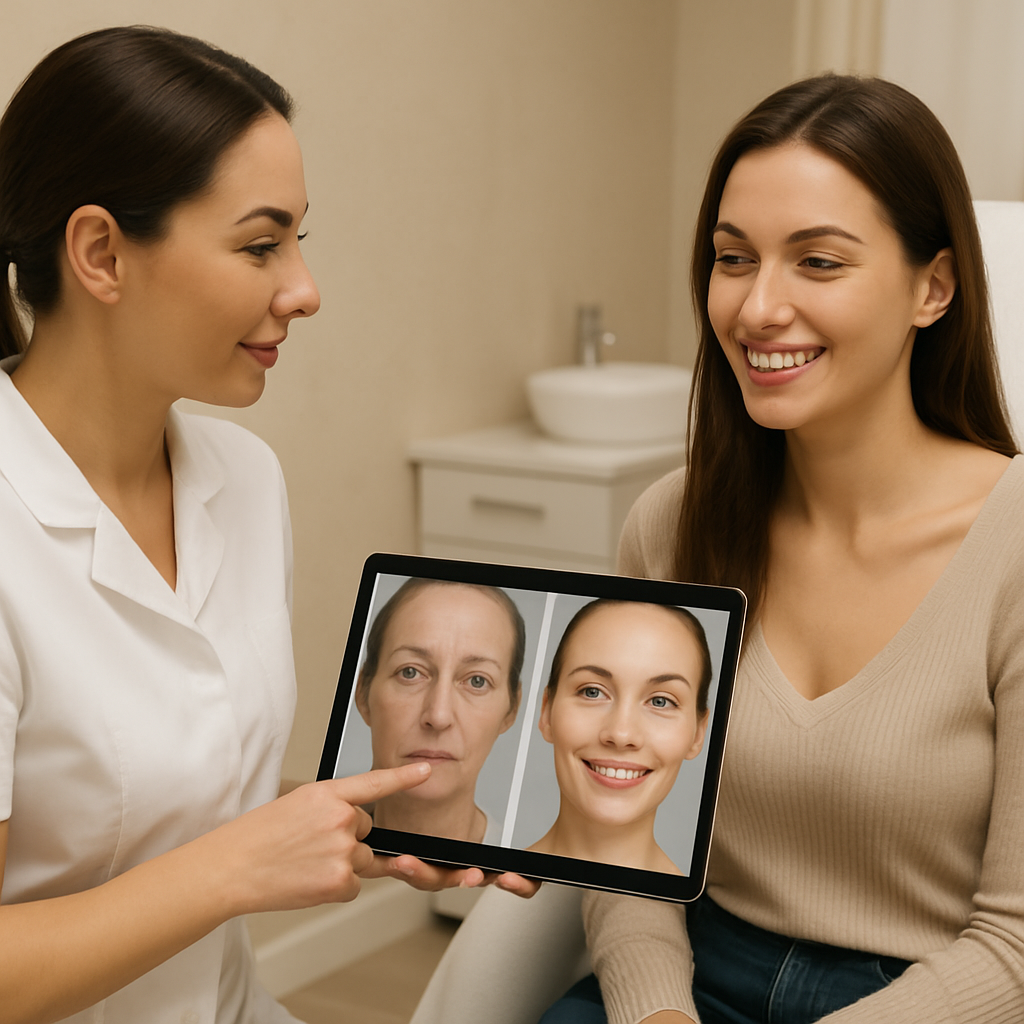
If before/after photos are your most persuasive asset, video testimonials are your most trusted. Seeing a real person — hearing their voice, watching their expression — removes every last trace of manufactured skepticism. A well-shot video testimonial from a patient who genuinely loves their results can do more for your booking rate than months of paid advertising.
Making It Easy to Capture
Most patients are happy to provide a short video — they just need to be asked in the right context and given a low-friction path to do it.
In-practice capture: After a follow-up appointment where a patient is visibly thrilled with their results, ask if they’d be comfortable sharing their experience on camera. Keep it conversational — not a scripted commercial. A 60-90 second authentic account is worth far more than a polished two-minute performance. All you need is a smartphone with decent lighting.
Remote capture tools: Apps like VideoAsk or Bonjoro let you send a video message to patients and invite them to respond with their own video. These are especially effective in 3-week post-procedure follow-up sequences when results are peaking.
What to ask: Guide patients with three simple prompts:
- What made you consider this treatment, and what hesitations did you have?
- What was your experience like at the practice?
- What would you tell a friend who’s thinking about the same thing?
These three questions produce testimonials that speak directly to the objections your prospective patients are wrestling with.
Distribution
Video testimonials work hardest when they’re everywhere:
- Embedded on service pages and homepage
- Shared to Instagram Reels and Facebook (with patient permission)
- Included in email nurture sequences for prospective patients
- Featured in paid social campaigns (video ads with authentic patient stories often dramatically outperform polished production ads)
If you’re running Google Ads for your practice, see our digital marketing guide for plastic surgeons for how to integrate social proof into your paid campaigns effectively.
Deploying Social Proof Strategically: Where It Makes the Biggest Difference
Collecting social proof is only half the work. Deploying it in the right places — where prospective patients experience the most doubt — is where conversion actually happens.
Your Website
Homepage: Feature your highest-impact testimonial and a before/after photo or video prominently above the fold. Not buried at the bottom — at the top, where every visitor sees it.
Service pages: Each treatment page should have:
- 2-3 before/after photos for that specific treatment
- 1-2 patient testimonials about that treatment
- Star rating aggregate
- A clear CTA to book a consultation
Contact and booking pages: Patients about to book are often the most anxious. A testimonial or two on the booking page — reassuring, specific, human — can dramatically reduce form abandonment.
Landing pages for paid campaigns: Every ad landing page should lead with social proof before asking for anything. A photo, a quote, a star rating. Establish credibility before making the ask.
Email Sequences
Your consultation follow-up sequence — the emails that go to prospective patients who haven’t yet booked — is one of the highest-leverage places to deploy social proof. Instead of sending generic “Did you have questions?” follow-ups, send emails with subject lines like: “What our patients say about [Treatment Name]” and feature specific testimonials. Each email plants another seed of trust.
For patients who had a consultation but haven’t committed, a case study email — one patient’s complete journey from concern to result — can be what finally tips the decision.
See our guide on automated follow-up sequences for how to build and automate this entire workflow.
Social Media
Aesthetic practices have a natural advantage on visual platforms. Instagram and Facebook are where prospective patients do their research, and before/after content consistently generates the highest engagement in the aesthetic category.
Key principles for social proof on social:
- Feature results, not just your process — patients want to see outcomes
- Include short captions in patients’ own words — a quote from the patient alongside the photo
- Story Highlights — create a dedicated “Results” or “Patient Stories” highlight on Instagram
- Respond to comments — when patients tag you or comment positively, engage. That interaction is visible to everyone who scrolls past.
- User-generated content — when patients post their own results and tag you, reshare it (with permission). UGC is the highest form of social proof because it’s completely uncontrolled.
Review Platforms
Your Google Business Profile star rating often determines whether a prospective patient clicks to your website at all. A practice with 4.8 stars and 200 reviews will outperform one with 4.9 stars and 20 reviews every time — because volume signals established trust.
Prioritize reviews on:
- Google — highest impact on local search visibility
- RealSelf — the dominant platform for aesthetic procedures
- Healthgrades — important for practices with physician providers
- Yelp — market-dependent but still relevant in many regions
Build review collection into your post-appointment workflow. For systematic review automation, our review generation automation guide covers the full playbook.
Measuring Social Proof Performance
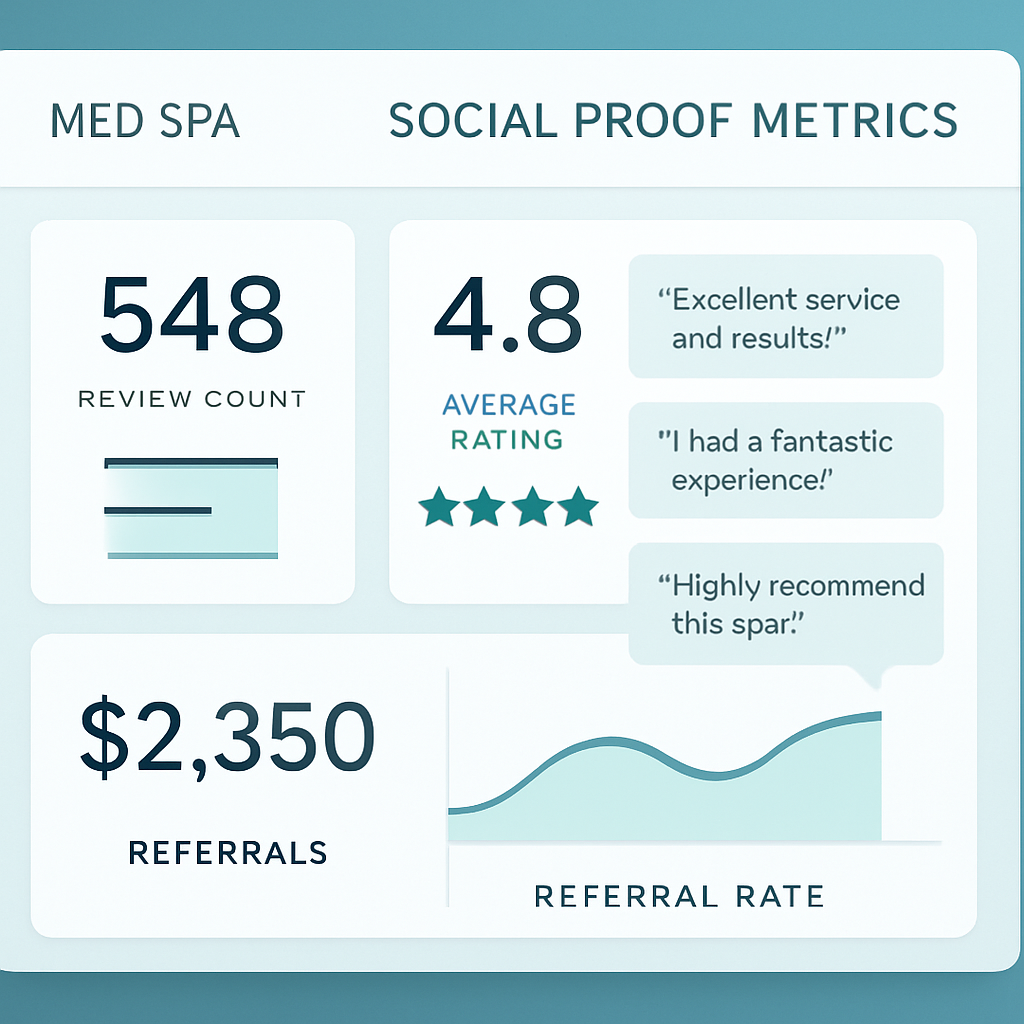
Like any marketing investment, your social proof strategy needs to be measured and optimized. Track these metrics:
Consultation booking rate from social proof touchpoints: If you’re using a CRM or patient management system, tag leads that came in through referral-heavy channels (Google reviews, RealSelf, word of mouth) and track their booking rate versus paid traffic.
Time to decision: Social proof shortens the time between first contact and booking. If you’re nurturing leads, measure how many touchpoints (and which types of social proof) a typical patient engages with before booking.
Review volume and velocity: Track how many new reviews you’re collecting per month, not just your overall rating.
Before/after gallery engagement: Google Analytics will show you how many visitors view your gallery, how long they stay, and whether they navigate to service pages afterward. High engagement means your content is working.
Testimonial email performance: If you’re A/B testing social proof emails in your drip sequences, open rates and click-through rates tell you which testimonials and formats resonate most.
For a complete analytics setup for your practice, our Google Analytics 4 guide for small businesses covers the essential tracking configurations.
Building Your Social Proof Action Plan
Don’t try to overhaul everything at once. Here’s a practical sequenced approach:
Week 1-2: Get the foundation right
- Create or update your patient marketing authorization form
- Set up a consistent photo station with proper lighting and a documented protocol
- Make a list of your top 10-15 happiest patients and reach out personally for testimonials
Week 3-4: Improve collection systems
- Add a review request to your post-appointment email/text sequence
- Brief your front desk or patient coordinator on how to ask for testimonials at follow-ups
- Set up a video testimonial capture process
Month 2: Optimize deployment
- Audit your website and add social proof to every service page
- Update your email follow-up sequences with testimonial content
- Create a “Results” highlight reel on Instagram
Month 3+: Systematize and scale
- Review collection becomes fully automated
- Monthly gallery updates become part of your workflow
- Track performance and optimize which types of social proof drive the most consultations
The practices that consistently outperform their competitors on social proof aren’t doing anything magical. They’ve simply built systems that make collection and deployment automatic — so it happens consistently, regardless of how busy the practice is.
Frequently Asked Questions
Can I use patient photos on social media without HIPAA concerns?
Yes — with proper written authorization. You need a signed marketing consent form that explicitly covers social media use. Without it, sharing any identifiable patient photo (including before/after photos where the face is visible) violates HIPAA. Many practices build this consent into their standard intake paperwork.
How many reviews do I need before social proof starts driving results?
The threshold varies by platform, but a general benchmark: 50+ Google reviews with a 4.7+ rating starts to meaningfully influence click-through from search results. For RealSelf, practices with 20+ reviews begin appearing regularly in relevant searches. Quality and recency matter as much as volume — 200 reviews with the most recent from 2 years ago looks worse than 80 reviews with fresh content.
What’s the best way to handle a patient who wants their testimonial removed?
Promptly and without resistance. Remove the content from all platforms, confirm with the patient that it’s been taken down, and update your records to reflect their revoked consent. Under HIPAA, patients have the right to revoke marketing authorization at any time. Practices that handle these requests gracefully protect both their legal standing and their reputation.
Should we ask for reviews via text or email?
Both work — but text message follow-ups typically see 3-5x higher open rates than email for review requests. The key for either channel is a direct link to your review platform, a warm personal message, and timing it at the right moment post-appointment. SMS requests sent 24-48 hours after a positive visit consistently outperform all other formats.
Social proof is the most efficient marketing investment an aesthetic practice can make. Every patient you turn into an advocate works for you indefinitely. Every review collected adds to an asset that compounds over time. Every before/after photo you post is a conversion tool that operates around the clock.
The practices winning in 2026 aren’t the ones with the biggest advertising budgets. They’re the ones whose patients do their marketing for them.
Ready to build a social proof system that consistently fills your consultation schedule? Contact our team to learn how we help aesthetic practices automate the entire process — from consent capture to gallery management to review collection.