
Price is the number one reason potential patients don’t book aesthetic procedures. They want the results—the confidence boost, the rejuvenation, the transformation—but the upfront cost stops them cold.
Here’s what most practices miss: it’s not that patients can’t afford treatment. It’s that they can’t afford it all at once. The practices that understand this distinction and market financing effectively see 30-50% higher conversion rates from consultation to booking.
This guide breaks down exactly how to position, present, and promote patient financing so it removes barriers instead of creating awkward money conversations.
Why Financing Marketing Matters More Than Ever
The aesthetic industry has changed. Patients are younger, more informed, and more comfortable with payment plans. They finance their phones, cars, and furniture—why not their appearance?
The numbers tell the story:
- 73% of patients say financing availability influences their choice of provider
- Practices offering financing see average ticket sizes increase by 25-40%
- Patient satisfaction scores are higher when financing stress is removed
- Treatment acceptance rates jump from ~40% to 70%+ with well-presented options
Yet most practices treat financing like an afterthought. It’s buried on the website, mentioned reluctantly during consultations, or presented only when patients balk at the price.
That’s backwards. Financing should be a core part of your marketing message from the first touchpoint.
The Psychology of Monthly Payments
When you show a patient “$12,000 for a mommy makeover,” their brain registers unaffordable. When you present “$299/month for 48 months,” the same brain thinks manageable.
This isn’t manipulation—it’s how modern consumers evaluate purchases. Your iPhone, car, and mortgage all work this way. Aesthetic treatments should too.
The key is normalizing financing early and often, so patients never feel embarrassed to ask about it.
Understanding Your Financing Options
Before you can market financing effectively, you need the right options in place. Here’s what works for aesthetic practices:
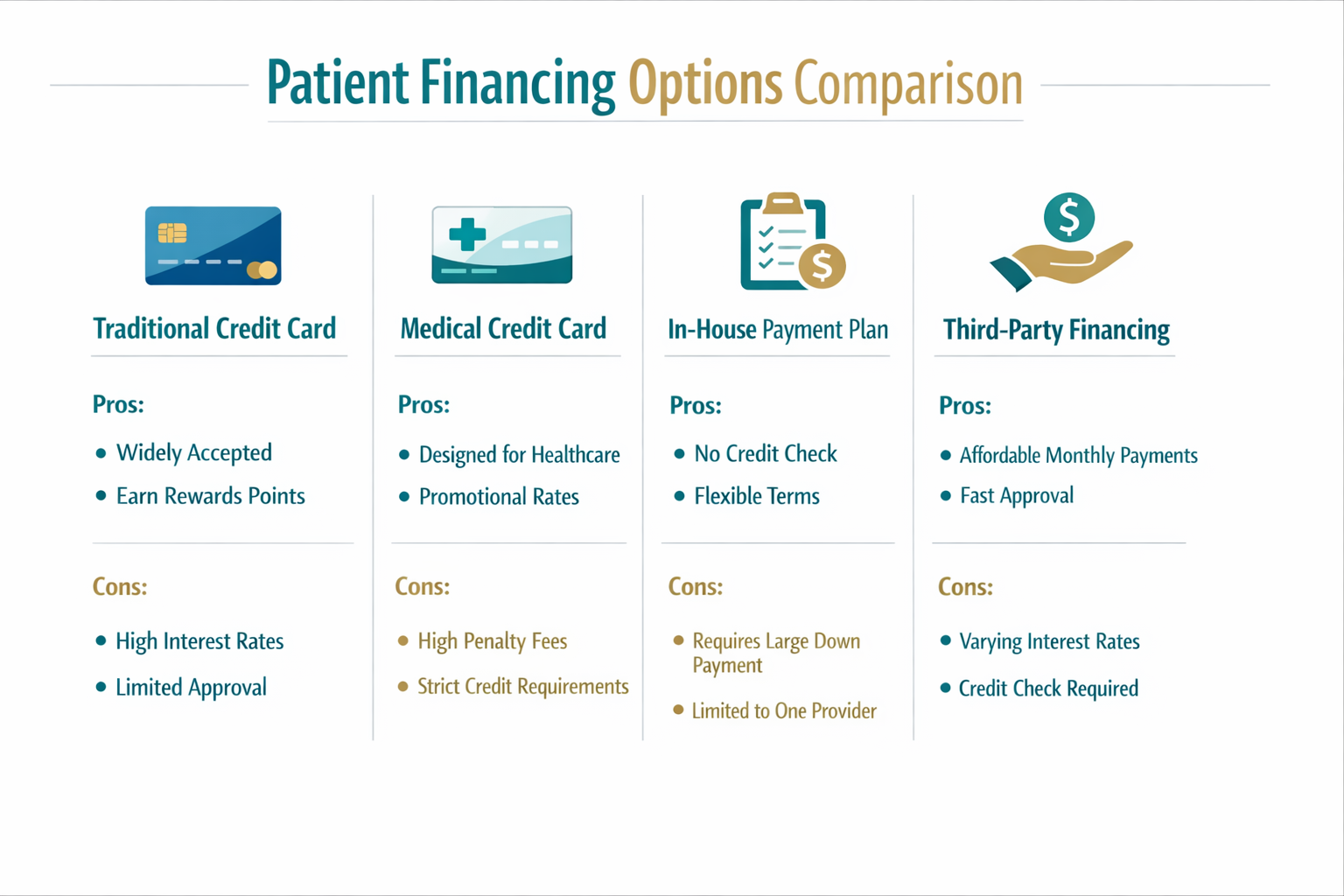
Medical Credit Cards (CareCredit, Alphaeon)
These purpose-built cards offer promotional periods—often 0% interest for 12-24 months. They’re familiar to patients and easy to apply for.
Pros:
- Established, trusted brands
- Quick approval process
- No-interest promotional periods
- You get paid upfront
Cons:
- Credit check required
- Not everyone qualifies
- Deferred interest can surprise patients
- Processing fees (typically 5-10%)
Third-Party Financing (Cherry, PatientFi, Prosper)
These newer options often have higher approval rates and more flexible terms. Some don’t do hard credit pulls.
Pros:
- Higher approval rates (some claim 85%+)
- Soft credit checks available
- Often more competitive rates
- Modern, patient-friendly applications
Cons:
- Less brand recognition
- Varying fee structures
- Some have shorter terms
In-House Payment Plans
You handle the financing directly, collecting payments over time.
Pros:
- Complete control over terms
- No third-party fees
- Can customize to patient needs
- Builds direct relationship
Cons:
- You carry the risk
- Administrative burden
- Cash flow is delayed
- Collection challenges
Hybrid Approach (Recommended)
Most successful practices offer 2-3 options: a medical credit card for patients who qualify for promotional rates, a third-party option with higher approval rates, and in-house plans for established patients or smaller amounts.
This ensures almost everyone has a path to treatment.
Marketing Financing at Every Touchpoint
Now for the practical part: how to actually promote financing so patients know about it, understand it, and feel comfortable using it.
On Your Website
Don’t: Bury financing info in a FAQ or footer link.
Do: Feature financing prominently on every service page.
Here’s the framework:
-
Service pages: Include monthly payment estimates alongside full prices. “Breast Augmentation: Starting at $6,500 or $185/month”
-
Dedicated financing page: Create a comprehensive page explaining all options, application process, and what to expect. Include a pre-qualification form.
-
Header/navigation: Add a “Financing” or “Payment Options” link to your main navigation.
-
Pop-ups/banners: Consider a site-wide banner during promotions: “0% Financing Available for Qualified Applicants”
Pro tip: Add a financing calculator widget. Let patients input a procedure cost and see estimated monthly payments instantly. This self-service tool answers their question without requiring a phone call.
In Marketing Campaigns
Every ad campaign should reference financing. Not as the headline, but as a supporting point that removes the price objection.
Example ad copy structures:
- “Achieve your dream look. Flexible financing available from $99/month.”
- “Why wait? 0% interest financing for qualified patients.”
- “[Procedure name] is more affordable than you think. Ask about our payment options.”
For email marketing, create a dedicated sequence about financing:
- Email 1: Introduce your financing options (after a lead downloads a guide or books a consultation)
- Email 2: Share a patient success story who used financing
- Email 3: Address common financing concerns/FAQs
- Email 4: Special financing promotion (if applicable)
Social Media Content
Create posts that normalize financing without being salesy:
- “Real talk: We know [procedure] is an investment. That’s why we offer flexible payment plans starting at $X/month. DM us to learn more.”
- Before/after posts with: “Sarah transformed her confidence with a customized treatment plan and monthly payments that fit her budget.”
- FAQ videos: “How does patient financing work? Let me break it down…”
During Consultations
This is where most practices fumble. Staff feel awkward discussing money, so they either avoid it or present financing only when patients object to the price.
Train your team to introduce financing early and naturally:
Instead of: “The procedure is $8,000. [pause] We do offer financing if that’s an issue.”
Try: “The investment for this treatment is $8,000. Most of our patients use our financing options—it works out to about $220 per month with our most popular plan. Would you like me to walk you through the options?”
Notice the difference:
- Calling it an “investment” frames it positively
- “Most patients” normalizes financing
- Presenting monthly cost immediately reframes the number
- Asking a question keeps the conversation moving

Overcoming Common Financing Objections
Even with good marketing, patients have concerns. Here’s how to address them:
“I don’t want to go into debt for cosmetic surgery.”
Response: “I completely understand. The way most of our patients think about it—they were going to save for this anyway, which might take 2-3 years. Financing lets you enjoy the results now while paying the same amount over time. And with our 0% options, you’re not paying any extra."
"What if I’m not approved?”
Response: “We work with multiple financing partners specifically because approval rates vary. If one doesn’t work out, we usually have another option. And checking won’t affect your credit score—we do a soft pull first."
"The interest rates seem high.”
Response: “I get that concern. Let me show you our promotional options—[X months] at 0% interest for qualified applicants. Even our standard rates often beat credit card APRs. We can run the numbers together to find what works for your budget."
"I’d rather just save up.”
Response: “That’s absolutely an option. Some patients prefer that. What I’ve noticed is that saving often gets derailed by life—car repairs, vacations, unexpected expenses. Financing locks in today’s price and guarantees you’ll actually get to your goal. But there’s no pressure—we’ll be here whenever you’re ready.”
Measuring Financing Marketing Success
Track these metrics to know if your financing marketing is working:
- Financing utilization rate: What percentage of patients use financing? Healthy practices see 40-60%.
- Approval rates by provider: Which financing partner approves the most patients?
- Average financed amount: Are patients financing more (good) or less (might indicate presentation issues)?
- Consultation-to-booking rate: Compare patients who use financing vs. pay cash.
- Website financing page traffic: Is your page getting views? Add it to your analytics dashboard.
- Pre-qualification form submissions: If you offer pre-approval, how many patients complete it?
Review these monthly. If financing utilization is low, the issue is usually marketing (patients don’t know about it) or presentation (staff aren’t comfortable discussing it).
Your Financing Marketing Action Plan
Here’s how to implement everything in this guide:
This week:
- Audit your website—is financing visible on service pages?
- Train staff on the consultation language above
- Add monthly payment estimates to your top 3 service pages
This month:
- Create a dedicated financing page with all options
- Add financing messaging to your next ad campaign
- Send an email to your list introducing/reminding about financing
This quarter:
- Evaluate your financing partners—are approval rates where they should be?
- Add a financing calculator widget to your website
- Create social proof content featuring patients who used financing
Ongoing:
- Track financing metrics monthly
- A/B test financing messaging in ads
- Refresh staff training quarterly
Financing isn’t about convincing patients to spend money they don’t have. It’s about removing artificial barriers that prevent them from getting treatments they genuinely want.
When you market financing well, you’re not being pushy—you’re being helpful. You’re saying, “Hey, this is more accessible than you might think, and here’s how.”
The practices that master this don’t just book more procedures. They build more trust, because patients feel like the practice genuinely wants to find a way to help them.
Ready to optimize your practice’s patient journey? Monsoft Solutions helps aesthetic practices build systems that convert consultations into bookings. Contact us to discuss how we can help you grow.